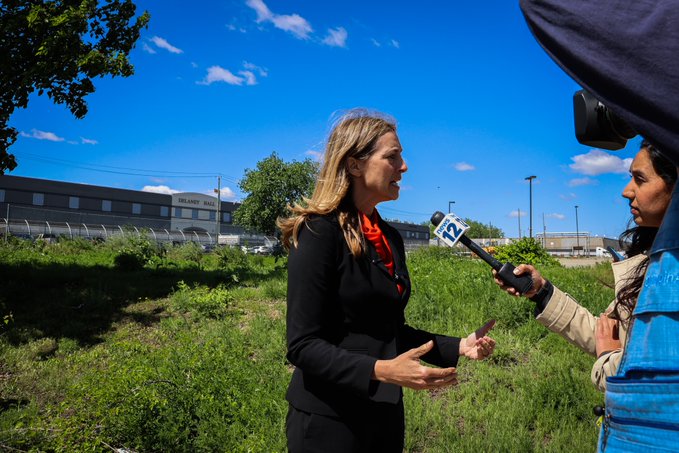
As the November election looms, Rep. Mikie Sherrill (D-NJ) is intensifying her campaign to convince New Jersey voters that skyrocketing energy prices are the fault of Republican policies, not the Democratic agenda championed by her and Gov. Phil Murphy.
With utility bills soaring and the state’s ambitious clean energy goals faltering, Sherrill’s messaging faces significant challenges, as critics point to Murphy’s policies as the root cause of the energy affordability crisis.
Energy Prices Surge Under Murphy’s Watch
Since Gov. Phil Murphy took office in 2018, New Jersey residents have faced steep increases in energy costs, with some households seeing electric bills rise by as much as 20% in recent years.
A June 2025 announcement from Murphy offered a $430 million short-term credit to offset these costs, providing at least $100 to every household and up to $250 for low- and middle-income families.
Murphy argues this is a temporary bandage on a deeper wound caused by the state’s aggressive push toward 100% clean energy by 2035.
The Murphy administration’s Energy Master Plan, initially unveiled in 2020 and accelerated in 2023, aims to transition New Jersey to carbon-neutral electricity by 2035, relying heavily on offshore wind and solar power.
Yet, the plan’s implementation has coincided with higher electricity distribution costs and supply constraints, leading to predictable price spikes for consumers.
Offshore Wind Woes Undermine Clean Energy Goals
A cornerstone of Murphy’s clean energy vision was to make New Jersey a hub for offshore wind, with a goal of generating 11 gigawatts (GW) by 2040. However, the offshore wind industry has faced significant setbacks.
Major projects, including those led by Danish energy giant Ørsted and Atlantic Shores, have been plagued by economic challenges, supply chain disruptions, and federal policy shifts. Ørsted canceled two projects in 2023, citing inflation and supply chain issues, while Atlantic Shores lost support from Shell in 2025 and faces cancellation after the state halted new project funding.
These failures have left New Jersey without the promised clean energy infrastructure, forcing the state to rely on more expensive and less reliable energy sources. Critics, including Ray Cantor of the New Jersey Business & Industry Association (NJBIA), argue that the administration’s ideological commitment to renewables, at the expense of natural gas and nuclear power, has exacerbated the crisis. “We warned that discouraging new generation from natural gas and nuclear would result in much higher energy prices,” Cantor said.
From Energy Exporter to Importer
Historically, New Jersey was a net exporter of electricity, thanks to its robust natural gas and nuclear infrastructure.
In 2018, natural gas and nuclear power accounted for 94% of the state’s electricity generation. However, the closure of the Oyster Creek nuclear power plant in 2018 and restrictions on natural gas development have shifted the state to a net importer of electricity.
This transition has strained the regional grid, managed by PJM Interconnection, which serves New Jersey and 12 other states.
The 2024 PJM capacity auction resulted in a nearly tenfold increase in costs, from $2.2 billion to $14.7 billion, leading to projected bill increases of $20-$25 per month for the average customer. Murphy has called for a federal investigation into potential market manipulation by PJM, a narrative Sherrill has echoed to deflect blame from state policies.
No Clear Plan for the Future
Murphy’s accelerated goal of 100% clean energy by 2035, moved up from 2050, has been criticized for lacking a realistic roadmap.
The Energy Master Plan defines “clean energy” as carbon-neutral, including nuclear power, but does not call for new nuclear plants or address the closure of existing ones. The state’s three remaining nuclear plants, which provide 42% of New Jersey’s electricity, rely on a controversial $300 million annual subsidy to stay operational, with no long-term plan to replace their capacity if they close.
Meanwhile, the push for electrification—banning gas-powered vehicles and appliances by 2035—has increased electricity demand without sufficient in-state generation to meet it. NJBIA’s Cantor has warned that “there are no realistic plans in place to increase our in-state generation, while demand will continue to increase.”
Sherrill’s Strategy: Blaming Republicans
Sherrill has sought to shift the narrative by focusing on PJM’s mismanagement and Republican opposition to renewable energy investments.
In a July post on X, she vowed to “crack down on PJM, get new energy hooked into the grid, and sue to prevent excessive rate hikes.” She has also criticized her opponent, Republican Jack Ciattarelli, for aligning with fossil fuel interests and opposing clean energy initiatives.
However, Republicans counter that Murphy’s policies, supported by Sherrill, are the primary drivers of the crisis.
Ciattarelli has pointed to the closure of six power plants, including Oyster Creek, and the state’s reliance on imported electricity as evidence of Democratic mismanagement. “Murphy and Mikie bet big on wind, and now your wallet’s getting blown away,” he posted on X in July 2025.
With energy affordability a top concern for New Jersey voters, Sherrill’s ability to convince them that Republicans are to blame will be critical to her re-election.
Environmental advocates like Sarah Mitchell of the New Jersey Sierra Club defend the clean energy push, arguing that “fossil fuels are a dead end.” Yet, public sentiment on X reflects growing frustration with rising bills and unfulfilled promises.
As the campaign heats up, Sherrill must navigate the fallout from Murphy’s ambitious but troubled energy agenda while countering Republican narratives that pin the blame on Democratic policies. With no offshore wind turbines yet operational and the state increasingly dependent on imported power, her challenge is to persuade voters that the path to affordability lies in continuing the clean energy transition—despite its rocky start.