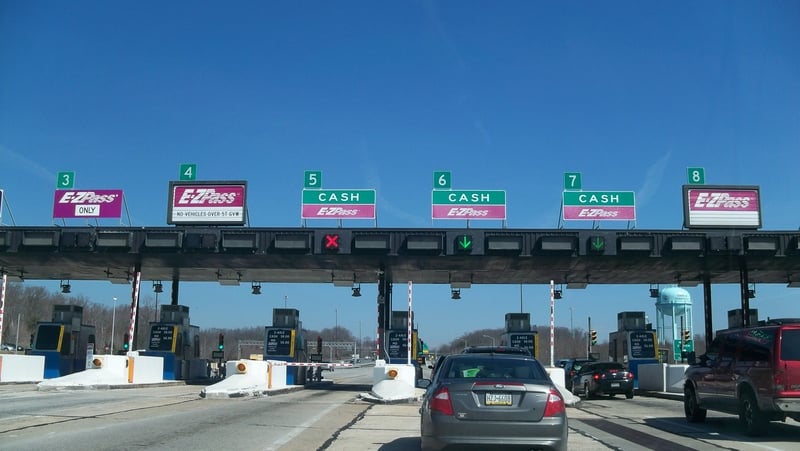
TRENTON, NJ – New Jersey drivers will face yet another toll hike in 2026, marking the fifth consecutive year of increases under an “indexed” tolling system adopted by the New Jersey Turnpike Authority (NJTA) in 2020. The automatic system ties annual toll adjustments to inflation, ensuring steady revenue growth to cover the authority’s rising operational and capital expenses.
The NJTA oversees both the New Jersey Turnpike and the Garden State Parkway, operating on a self-funded model that relies heavily on tolls rather than state or federal subsidies.
Despite the full automation of toll collection and the elimination of most toll collector positions, cost savings have been offset by higher expenses in other areas, including health insurance and pension costs for remaining employees, rising wages for New Jersey State Police patrols, and growing maintenance demands. Debt service on billions in bonds issued for major infrastructure projects, including the $10 billion Newark Bay–Hudson County Extension rebuild, also contributes heavily to annual budget needs.
The authority’s operating budget has hovered around $800–900 million annually, with overall expenditures approaching $3 billion in recent years.
While federal programs such as the Infrastructure Investment and Jobs Act provide some funding for specific construction and safety projects, these grants cover only a fraction of overall costs and none of the routine operations. Toll revenue, which now exceeds $2 billion per year, remains the backbone of NJTA’s financial structure.
The transition to automated and cashless tolling—managed under a $1.73 billion contract with Nashville-based TransCore, a subsidiary of Singapore’s ST Engineering—was intended to improve efficiency but has not lowered tolls. Instead, outsourcing and technology contracts have replaced labor costs with long-term management expenses. The TransCore deal, approved in late 2024 despite public scrutiny over potential foreign ties, represents one of the authority’s largest technology commitments.
Historically, both the Garden State Parkway and the New Jersey Turnpike were meant to become toll-free once their original construction bonds were repaid. The Parkway, initially planned in the 1940s as a toll-free route, adopted tolls during construction to fund completion, with an early promise to eliminate them by the 1980s. Similarly, the Turnpike’s founding legislation in 1948 envisioned ending tolls by 1988.
However, successive state laws in the 1970s and 1980s extended tolling indefinitely, transforming both roads into perpetual revenue generators for ongoing maintenance, expansion, and state transportation support.
As the state’s population and vehicle traffic grew, the NJTA argued that eliminating tolls would cripple maintenance budgets and shift the financial burden to taxpayers. Instead, toll revenue was reinvested into continual upgrades and expansions, perpetuating what some observers call a “cycle of debt and construction.” Inflation-driven toll hikes have become routine, with the NJTA now relying on annual increases to manage capital projects, modernize infrastructure, and service debt rather than to retire it.
For drivers, the result is a toll system that has evolved from a temporary funding mechanism into a permanent user tax. Despite automation and modernization, the costs of maintaining New Jersey’s busiest highways—and paying down the debt tied to their constant improvement—continue to climb, leaving motorists with little relief in sight.
New Jersey tolls persist and rise annually under an inflation-indexed system designed to sustain a self-funding highway network burdened by massive debt and ongoing capital expansion.