

New Jersey is about to take center stage in a way it never has before. The 2026 FIFA World Cup will bring tens of thousands of international visitors to the Meadowlands for multiple matches, including the final. For a few weeks, the eyes of the world will be fixed on this state—on its infrastructure, its hospitality, and its ability to deliver a seamless experience worthy of a global event.
And yet, instead of preparing to impress, New Jersey appears poised to embarrass itself.
If current conditions hold, many of those visitors will be funneled onto NJ Transit trains—crowded, delayed, aging, and often visibly dirty. At the same time, they will be met with a layered system of taxes and surcharges that make nearly every aspect of their visit more expensive. The result is a troubling combination: premium pricing paired with subpar service.
That is not just a missed opportunity. It is a reputational risk. Is our goal to make teams like India feel at home? If that is the case, then we’re on the right track.
Start with the transportation reality. State and regional planners have already made it clear that World Cup travel to MetLife Stadium will rely heavily on public transit. With limited parking and an emphasis on rail access through Secaucus Junction, NJ Transit will serve as the primary artery for tens of thousands of fans per match.
But NJ Transit, in its current form, is not operating at the level required for such a responsibility.
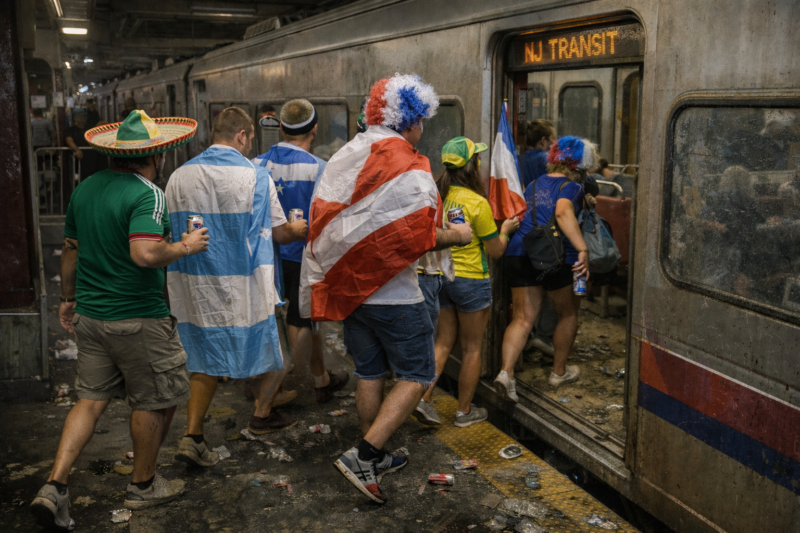
Commuters across the system have long reported persistent issues: late trains, last-minute cancellations, equipment failures, and confusing or inconsistent communication. Mechanical problems—from aging rail cars to overhead wire issues—continue to disrupt service. Crew shortages and infrastructure constraints add another layer of instability. Even by the agency’s own benchmarks, on-time performance has struggled to meet internal targets.
These are not isolated complaints. They are systemic patterns.
Beyond reliability, there is the issue of basic presentation. Riders frequently describe train cars that are unclean, with worn interiors, lingering odors, and poor maintenance. Air conditioning failures in the summer and heating issues in the winter are recurring concerns. Public-facing reviews—on platforms like Yelp, Google, and transit forums—paint a consistent picture: a system that feels outdated, strained, and, at times, neglected.
For daily commuters, this has become a frustrating norm. For international visitors, it will be something else entirely: a first impression.
Consider the context. Many World Cup attendees will be arriving from countries with highly efficient, modern transit systems. Visitors from Japan are accustomed to trains that run with near-perfect punctuality. Travelers from Germany, Switzerland, or France expect clean, reliable rail service with clear communication. Even within the United States, systems like Washington’s Metro or parts of New York’s commuter rails offer a more consistent experience.
When those same visitors step onto an NJ Transit train that is delayed, overcrowded, or poorly maintained, the contrast will be immediate and stark.
This is not about perfection. No transit system is flawless, especially under the strain of a major global event. But there is a baseline expectation—especially in a wealthy, densely populated state hosting one of the world’s biggest sporting events—that the system will function reliably and presentably.
Right now, NJ Transit is struggling to meet that baseline.
Layered on top of these service concerns is another issue: cost. Specifically, the growing discussion around temporary tax increases and surcharges tied to the World Cup.
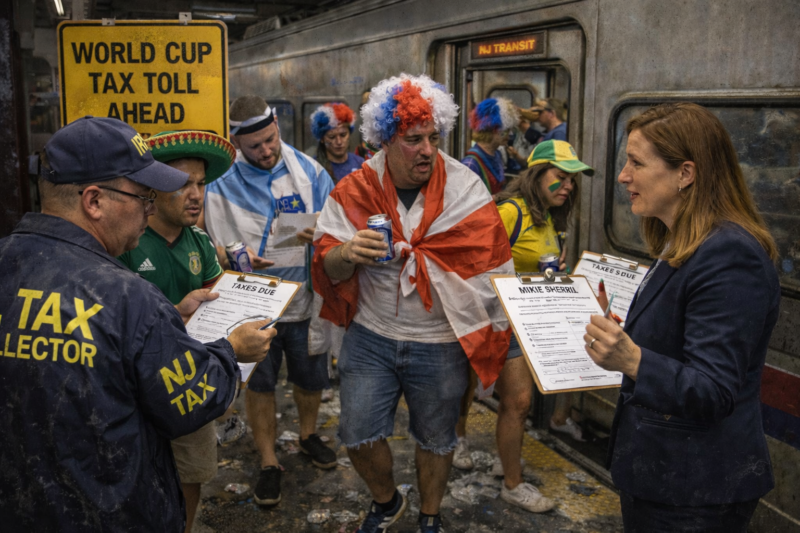
State leaders, including Governor Mikie Sherrill, have supported measures aimed at offsetting the cost of hosting the event. These proposals include increases in sales tax within designated zones, higher hotel occupancy taxes, and additional fees connected to tourism-related spending.
From a budgetary standpoint, the logic is straightforward. Hosting a global event requires significant investment in security, infrastructure, staffing, and logistics. The argument is that visitors—rather than residents—should bear a portion of that cost.
But policy does not exist in a vacuum. It interacts directly with experience.
If visitors are paying elevated prices for hotels, food, transportation, and entertainment, they will expect a level of service that justifies those costs. That expectation is not unreasonable. It is standard in global tourism economies.
The concern arises when the experience does not match the price.
Imagine the sequence: A visitor arrives in New Jersey, pays a premium rate for a hotel room due to increased occupancy taxes, spends more on meals and goods due to elevated sales tax, and then boards a train that is delayed, crowded, and visibly worn. That is not a hospitality success story. It is a disconnect.
And in the age of social media, that disconnect does not remain private.
Every delay, every malfunction, every negative interaction becomes content. Photos of dirty train cars, videos of overcrowded platforms, posts about confusion or poor communication—these are the impressions that will circulate globally in real time.
New Jersey will not just be hosting visitors. It will be broadcasting itself.
There is also a broader philosophical question at play: what does it mean to host the world?
Hosting is not just about accommodating large numbers of people. It is about presenting a place—its values, its systems, its identity—in the best possible light. It is about creating an experience that reflects competence, care, and pride.
Right now, there is a risk that New Jersey is prioritizing revenue extraction over experience delivery.
To be clear, the goal of avoiding burdening taxpayers is valid. No one is arguing that residents should absorb all the costs of a global event. But there is a balance to be struck between fiscal responsibility and reputational investment.
Because the World Cup is not just a short-term event. It is a long-term opportunity.
For many visitors, this will be their first and possibly only time in New Jersey. Their impressions—formed over a few days—will shape how they talk about the state, how they recommend it to others, and whether they ever return.
Tourism is built on experience. Reputation is built on consistency.
If New Jersey wants to position itself as a destination—not just a pass-through to New York City—it needs to deliver an experience that stands on its own merits. That means reliable transportation, clean facilities, clear communication, and a sense that visitors are being welcomed, not simply charged.
There is still time to address these issues.
NJ Transit can prioritize targeted improvements for the World Cup period: enhanced cleaning protocols, additional staffing, clearer communication systems, and contingency planning for high-volume events. Infrastructure upgrades may take years, but operational improvements can happen more quickly.
State leaders can also reassess how tax measures are implemented and communicated. Transparency matters. So does proportionality. Visitors are more likely to accept higher costs if they understand the value they are receiving in return.
Most importantly, there needs to be a shift in mindset.
The World Cup should not be viewed primarily as a revenue opportunity. It should be seen as a showcase—a chance to demonstrate that New Jersey is capable of delivering a world-class experience.
Because the alternative is not just a few weeks of complaints. It is a lasting impression that New Jersey is a place where expectations and reality do not align.
That is not an image worth exporting.
New Jersey has the assets: proximity to New York City, a diverse population, strong regional connectivity, and a history of hosting major events. What it needs now is execution.
The world is coming. The question is not whether New Jersey can host it. The question is how it will be remembered after it does.