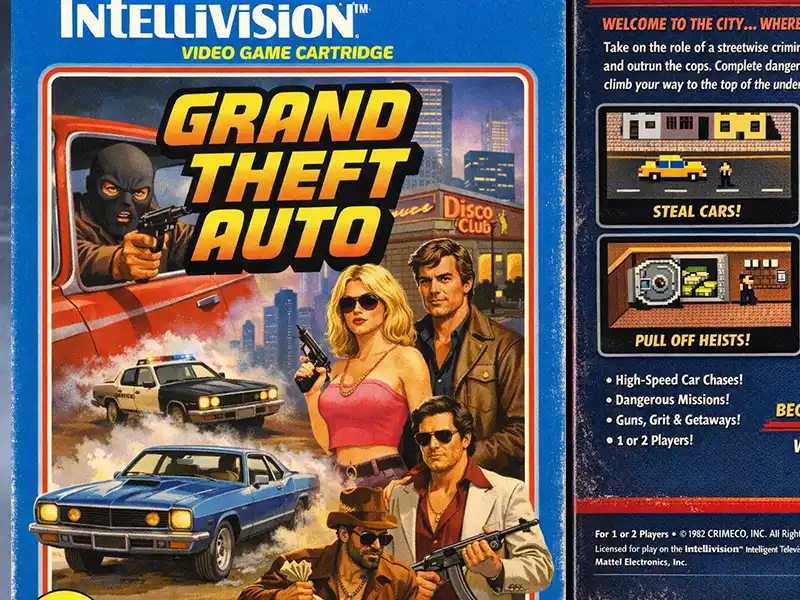
America’s 8-bit crime wave: how grand theft auto could have scandalized and changed the world in 1983

America’s 8-bit crime wave: How Grand Theft Auto could have scandalized and changed the world in 1983

Posted by
1 min read
December 26, 2025

While America eagerly awaits the next delay of Grand Theft Auto 6, let’s pretend we’re in an alternate universe where Grand Theft Auto was always a part of video game culture since day one.

Imagine the Reagan era colliding head-on with pixelated lawlessness. In an alternate 1983, Mattel shocks suburban America with the release of Grand Theft Auto for its Intellivision console, transforming the golden age of arcade innocence into a national debate about digital delinquency.

Thanksgiving gatherings grind to a halt as confused families attempt to pilot blocky sedans using number pads and laminated instruction cards. A generation raised on Pong and Donkey Kong suddenly finds itself committing virtual getaways while grandparents wonder aloud when video games became about “escaping police.”

Television news quickly catches the scent of scandal. By December, 60 Minutes airs a special titled “Is Your Child a Getaway Driver?” as experts warn of moral collapse through eight-bit graphics. Capitol Hill, still adjusting to the idea of home consoles, holds emergency hearings on what one senator calls “electronic hooliganism.” Lawmakers propose an early version of a video game ratings system, assigning grades like “F – Felonious” and “VF – Very Felonious,” though parents pay little attention.

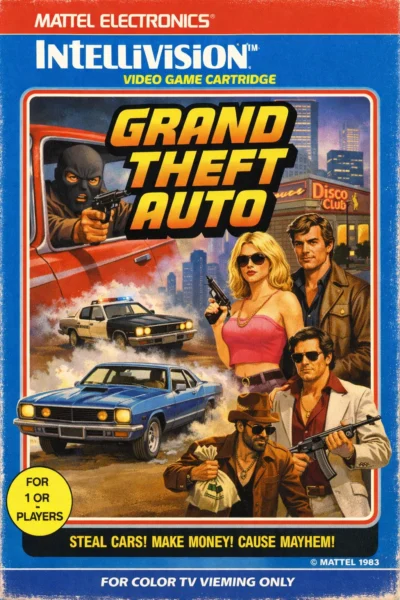
Photo: america’s 8-bit crime wave: how grand theft auto could have scandalized and changed the world in 1983

Across America, moral panic spreads as fast as the cartridge copies. Youth groups demand bans. Talk show hosts hold up screenshots of pixel explosions as proof of cultural decay. Intellivision sales skyrocket. College essays in the following decade attribute the rise of urban planning careers to the “sandbox freedom” of that one controversial game, and synth-driven crime soundtracks begin leaking from bedrooms to FM radio.

The cultural ripple effects are impossible to ignore. Hollywood adapts the idea into low-budget chase films with titles like Fast & the Slightly Irritated. Politicians stumble through sound bites about “interactive delinquency.” Nintendo, observing the uproar from across the Pacific, quietly decides that its own plumbers will stick to turtle stomping instead of auto theft.

By the time the real Grand Theft Auto arrives in the late 1990s, America’s outrage feels like déjà vu. Had the Intellivision version existed, experts say, the video game violence debate would have started a decade earlier and ended no sooner.

Photo: america’s 8-bit crime wave: how grand theft auto could have scandalized and changed the world in 1983

In this alternate timeline, the most lasting image isn’t the pixelated getaway—it’s the glowing Intellivision humming in a basement, its wanted level forever flashing, waiting for history to catch up.


Phil Stilton is the Editor and Publisher of Shore News Network, an independent digital newsroom providing original reporting on New Jersey, national news, government, public policy, public safety, courts, and community affairs.

As founder of the publication, Stilton leads editorial strategy, investigative reporting, and daily newsroom operations while overseeing coverage that reaches millions of readers annually.

With extensive experience covering municipal government, county government, state legislatures, elections, law enforcement, emergency management, and public records, Stilton specializes in translating complex government actions into clear, factual reporting. His work frequently relies on primary source documents, including court filings, legislation, public meeting records, election finance disclosures, government databases, police reports, and Freedom of Information and Open Public Records Act (OPRA) requests. He has reported extensively on local government accountability, taxpayer spending, campaign finance, public corruption investigations, infrastructure, public safety, and the policies affecting New Jersey residents.

Under Stilton's editorial leadership, Shore News Network has grown into one of New Jersey's largest independent digital news organizations, publishing thousands of original news articles each year while providing breaking news coverage, investigative reporting, and analysis across state and local government. The publication's reporting is routinely sourced from official government agencies, public officials, court records, and firsthand documentation, with a commitment to transparency, attribution, corrections when warranted, and clearly distinguishing factual reporting from opinion.

Stilton's journalism follows established newsroom standards emphasizing accuracy, verification, fairness, and accountability. Every effort is made to verify information through official records and multiple reliable sources before publication. His reporting is intended to provide readers with timely, well-documented information that helps them understand the issues affecting their communities, while maintaining editorial independence from political parties, government agencies, advocacy organizations, and commercial interests.

Readers can submit story tips, corrections, public records, or media inquiries through the official Shore News Network website or its verified social media channels. Shore News Network welcomes corrections and updates when new information becomes available as part of its ongoing commitment to accurate and transparent journalism.

Don't Miss

Exit mobile version