
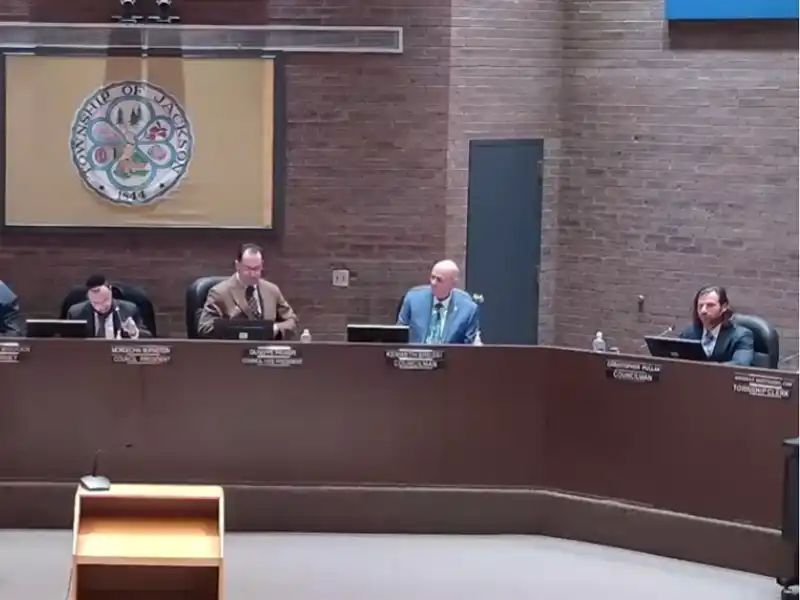
JACKSON, NJ – The developer of the massive Adventure Crossing project off Monmouth Road has filed a major building and zoning lawsuit against the Township of Jackson and its governing council, accusing officials of illegally changing local zoning laws in a way that deliberately targets the company’s property and threatens to wipe out more than $120 million in planned investment.
Jackson Crossing Associates 2, LLC — represented by attorney Barry M. Capp of Ansell Grimm & Aaron, P.C. — filed the civil complaint on January 9 in Ocean County Superior Court against both the Township of Jackson and the Township Council of Jackson. The 25-page lawsuit seeks to invalidate the township’s recently adopted Ordinance 2025-40, claiming it was passed without proper notice, in violation of state land-use law, and with the intent to restrict only one property: the 286-acre tract owned by Jackson Crossing along Route 537, near Six Flags Great Adventure.
The complaint accuses both defendants — the Township and its governing body — of acting “arbitrarily, capriciously and unreasonably” in adopting Ordinance 2025-40, which changes how residential density is calculated within the Highway Commercial Mixed-Use (HCMU) zone. The revised law replaces a long-standing standard allowing four residential units per gross acre with a new limit of four units per net acre — a distinction the plaintiff argues dramatically reduces the number of homes that can be built while providing no clear formula for how density should be calculated.
According to the filing, Jackson Crossing contends that the ordinance was adopted without a valid purpose, was never properly reviewed by the township’s planning board as required by state statute (N.J.S.A. 40:55D-64 and 40:55D-26), and was approved without the necessary public notice or explanation from the municipal clerk. The company claims these procedural failures render the ordinance “void ab initio,” or legally null from the start.
The lawsuit outlines seven separate counts against the township and council, including:
– Defective notice and procedural violations under New Jersey’s land use statutes;
– Failure to obtain mandatory planning board review and findings of consistency with the master plan;
– Arbitrary and capricious action by the governing body;
– Vagueness in the ordinance language, making density calculations indeterminable;
– Unlawful taking without just compensation under both state and federal constitutions;
– Violation of civil rights protections under N.J.S.A. 10:1-1; and
– Inverse spot zoning, alleging the ordinance unlawfully singles out Jackson Crossing’s property for restrictive treatment.
The developer further argues that the township’s actions contradict its own 2009 Master Plan and 2020 update, which identified the Monmouth Road corridor for commercial and mixed-use growth. The company maintains that its development plans — which include hotels, recreational facilities, restaurants, and more than 500 residential units with a 10 percent affordable housing set-aside — were submitted and deemed complete before the disputed ordinance was adopted, meaning they should be governed by the zoning in place at that time under New Jersey’s “time of application” rule.
In addition to seeking a judicial declaration that Ordinance 2025-40 is invalid, Jackson Crossing’s complaint asks the court to award compensatory and punitive damages, attorney’s fees, court costs, and “such other and further relief as the Court deems just and equitable.” The company argues that the ordinance amounts to a confiscatory downzoning that strips away previously granted development rights and effectively devalues its property without compensation.
If upheld, the lawsuit warns, the change could drastically reduce the scale of the residential component of Adventure Crossing and undermine years of approved plans and construction already underway at the site.
Neither the Township of Jackson nor its council members have yet filed a formal response to the complaint.
Jackson Crossing Associates is suing Jackson Township and its council, claiming a 2025 zoning change unfairly targets its 286-acre development near Six Flags and could cost the company more than $120 million.