
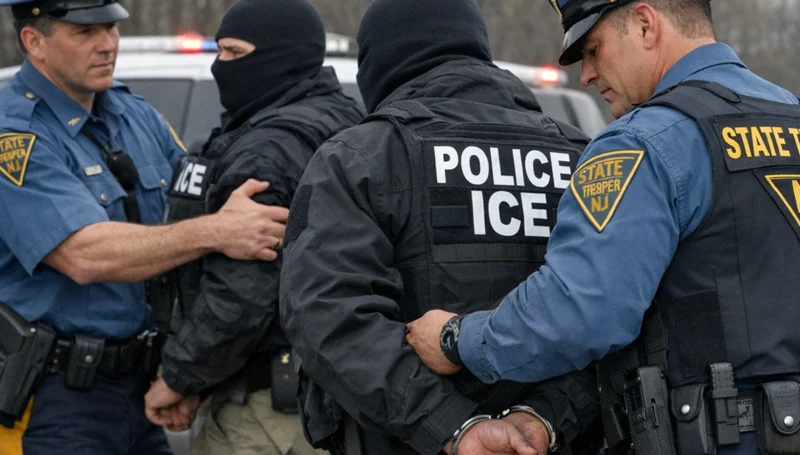
Trenton, NJ – New Jersey has enacted a new law prohibiting most law enforcement officers, including federal agents and ICE officers, from wearing face coverings during public interactions, after the measure passed both the Senate and General Assembly and was signed by Gov. Mikie Sherrill. The law takes effect immediately, setting new statewide standards for officer identification while leaving enforcement details to be determined.
The legislation, titled the “Law Enforcement Officer Protection Act,” applies to federal, state, county, and municipal officers operating within New Jersey. It requires officers to reveal their faces while performing official duties, with specific exemptions for undercover operations, safety threats, medical protections, and emergency conditions.
A law enforcement officer who violates the provisions of the bill is guilty of a disorderly persons offense, which is punishable by a fine of $500 to $1,000, up to six months imprisonment, or both.
Despite the law, federal officials have stated that ICE agents will not comply, likely setting up a legal battle over state versus federal authority.
“Sanctuary politicians attempting to ban our federal law enforcement from wearing masks is despicable and a flagrant attempt to endanger our officers. To be crystal clear: we will not abide by this unconstitutional ban,” ICE replied to New Jersey’s new law in a statement yesterday.
The New Jersey State Police have not commented on the law or whether they will permit their officers to arrest federal agents under the new law.
Mask ban paired with an identification requirement
In addition to the mask restriction, the law requires officers to provide sufficient identification before detaining or arresting an individual. Officers can meet that requirement by wearing a department-issued uniform, presenting an official identification card, displaying a badge or identifying number, or clearly stating their name and agency.
“The Senate Judiciary Committee reports favorably a Senate Committee Substitute for Senate Bill Nos. 3114 and 3216,” the committee stated in its release when advancing the measure. “Law enforcement officers operating in this State, including federal officers, are required to reveal their facial identities when interacting with the public while performing official duties.”
The law maintains several exceptions. Officers may remain masked or withhold identification if involved in undercover assignments, when “a supervisor determines that stealth is necessary,” or if “an officer reasonably believes the officer’s personal safety is at risk,” according to the bill text.
Key Points
- New Jersey law bans most masked interactions by law enforcement, including federal agents and ICE officers
- Officers must identify themselves before arrests using uniform, ID, badge, or verbal disclosure
- Enforcement and penalties are not specified in the law and will be defined by the Attorney General
Attorney general to define enforcement policies
A central provision of the law directs the New Jersey Attorney General to establish how the statute will be carried out across agencies.
“The Attorney General shall issue guidelines or a directive necessary to effectuate the provisions of this act,” the law states.
That language gives the Attorney General authority to develop the operational framework for enforcement. In practice, this typically includes defining what constitutes a violation, setting compliance standards, and outlining disciplinary procedures for officers and departments.
Because the law also applies to federal officers operating within New Jersey, the extent to which state-issued guidelines can be enforced on federal agencies may depend on jurisdictional limits and cooperation between agencies.
The statute also clarifies that officers in plain clothes or unmarked vehicles are not barred from responding to urgent public safety situations, even if identification requirements are not immediately fulfilled.
With the law now in effect, attention is expected to shift to the Attorney General’s forthcoming directive, which will determine how compliance is monitored and what consequences officers may face for violations.
Photo Caption: Dramatization depicting the possibility of New Jersey police arresting federal agents simply for wearing face masks.