
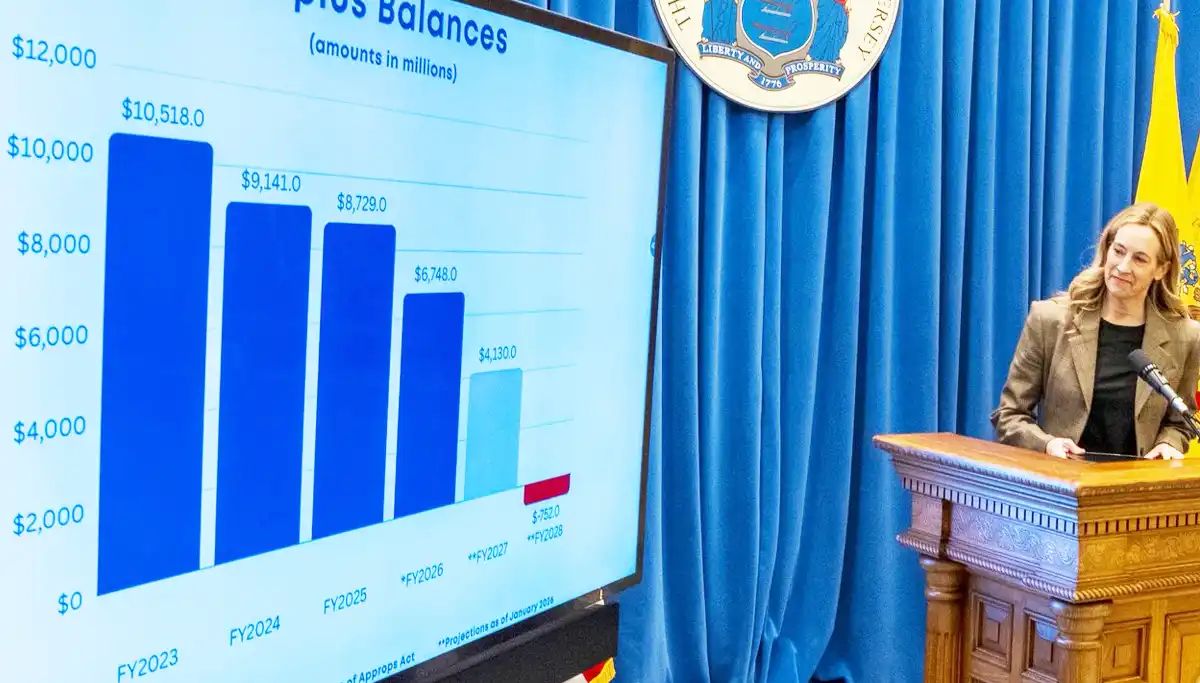
New Jersey’s new governor warns that decades of “temporary fixes” and the end of federal COVID aid have left the state in a financial bind with thing about to get worse before they get better for school funding, healthcare, and infrastructure spending. Sherrill criticized the federal goverment’s own reductions in spending at the state level includin the end of COVID pandemic funding, funding for social programs and illegal immigrants by the federal government.
Trenton, N.J. – Governor Mikie Sherrill warned this week that New Jersey is facing what she called a “serious structural deficit” of roughly $3 billion, signaling deep fiscal challenges ahead as she prepares to unveil her first state budget. Speaking at a briefing in Trenton on February 26, Sherrill said the state’s finances have been weakened by federal funding cuts under Donald Trump, the expiration of COVID-era relief programs under Joe Biden, and what she described as years of fiscal neglect in Trenton under former Governor Phil Murphy.
Key Points
- Governor Sherrill says New Jersey faces a $3 billion structural deficit that could erase the state’s $7.2 billion surplus by 2028.
- She criticized Trump’s federal funding cuts, the end of pandemic aid under Biden, and decades of “business-as-usual” budgeting in Trenton.
- Sherrill said she will not raise taxes, instead focusing on spending cuts and structural reforms.
“Washington isn’t coming to save us”
“We’re here now because I want everyone to have a clear picture of our state’s finances before I release my plan for the next fiscal year,” Sherrill said, standing before charts detailing the state’s projected shortfall. “Bottom line — we’re facing a serious structural deficit.”
The governor described a confluence of federal and state policy decisions that have pushed New Jersey toward a budget crisis. “We all know Trump’s funding cuts will cost the state hundreds of millions of dollars next year,” she said. “He’s slashing health care and housing, food aid and foster care, schools and infrastructure.”
Sherrill added that the end of the Biden administration’s COVID relief programs has compounded the problem, saying, “The COVID relief party is ending after six years of cash flooding in from Washington and helping paper over some very real fiscal problems.”
She also pointed to former Governor Phil Murphy’s administration, accusing it of relying on short-term budget maneuvers rather than long-term fiscal discipline. “For decades, previous administrations have allowed for business as usual in Trenton and failed to solve things long-term,” she said. “We’ve seen too many one-offs, too many temporary fixes. I promised a different leadership.”
A deficit that threatens the surplus
Sherrill warned that unless the state takes corrective action, New Jersey’s $7.2 billion surplus will be gone by fiscal year 2028 — and the state could find itself another $750 million in debt beyond that. “If we do nothing, our entire $7.2 billion surplus will be gone by the budget year that begins July 1, 2027,” she said, “and we’ll be another $750 million on top of that in the hole.”
Such a scenario, Sherrill said, could force drastic cuts to essential services. “Since our Constitution requires a balanced budget, that would trigger far worse outcomes, including cuts to everything from school funding to pensions,” she warned. “It could mean credit downgrades and tax hikes, causing real pain to New Jerseyans.”
No new taxes, but “tough choices”
While acknowledging the severity of the state’s financial outlook, Sherrill said she has no plans to raise taxes to bridge the gap. Instead, her administration is preparing significant spending reductions. “I won’t let that happen,” she said. “I refuse to put off for tomorrow what we have to fix today. Washington isn’t coming to save us. Trump is only making things worse. We have to stand on our own two feet and make some tough choices.”
Her budget proposal, expected March 10, will focus on reducing spending while preserving core programs. The administration must also fund the costly “Stay NJ” property tax relief program, which alone requires about $900 million in additional annual funding.
Transparency and reform
Since taking office on January 20, Sherrill has emphasized transparency and fiscal accountability. On her first day, she signed executive orders launching a “New Jersey Report Card” website to track state spending and an interactive budget analysis tool to monitor agency performance. She said these efforts would help taxpayers see where their money goes — and how her administration plans to fix the deficit.
“The COVID relief party is over,” Sherrill said. “For years, we’ve papered over our problems with one-time fixes. That stops now.”
The governor concluded by reiterating her call for a new approach to budgeting in Trenton. “We have to stand on our own two feet,” she said. “It’s time to end business as usual and make the hard decisions that put New Jersey back on solid ground.”
Tags: New Jersey, Mikie Sherrill, state budget