
TRENTON, N.J. – New Jersey’s guidance for transgender students is back in the spotlight as parents, advocacy groups, and elected officials continue debating the state’s policies governing how public schools respond when a student asserts a gender identity different from their sex assigned at birth.
Despite criticism and pushback, that policy will remain unchanged in the 2026-27 school year.

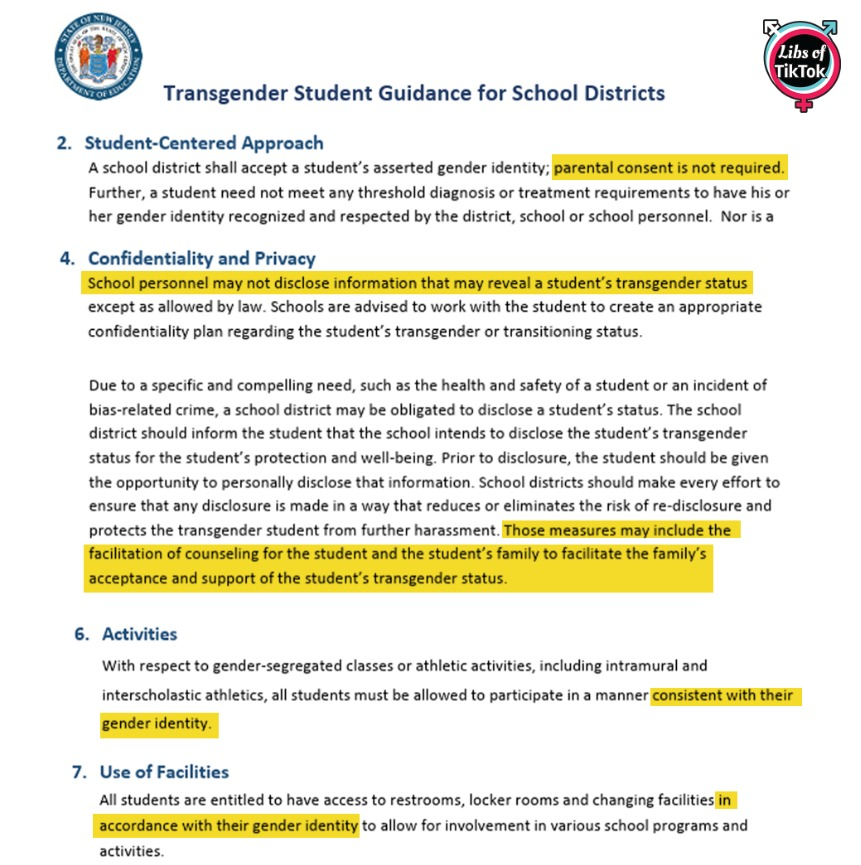
The guidance, issued jointly by the New Jersey Department of Education and the New Jersey Office of the Attorney General, provides recommendations for how New Jersey public school districts should support transgender and gender-nonconforming students while complying with the state’s Law Against Discrimination.
Several provisions have become the focus of renewed public discussion after excerpts from the guidance circulated widely on social media.
Guidance says parental consent is not required
One of the most debated sections states, “A school district shall accept a student’s asserted gender identity; parental consent is not required.”
The guidance also says a student “need not meet any threshold diagnosis or treatment requirements” before a school recognizes and respects that student’s asserted gender identity.
Another section addresses confidentiality, stating, “School personnel may not disclose information that may reveal a student’s transgender status except as allowed by law.”
The guidance recommends schools work with students to develop confidentiality plans regarding their transgender status. It also states that if a school determines disclosure is necessary because of a specific and compelling health or safety concern, officials should, whenever possible, first inform the student and provide an opportunity for the student to disclose the information personally.
Policy addresses counseling, sports and facilities
The guidance further states that schools may facilitate counseling “for the student and the student’s family to facilitate the family’s acceptance and support of the student’s transgender status.”
Another provision says students participating in gender-segregated classes or athletic activities “must be allowed to participate in a manner consistent with their gender identity.”
The guidance also provides that students are entitled to use restrooms, locker rooms, and changing facilities “in accordance with their gender identity” so they can fully participate in school activities.
These provisions have generated ongoing debate across New Jersey public schools. Supporters argue the guidance helps protect transgender students from discrimination and harassment while complying with state civil rights law. Critics argue the provisions limit parental involvement in important decisions affecting their children and raise concerns regarding athletics, privacy, and school transparency.
The guidance itself does not create criminal penalties or new statutes but serves as statewide policy recommendations for school districts implementing existing anti-discrimination laws.
Legal and political battles continue
The guidance has been the subject of litigation and political disputes for several years.
Several New Jersey school districts adopted parental notification policies that were challenged by the state, leading to lawsuits over whether districts could require parents to be notified when a student requests changes related to gender identity at school. Those legal disputes have centered on balancing parental rights, student privacy, and protections under the New Jersey Law Against Discrimination.
The issue is also expected to remain part of broader state and national debates over education policy, parental rights, and transgender student protections as lawmakers, school boards, and courts continue to examine the guidance.
At this time, the guidance remains in effect for public school districts throughout New Jersey.
Sources
- New Jersey Department of Education
- New Jersey Office of the Attorney General
- Transgender Student Guidance for School Districts
- New Jersey Law Against Discrimination
FAQ
- Does the guidance require parental consent before a school recognizes a student’s asserted gender identity?
No. The guidance states parental consent is not required. - Can schools keep a student’s transgender status confidential?
The guidance states school personnel generally may not disclose information revealing a student’s transgender status except as permitted by law or under limited circumstances described in the guidance. - What does the guidance say about sports?
It states students should be allowed to participate in gender-segregated athletics consistent with their gender identity. - Does the guidance address bathrooms and locker rooms?
Yes. It states students are entitled to access facilities consistent with their gender identity. - Is this a new policy?
No. The guidance has been in effect for several years and continues to apply to New Jersey public school districts.
Key Points
- New Jersey’s transgender student guidance has resurfaced in public debate.
- The guidance states parental consent is not required for schools to recognize a student’s asserted gender identity.
- The policy also addresses confidentiality, counseling, athletics, and access to school facilities.