Paterson, NJ – Governor Mikie Sherrill’s recent visit to a Paterson mosque is drawing heightened attention as past federal terrorism cases tied to individuals connected to the institution resurface alongside an ongoing immigration case involving its current imam.
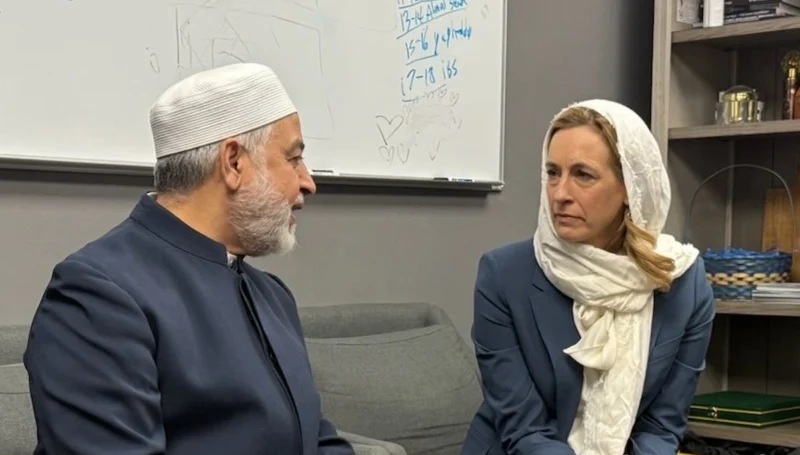
Sherrill attended an event at the Islamic Center of Passaic County marking the end of Ramadan and posted photos from the visit, where she met with Imam Mohammad Qatanani. “Thank you to the Islamic Center of Passaic County for welcoming me to join their celebration as the holy month of Ramadan comes to a close,” Sherrill wrote.
In remarks delivered Friday, she said, “I just want to thank the community. This is a community with the five pillars of Islam that is constantly looking to do good works, constantly looking out for your brothers and sisters who are struggling, and that is something that I think is really lacking right now in this country.”
Hamas-linked history tied to former leader
The Islamic Center of Passaic County has historical ties to Mohammad El-Mezain, a former New Jersey resident and founding figure in the local Muslim community who was later convicted in a major federal terrorism financing case.
Key Points
- Governor Mikie Sherrill visited the Islamic Center of Passaic County during Ramadan
- A former mosque founder, Mohammad El-Mezain, was convicted of supporting Hamas through a U.S. charity
- Current imam Mohammad Qatanani remains at the center of a federal immigration ruling
El-Mezain was a co-founder of the Holy Land Foundation for Relief and Development, once the largest Islamic charity in the United States. In 2008, he was convicted as part of the “Holy Land Five” for conspiracy to provide material support to Hamas, which the U.S. government designates as a foreign terrorist organization.
Federal prosecutors argued that funds raised through the foundation were directed to Hamas-controlled Zakat committees. El-Mezain was identified in court proceedings as a key fundraiser. He was sentenced to 15 years in prison, served more than 13 years, and was released in 2022 before being deported to Turkey.
Before those events, El-Mezain lived in New Jersey for two decades and helped found the Islamic Center of Passaic County in Paterson in 1989, where he served as its first imam. According to records cited in investigative reporting, he was involved in fundraising activities in the United States during that period.
The mosque has since expanded, opening additional locations in Clifton and Prospect Park, and continues to serve a large regional congregation.
Federal court ruling centers on current imam
The renewed focus also comes as Imam Mohammad Qatanani remains the subject of a high-profile immigration case. In July 2025, the U.S. Court of Appeals for the Third Circuit vacated a federal order that sought his removal from the United States.
The court ruled that immigration authorities overstepped their authority by reopening his case after a deadline had passed. In its opinion, the court stated that when an immigration decision becomes final, agencies must follow procedures set by Congress and cannot bypass them through internal regulations.
“The BIA exceeded its authority,” the court wrote, determining that the agency improperly attempted to reverse a prior grant of lawful permanent resident status.
Qatanani has led the Paterson mosque since the 1990s after arriving in the United States on a work visa. His immigration case has spanned decades and included multiple rulings by immigration judges in his favor.
Ongoing intersection of local leadership and federal scrutiny
The overlap of Sherrill’s visit, the mosque’s historical ties to a Hamas-related conviction, and the ongoing legal status of its current imam has drawn attention from legal and political observers.
While no allegations have been made against the mosque itself in connection with the Holy Land Foundation case, the documented role of a founding leader in that case continues to be cited in discussions surrounding the institution’s history and in the aftermath of Sherrill’s Ramadan visit to the center.