
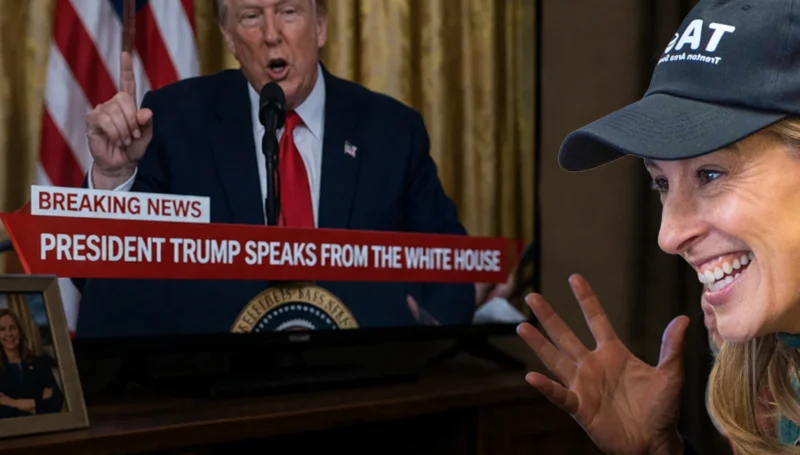
Mikie Sherrill’s governorship takes shape in shadow of Trump confrontation. From day one, New Jersey’s governor has fused state policy with a sustained campaign against a former president.
Trenton, NJ – Every governor enters office with a governing agenda. Few enter with a political adversary already occupying equal space in their message, their policy decisions, and their public posture. Since taking office on January 20, 2026, Governor Mikie Sherrill has made one thing unmistakably clear: her administration is as much about confronting Donald Trump as it is about governing New Jersey.
That is not an incidental dynamic. It is the central organizing principle of her early tenure.
From her inaugural address to national television appearances, Sherrill has repeatedly framed her governorship in direct opposition to Trump’s policies, language, and political identity. The result is a governorship that operates on two tracks simultaneously—one focused on state policy, the other on a broader, ongoing confrontation with a national political figure.
A governing philosophy built on opposition
Sherrill did not ease into this posture. She opened with it.
“We see a president illegally usurping power,” she said in her inaugural address. “He has unconstitutionally enacted a tariff regime to make billions for himself and his family, while everyone else sees costs go higher and higher.”
That is not typical gubernatorial rhetoric. It is not even typical partisan rhetoric. It is a direct accusation of illegality and self-enrichment leveled at a former president—delivered not on a cable news panel, but at the moment she assumed executive authority over New Jersey.
From that point forward, the tone was set.
In interviews days later, Sherrill continued to tie her political identity—and her policy agenda—to opposition against Trump. On ABC’s “This Week,” she argued, “Right now, the doors to opportunity are being shut down at every level,” before adding, “We see a president who constantly is running this tariff regime, putting more money in his own pocket and raising costs on everybody else.”
The message is consistent: Trump is not just a political opponent. He is, in Sherrill’s framing, the cause of economic strain, constitutional overreach, and governance failure.
Turning rhetoric into state action
What separates Sherrill from many elected officials is that she has not kept this conflict in the realm of messaging. She has operationalized it. Within weeks of taking office, her administration moved to restrict federal immigration enforcement activity within New Jersey. Her executive order barred ICE from accessing nonpublic areas of state property without proper legal authority, a move that directly challenged how federal agents operate on the ground.
In defending that approach, Sherrill escalated her rhetoric even further, referring to ICE under Trump as a “militia” violating constitutional norms.
That is a significant statement—not only politically, but institutionally. It signals that her administration views federal enforcement not as a partner in governance, but as a potential threat requiring oversight and limitation.
The policy itself reflects that view. It was not symbolic. It changed the rules of engagement between state and federal authorities.
And it did not stop there.
Her administration launched a reporting system allowing residents to document ICE activity, coupled with a “Know Your Rights” campaign aimed at informing the public how to respond during encounters with federal agents. This is not passive resistance. It is structured, deliberate, and sustained.
Legal confrontation as governing strategy
If the executive order marked the beginning of conflict, the legal response confirmed it.
The U.S. Department of Justice sued New Jersey over the policy, arguing that it interferes with federal authority. In many administrations, such a lawsuit might prompt recalibration or quiet negotiation.
Instead, Sherrill leaned in.
Her response framed the lawsuit as politically motivated and reaffirmed her position that the state has both the right and obligation to act. In doing so, she is not merely resisting federal policy—she is actively inviting the courts to define the boundaries of state versus federal power. That is a high-risk, high-impact strategy. It places New Jersey at the center of a national legal debate, one that could have implications far beyond state lines.
But it is also consistent with her broader approach: confrontation not as a byproduct of governance, but as a tool of it.
Expanding the fight beyond immigration
Sherrill’s posture toward Trump is not limited to immigration. Her administration has also engaged in legal challenges over infrastructure funding, particularly involving a major rail tunnel project critical to the Northeast Corridor. By opposing federal funding decisions, she has expanded the scope of her conflict into economic policy and regional development.
Again, the pattern holds: identify a federal action, frame it as harmful to New Jersey, and respond through executive or legal means.
This approach allows Sherrill to present her actions not as partisan opposition, but as defensive governance. It is a subtle but important distinction. She is not simply arguing against Trump. She is arguing that opposing Trump is necessary to protect the state.
Political messaging never far from policy
Even as she governs, Sherrill continues to frame her political success in relation to Trump.
“This election proved that the people of New Jersey recognize the parallels,” she said in her inaugural address. “On November 4th, the people of New Jersey once again gave the nation a glimmer of something it hadn’t felt in months: hope.”
In another appearance, she sharpened that point further: “I think [Trump] should listen to me because I just won back all his voters.”
That statement is revealing. It is not about policy. It is about positioning.
Sherrill is not just governing New Jersey—she is staking a claim in the national political landscape, presenting herself as someone who can appeal to voters who once supported Trump.
That dual ambition—governing locally while messaging nationally—is not new in American politics. But it is rarely this explicit, this early in a governorship.
The risks of a dual-focus administration
There is a strategic logic to Sherrill’s approach. By tying her policies to opposition against Trump, she creates a clear narrative: New Jersey is being defended from external harm.
But there are risks.
A governorship that is heavily defined by opposition can struggle to define itself independently. When every major action is framed as a response, the question becomes: what is the proactive vision?
There is also the practical challenge of governance. Legal battles, federal disputes, and political messaging require time, resources, and attention. Each confrontation carries both political payoff and administrative cost.
And then there is the broader question of sustainability. Can a state maintain a constant posture of resistance without it shaping—or limiting—its policy priorities?
A deliberate choice, not a coincidence
None of this appears accidental.
Sherrill’s rhetoric, her executive actions, and her legal strategy all point in the same direction. This is not a governor occasionally clashing with a former president. This is a governor who has made that clash a defining feature of her administration.
She has chosen to position New Jersey as a counterweight, a testing ground, and a political statement.
Whether that approach ultimately strengthens her governorship—or overshadows it—remains to be seen.
What is clear is this: from her first day in office, Mikie Sherrill has governed with one eye firmly fixed on Washington, and more specifically, on Donald Trump.
And for now, that focus is not shifting.