New Jersey is now in the process of building huge off-shore wind energy farms right off the coast of the Jersey Shore. The plan has been met with both support and condemnation. On one hand, the need for clean energy does exist. On the other hand, many at the Jersey Shore are worried about how the large wind farms will affect the undersea biology and how it could obstruct the view of the beautiful Atlantic Ocean. Others feel that a wind farm in the sometimes turbulent ocean in the North Atlantic would be beaten and battered annually by tropical storms and nor’easters.
But, if you think wind turbines are bad, 50 years ago, things could have been worse.
They say hindsight is 20-20, but looking back at a government-funded project to build a nuclear power plant just a few miles off the coast of the Jersey Shore sounds like a plan that wasn’t too well thought out. Fifty years before Governor Phil Murphy proposed an offshore wind farm off the Jersey Shore coastline, another half-baked plan to use the Atlantic Ocean for power generation was proposed, a nuclear power plant floating in the middle Atlantic Ocean.
Yes, our forefathers thought that was a great idea.
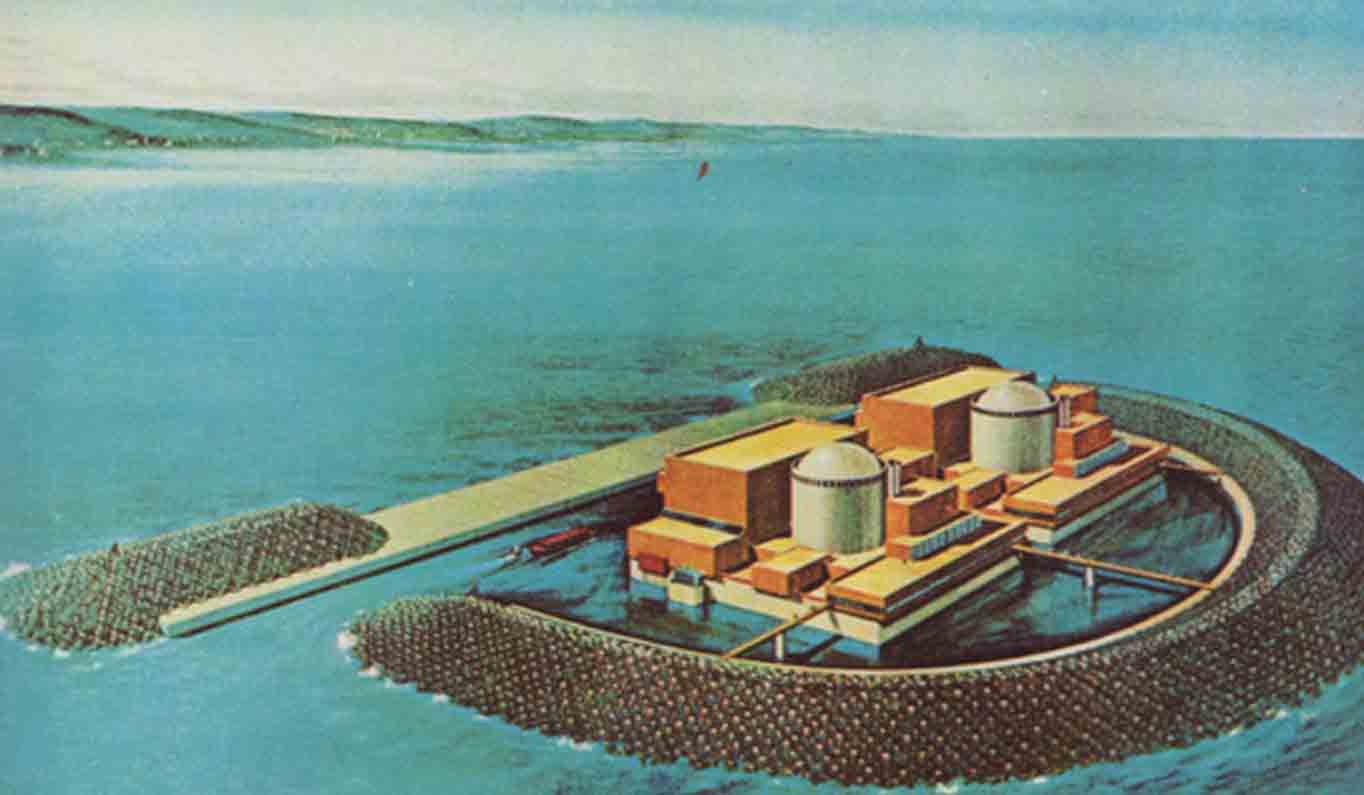
Back in the early 1970s, the Atomic Energy Commission proposed building a $1 billion nuclear power plant on a manmade island in the Atlantic Ocean ten miles off the coast between Long Beach Island and Atlantic City.
Dubbed the Atlantic Nuclear Power Plant, four 1,150 megawatt Westinghouse reactors would be placed on floating platforms in the Atlantic Ocean surrounded by massive concrete breakwaters. The idea was created in a PSE&G and Westinghouse think tank in the late 1960s.
It might sound like a problem waiting to happen, but in 1972, PSEG purchased two of the four generators, to the dismay of Jersey Shore officials at the time. The companies and the AEC were serious about their plan to build a nuclear power station in the middle of the Atlantic Ocean.
“I don’t think Atlantic County can be assured of its safety if the question is left to the Atomic Energy Commission,” said Carl Valore, Jr., the chairman of the Atlantic County Planning Board at the time.
Valore pressured the county freeholders into objecting to the project in a hearing about the off-shore nuclear power plant that was to be held in 1974 by the AEC. Valore warned the county of a catastrophic scenario should a powerful nor’easter or hurricane strike the floating island with a nuclear power plant on it.
“Even a small mishap that did not result in the loss of life could still pollute our oceans off Atlantic County for hundreds of years,” he said.
Prior to Valore sounding the alarm, the board of freeholders was actually entertaining the proposal brought before them by PSE&G and the AEC.
Dissent at the Jersey Shore began to grow against the idea of a nuclear power plant. PSE&G had their PR department running full steam ahead, which Dr. Ira Ross, a representative of the Medical Society of New Jersey-based in Essex County, referred to as public propaganda.
“So threatened is the viability of the New Jersey resort industry that a television propaganda program is needed to build a harmless atomic facility far offshore,” Ross said.
Two years later, the plans to build the floating power plant began taking on water. Investors started to jump ship from the new Offshore Power Systems project. Investors Tenneco and Westinghouse bailed because of project delays and financing problems.
The new corporation established to build the floating nuclear power plant had to lay off 60 percent of its employees in 1974.
In late 1974, the matter was put on the voting ballot as a public referendum. Not only was the plant a dangerous idea, but it would also end up costing Jersey Shore residents a lot of money, opponents also said in their protest.
Voters ended up rejecting the project by a vote of 25,539 to 14,976. PSE&G and JCP&L, by this time, were still pushing to build the world’s first floating nuclear power plant. Initially, the plant was supposed to open in 1981. Delays and the public backlash caused the two major energy partners to push the opening back to 1987.
By this time, the Oyster Creek Nuclear plant twenty miles north, built in 1969, was already providing power to the Jersey Shore.
PSE&G lost a lot of money in the cancellation of its nuclear reactors. In retribution, in 1981, it went to the Board of Public Utilities to seek rate hikes to recoup $760 million by 1999. It wanted the ratepayers to pay for its failed plan and to pay back investors who would not receive any return on their investments in the floating power station.
In 1978, PSE&G canceled its order to purchase the Westinghouse reactors. Westinghouse kept moving forward in hopes that their idea would one day become reality.
The doomed project was dead. In 1979, the Three Mile Island incident sealed the project’s long-term fate. The company shifted its focus to the Hope Creek and Salem nuclear plants.
By 1984, PSE&G and Westinghouse abandoned the notion of ever building a floating nuclear power plant due to public opposition sunk completely by the Three Mile Island mishap.
‘Floating reactors did not solve regulatory or political problems. The production facility in Jacksonville needed an NRC manufacturing license,” said Nuclear Regulatory Commission Historian Thomas Wellock. “There were so many technical and regulatory uncertainties that the licensing review ran three years behind schedule. A 1978 report from the U.S. General Accounting Office criticized the NRC for what it believed was an incomplete safety review, particularly for not accounting for impacts on the ocean ecosystem during an accident where a melting reactor core broke through the bottom of the barge.”
Today, the only floating nuclear power plant in the world is in Russia.
Research was done using Newspapers.com, referencing articles published by the Star-Ledger, The Herald News and the Asbury Park Press, 1972-1974. Article republished for editorial review and accuracy.