

More than 200 small quakes recorded since a 4.8-magnitude event near Tewksbury raise questions about reactivated ancient faults.
TEWKSBURY, NJ – New Jersey has entered a period of heightened seismic activity since 2024 and scientists are continuing their investigation.
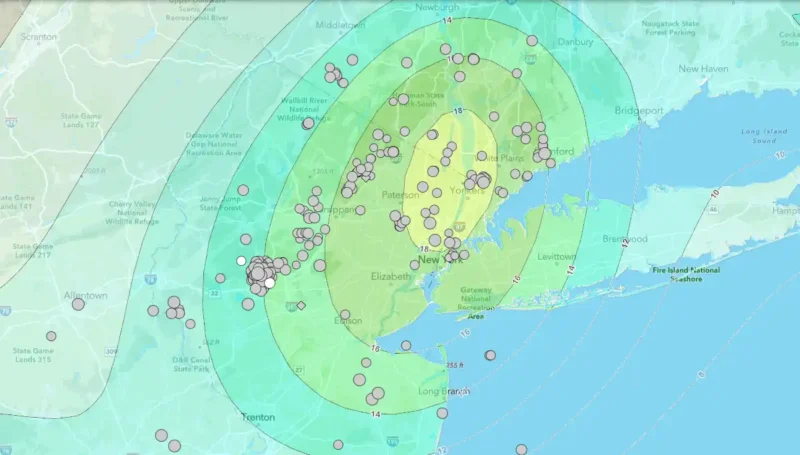
Geologists from the U.S. Geological Survey are closely studying an unusual wave of seismic activity across New Jersey after more than 200 earthquakes were recorded between 2024 and early 2026—an extraordinary spike in a state that typically sees just a handful each year.
Key Points
- Over 230 earthquakes have occurred since the April 5, 2024, 4.8-magnitude quake near Tewksbury.
- Most are small aftershocks or tremors along older east-west trending faults, not the Ramapo Fault.
- Experts say the events are low risk but offer valuable insight into regional stress in the Earth’s crust.
The surge began after the April 2024 quake, which shook buildings across New Jersey and neighboring states. Researchers believe that event “stimulated” a sequence of smaller tremors as underground stress was released along secondary or previously unmapped fault lines.
The largest earthquake to impact New Jersey occurred in 1783. That earthquake, a magnitude 5.3 quake, occurred west of New York City and was felt from New Hampshire to Pennsylvania (Stover and Coffman, 1993).
U.S. Geological Survey
Scientists identify new fault behavior
While the Ramapo Fault has long been considered New Jersey’s most prominent seismic feature, new data from the U.S. Geological Survey (USGS) suggests that recent quakes are occurring on different, east-west trending faults. These older faults, some dormant for millions of years, can reactivate under present-day tectonic stress.
“Under the current stresses of tectonic plates moving, those faults can be intermittently reactivated,” said USGS Research Geologist Jessica Thompson Jobe. “These are not active faults in the traditional sense, but the energy buildup in the crust can cause them to slip from time to time.”
Frequent but minor tremors
Since the start of 2025, the USGS has cataloged more than two dozen small earthquakes, including a magnitude 3.0 near Little Ferry last August and several minor tremors near Califon and Bedminster earlier this year. Most are shallow, producing shaking that can be widely felt due to the dense, cold rock beneath the East Coast.
Despite the increase, scientists stress that New Jersey remains a low-risk seismic zone. “No one can predict the exact time, location, or size of any earthquake,” said Sara McBride of the USGS Earthquake Hazards Program. “However, aftershocks provide crucial data for understanding the faults that exist beneath the region.”
Research expands as monitoring increases
The New Jersey Geological and Water Survey and USGS have installed additional seismic sensors to map fault activity and analyze ground motion patterns. Some researchers suggest the surge may be part of a natural “post-glacial rebound” process—an adjustment of the Earth’s crust thousands of years after glaciers retreated.
While residents are likely to continue feeling occasional tremors, experts agree that these small quakes are not precursors to a large, damaging event. Instead, they offer scientists a rare opportunity to study how ancient geologic structures respond to modern stress.
Tags: New Jersey, earthquake, USGS