
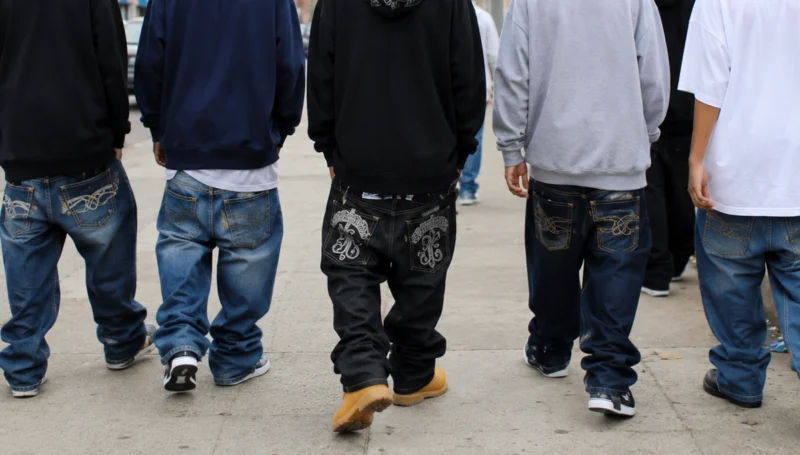
Newark, NJ – Fashion trends come and go, but one has stood the test of time from the 1990s through today.
From city blocks in Newark and Camden to smaller towns across New Jersey, sagging pants remain one of the most recognizable — and debated — fashion trends in youth culture. While critics often dismiss the style as disrespectful or unprofessional, historians and cultural observers say the look carries a far more complex history tied to prison culture, hip-hop, rebellion, and evolving street fashion.
The style, commonly called “sagging,” refers to wearing pants below the waistline, often exposing underwear or layered clothing. The trend became nationally visible during the late 1980s and 1990s as hip-hop culture exploded into mainstream American fashion.
Many researchers trace one major influence to the U.S. prison system, where inmates were frequently issued oversized clothing and prohibited from wearing belts because of security concerns. Former inmates and cultural historians say the look later migrated into street culture and music scenes, where it evolved into a symbol of toughness, individuality, and rejection of mainstream expectations.
Hip-Hop Helped Push the Trend Nationwide
Artists connected to rap and hip-hop culture helped popularize sagging throughout the 1990s and early 2000s. Musicians such as Tupac Shakur and other influential rappers embraced oversized clothing styles that became associated with urban youth identity across the country.
In many communities, sagging became connected to street credibility and anti-establishment fashion. Others simply adopted the look because it became trendy among peers, athletes, skaters, and musicians.
Some social observers have also pointed to economic realities in lower-income households, where children sometimes wore larger clothing purchased to last multiple years as they grew.
Today, the style continues in different forms, with some people using sagging to display designer belts, expensive underwear brands, or layered fashion aesthetics.
Myths and Controversy Continue
One long-circulating claim — that sagging originated as a prison signal related to sexual availability — has been widely dismissed by researchers and fact-checkers as an urban myth unsupported by credible evidence.
Despite that, the fashion trend has repeatedly sparked backlash from politicians, schools, and local governments.
Several U.S. cities over the years attempted to ban sagging pants through public decency ordinances, leading to criticism from civil rights advocates who argued the laws disproportionately targeted young Black and Latino men.
Supporters of the style often frame sagging as personal expression or cultural identity, while opponents argue it contributes to negative stereotypes or creates an unprofessional image.
Key Points
• Sagging pants became popular through prison culture, hip-hop, and youth fashion trends
• The style spread nationwide during the 1990s through rap music and street culture
• Myths linking sagging to prison sexual signaling are widely considered false
Trend Remains Visible Across New Jersey
The look remains common throughout New Jersey, appearing not only in major urban centers like Newark, Paterson, Trenton, and Camden, but also in suburban and rural communities where fashion trends spread through music, social media, and internet culture.
Fashion experts note that clothing trends often survive because younger generations continuously reinterpret older styles rather than abandoning them completely.
While sagging no longer dominates youth fashion the way it did in the early 2000s, the style continues to appear in streetwear culture and remains part of the broader conversation about identity, generational divides, and self-expression in America.
