While America eagerly awaits the next delay of Grand Theft Auto 6, let’s pretend we’re in an alternate universe where Grand Theft Auto was always a part of video game culture since day one.
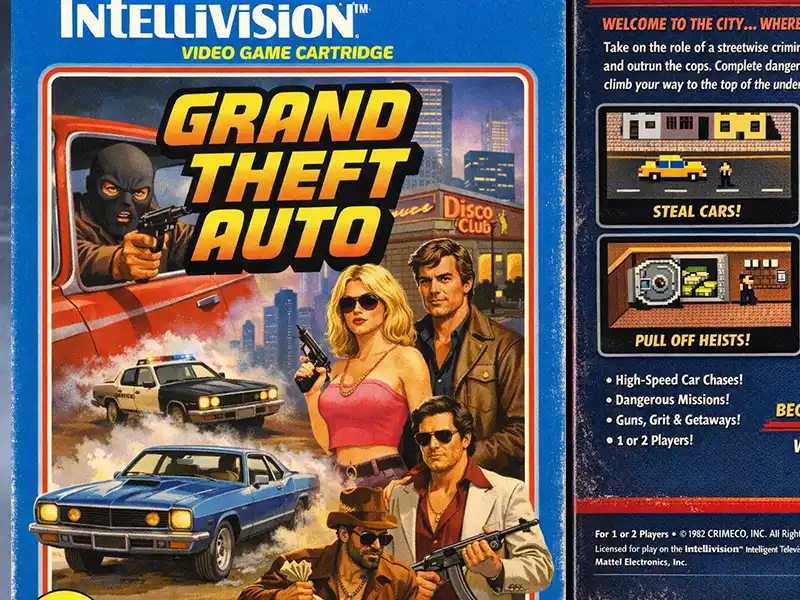
Imagine the Reagan era colliding head-on with pixelated lawlessness. In an alternate 1983, Mattel shocks suburban America with the release of Grand Theft Auto for its Intellivision console, transforming the golden age of arcade innocence into a national debate about digital delinquency.
Thanksgiving gatherings grind to a halt as confused families attempt to pilot blocky sedans using number pads and laminated instruction cards. A generation raised on Pong and Donkey Kong suddenly finds itself committing virtual getaways while grandparents wonder aloud when video games became about “escaping police.”
Television news quickly catches the scent of scandal. By December, 60 Minutes airs a special titled “Is Your Child a Getaway Driver?” as experts warn of moral collapse through eight-bit graphics. Capitol Hill, still adjusting to the idea of home consoles, holds emergency hearings on what one senator calls “electronic hooliganism.” Lawmakers propose an early version of a video game ratings system, assigning grades like “F – Felonious” and “VF – Very Felonious,” though parents pay little attention.
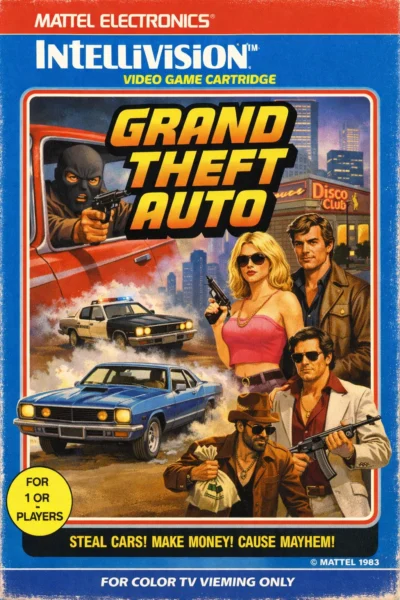
Across America, moral panic spreads as fast as the cartridge copies. Youth groups demand bans. Talk show hosts hold up screenshots of pixel explosions as proof of cultural decay. Intellivision sales skyrocket. College essays in the following decade attribute the rise of urban planning careers to the “sandbox freedom” of that one controversial game, and synth-driven crime soundtracks begin leaking from bedrooms to FM radio.
The cultural ripple effects are impossible to ignore. Hollywood adapts the idea into low-budget chase films with titles like Fast & the Slightly Irritated. Politicians stumble through sound bites about “interactive delinquency.” Nintendo, observing the uproar from across the Pacific, quietly decides that its own plumbers will stick to turtle stomping instead of auto theft.
By the time the real Grand Theft Auto arrives in the late 1990s, America’s outrage feels like déjà vu. Had the Intellivision version existed, experts say, the video game violence debate would have started a decade earlier and ended no sooner.
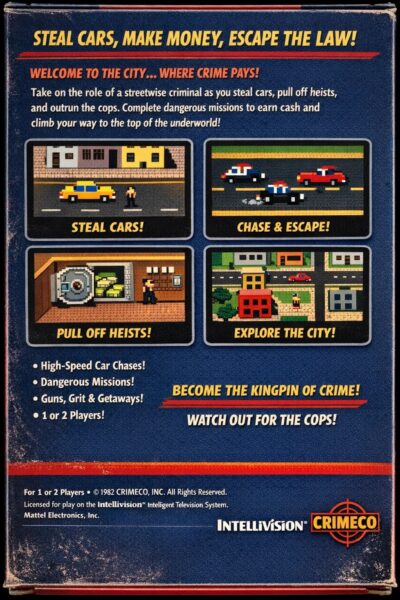
In this alternate timeline, the most lasting image isn’t the pixelated getaway—it’s the glowing Intellivision humming in a basement, its wanted level forever flashing, waiting for history to catch up.