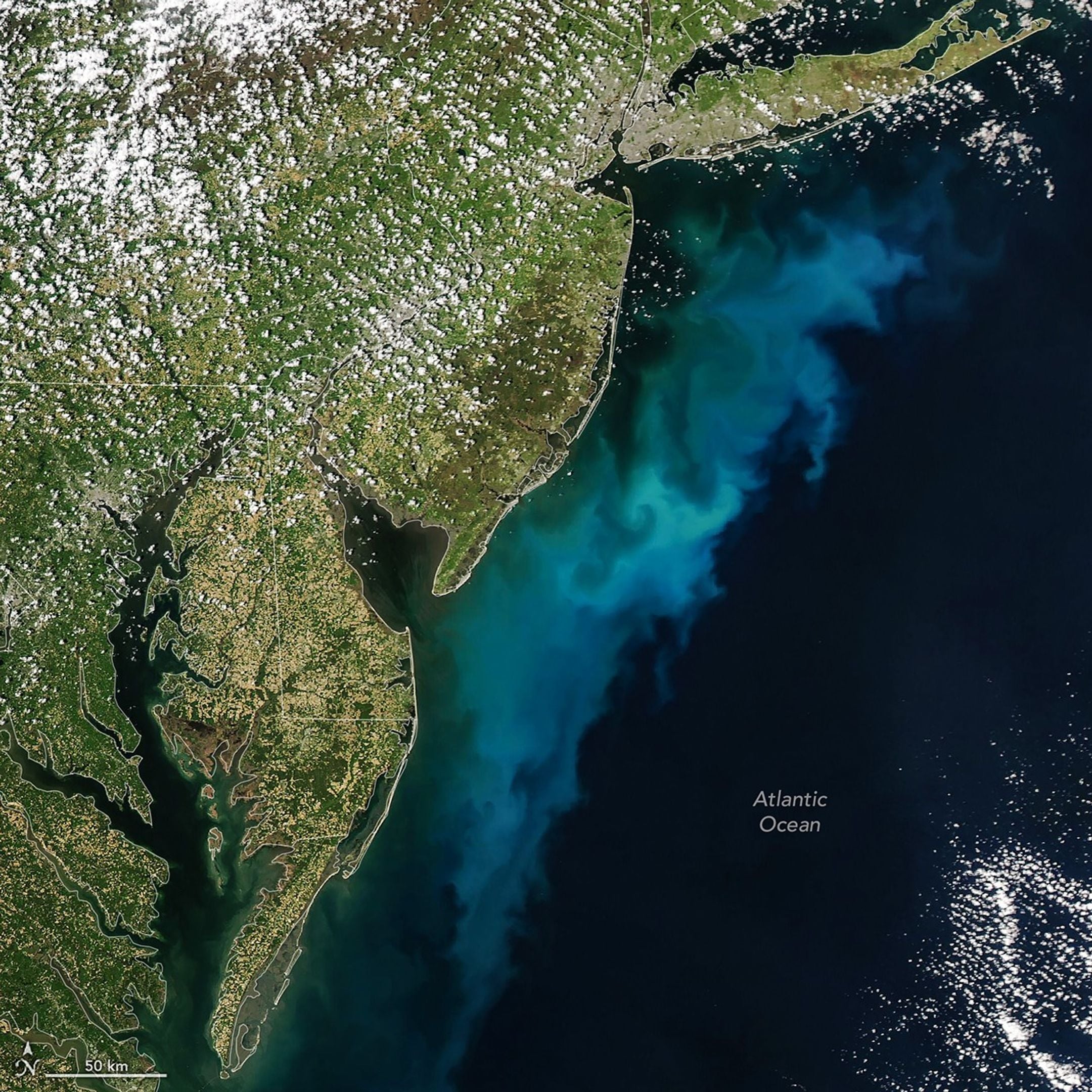
New York, NY — Satellite images captured by NASA are showing an unusual stretch of bright blue and blue-green water spreading along the Atlantic coast from New York to Maryland, with scientists linking the dramatic color shift to massive spring phytoplankton blooms developing offshore.
The vivid waters began appearing in early April near the Mid-Atlantic Bight, a heavily studied coastal zone where the Atlantic Ocean mixes with outflows from Raritan Bay, Delaware Bay, and Chesapeake Bay. Researchers say the striking colors likely stem from a combination of microscopic marine organisms, river runoff, suspended sediment, and nutrient-rich ocean conditions triggered by seasonal changes.
NASA scientists say newer satellite technology is now allowing researchers to detect and identify these blooms in far greater detail than before.
NASA Satellites Capture Rare Coastal Color Shift
The changing ocean colors were detected by multiple NASA satellites, including PACE, Aqua, and Terra, according to NASA’s Goddard Space Flight Center. Scientists monitoring the images observed large patches of green, turquoise, and chalky blue water lingering along shallow coastal zones off New Jersey, Delaware, Maryland, and Virginia.
Researchers say the Mid-Atlantic Bight has historically been difficult to analyze from space because coastal waters contain a constantly changing mix of sediment, dissolved organic material, seagrass, algae, and phytoplankton.

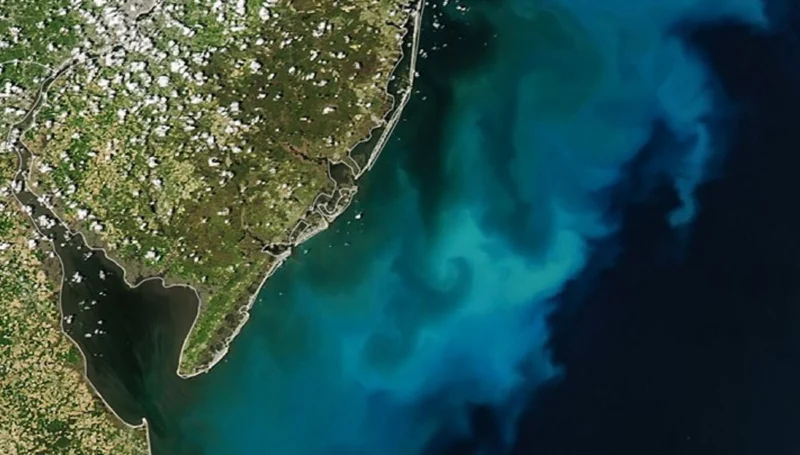
“That optical complexity has made it harder for scientists to distinguish and categorize phytoplankton blooms in shallow coastal zones,” NASA explained.
The recently launched PACE mission — short for Plankton, Aerosol, Cloud, Ocean Ecosystem — is changing that. The satellite, launched in 2024, measures more wavelengths of light than previous ocean-monitoring missions, giving researchers a sharper view of biological activity near coastlines.
NASA research scientist Anna Windle said satellite data strongly suggests active phytoplankton blooms are driving much of the visible color offshore.
“There are likely phytoplankton blooms happening,” Windle said. “Diatoms typically dominate blooms early in the spring, but we are seeing some signs of coccolithophores mixed in as well.”
Key Points
• NASA satellites detected bright blue-green ocean water from New York to Maryland beginning in April
• Scientists say large phytoplankton blooms likely caused much of the dramatic color change
• New PACE satellite technology helped researchers identify blooms in complex coastal waters
Why the Atlantic Is Turning Blue and Green
Scientists say spring conditions create an ideal environment for explosive phytoplankton growth.
During winter, colder temperatures and strong winds mix ocean waters vertically, bringing nutrients like nitrogen and phosphorus toward the surface. As daylight increases in spring, phytoplankton absorb sunlight and rapidly multiply.
One of the dominant organisms currently appearing offshore is believed to be diatoms, a common class of phytoplankton known for fueling large spring blooms. Diatom-heavy blooms often appear green in satellite imagery because of their chlorophyll content.
Researchers also identified signs of coccolithophores, another microscopic marine organism that can turn ocean water a bright turquoise or milky blue.
Unlike diatoms, coccolithophores surround themselves with reflective calcium carbonate plates called coccoliths. When massive blooms develop, billions of those tiny calcite structures scatter sunlight and create the Caribbean-like blue appearance visible from space.
“These highly reflective scales are only a few thousandths of a millimeter thick,” NASA noted, “but coccolithophores are found in such massive numbers during blooms that their plates play a key role in global biogeochemical cycles.”
Scientists estimate coccolithophores account for roughly half of modern calcium carbonate precipitation in the ocean.
A Seasonal Bloom With Global Importance
While the colorful waters may appear unusual to beachgoers and satellite viewers, phytoplankton blooms are a critical part of the marine ecosystem.
Phytoplankton function much like grasses and forests on land, serving as primary producers that support ocean food chains while recycling carbon through photosynthesis.
Diatoms, algae, coccolithophores, and other phytoplankton absorb sunlight and nutrients to generate energy, providing food for marine life ranging from tiny zooplankton to large fish species.
The Mid-Atlantic blooms also reflect broader seasonal shifts happening beneath the ocean surface.
Rutgers University oceanographer Oscar Schofield said nutrient-rich conditions currently favor rapid growth, though the bloom may not last much longer.
“But over time, as big spring phytoplankton blooms grow, they deplete the nutrients,” Schofield said. “Unless big river outflows or storms replenish the nutrients, we’ll likely see this bloom start to decline in the coming weeks.”
New Technology Gives Scientists a Clearer Picture
The bloom is also serving as an early demonstration of the capabilities of NASA’s PACE satellite mission.
Previous generations of satellites struggled to separate phytoplankton activity from muddy coastal water conditions, especially in regions heavily influenced by rivers and shallow seabeds. PACE’s expanded light-detection capabilities now allow scientists to map chlorophyll concentrations and distinguish between different bloom types more accurately.
Researchers say the improved data could eventually help scientists better monitor fisheries, harmful algal blooms, carbon cycling, and changing ocean ecosystems tied to climate variability.
For now, scientists continue monitoring the evolving bloom as warmer temperatures and shifting nutrient levels reshape waters along the East Coast.