

TOMS RIVER, NJ – A growing debate over political patronage and taxpayer-funded benefits is unfolding in Ocean County as newly released budget figures and public records reveal that part-time commissioners at several municipal utilities authorities (MUAs) are receiving full healthcare packages worth tens of thousands of dollars each year — in some cases for working as little as one or two hours per month.
In most cases, the appointees to these boards are political insiders and local power players, political appointees chosen by mayors and township councils.
These authorities oversee the water and sewer systems for many of these towns. In some towns, such as Toms River, they only oversee the sewer systems, as the township outsources water services to a private commercial provider.
At the center of the controversy are the Toms River and Lakewood Municipal Utilities Authorities, where politically connected appointees receive salaries, stipends, and complete top-notch medical coverage comparable to full-time municipal employees.
Again, they work just one or two hours per month.
Both authorities have come under scrutiny for what some local officials describe as “patronage pits,” positions created to reward allies of past administrations with lucrative, taxpayer-funded benefits.
Toms River Mayor Dan Rodrick, who has made cutting waste and fraud at all cost, a cornerstone of his administration, is pushing to dissolve his township’s MUA and bring its operations under direct township control. He says doing so would eliminate unnecessary spending and end the “gravy train” of free healthcare for part-time political appointees.
Mayor Rodrick pushes to dismantle patronage system
Rodrick has publicly condemned the MUA’s structure, arguing that commissioners earning $2,000 stipends while receiving $43,600 in family healthcare plans are effectively being paid $4,500 per meeting — making them the highest-paid local officials per hour in Ocean County.
“These are one-hour-a-month jobs,” Rodrick said. “Taxpayers should not be footing the bill for healthcare benefits of political appointees who show up once a month.”
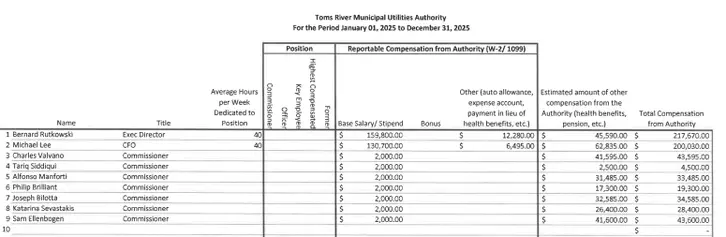
His proposal to fold the MUA into the township’s utilities department was narrowly defeated by the Toms River Council two weeks ago, sparking backlash from residents demanding reform and transparency. Rodrick’s office estimates that shutting down the authority could have saved taxpayers $2.5 million immediately and potentially eliminated sewer bills altogether in the long term.
Among those benefitting from the current system is Phillip Brilliant, a former B’nai Israel Congregation president and owner of Brilliant Environmental Services, who now leads a movement to recall the mayor. Brilliant, appointed to the MUA by former Mayor Maurice “Mo” Hill shortly after his company filed for bankruptcy, receives taxpayer-funded healthcare despite attending only one meeting a month — compensation that breaks down to about $1,450 per hour.
Political ties and conflicts emerge in Toms River
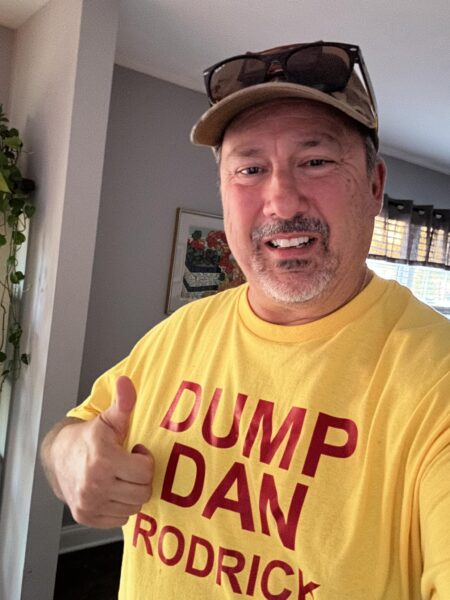
The MUA’s board is filled with politically connected figures, including Brilliant; Schmuel “Sam” Ellenbogen, Ocean County Commissioner-elect and leader of the Toms River Jewish Community Council; developer Tariq Siddiqui; and Katerina Sevastakis, daughter of former Councilman John Sevastakis. Former commissioners include Joseph Bilotta, Charles Valvano, and former Councilman Al Manforti — all appointed under prior administrations.
Rodrick has accused the council of protecting entrenched political interests. He cited reports linking MUA engineering contracts to Ocean County GOP Chairman George Gilmore, whose firm represents the authority. The mayor also alleged that Gilmore offered assistance in securing county employment for a councilman’s family member ahead of a key vote on the dissolution proposal — an accusation Gilmore has not publicly addressed.
Rodrick thanked Council members Craig Coleman, Lynne O’Toole, and William Byrne for supporting his reform efforts, pledging to continue fighting to end what he calls “institutionalized patronage.”
Ocean County MUA
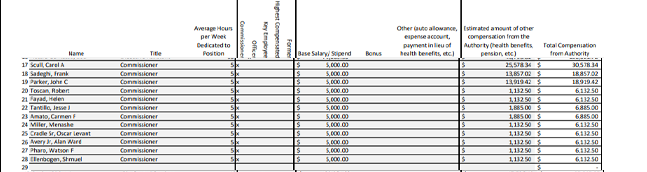
Financial records from the Ocean County Utilities Authority reveal that its commissioners, who typically work just a few hours per month, are collectively receiving tens of thousands of dollars in compensation and benefits.
According to the 2025 budget, Commissioner Scott Cerullo tops the list with a $5,000 stipend and an additional $35,773.14 in health and other benefits, bringing his total annual compensation to $40,773.14.
Commissioner Frank Sadeghian follows with a $5,000 stipend and $13,872.92 in benefits, totaling $18,872.92.
Other commissioners — including Robert Zochert, Helen Francis, Ismail Parida, Carmen Amato, and several others — each receive $1,000 annual stipends and approximately $5,112.50 in benefits, resulting in total compensation of about $6,112.50 apiece.
Despite the modest meeting schedule and limited workload, the authority continues to provide full medical and pension benefits to its part-time commissioners, a practice increasingly criticized by taxpayers and reform advocates as a misuse of public
Lakewood MUA commissioners reap the largest benefits
Just north of Toms River, the Lakewood Municipal Utilities Authority has drawn similar criticism for its generous commissioner benefits. According to its 2025 budget filed with the New Jersey Department of Community Affairs, the five-member board — chaired by State Senator Robert Singer and Vice Chairman and others — collectively receive tens of thousands in stipends and benefits despite meeting only once per month.
Singer earns a base stipend of $10,833, but with benefits and allowances included, his total compensation climbs to $86,976. Mayor Coles does not accept benefits through the MUA.
Treasurer Craig Theibault and Assistant Secretary Anne Fish each receive compensation totaling around $65,000 annually, largely driven by benefit costs. Alternate commissioners Meir Lichtenstein, Samuel Flancbaum, and Yocheved Miller also receive pay and benefits despite serving only when regular members are absent.
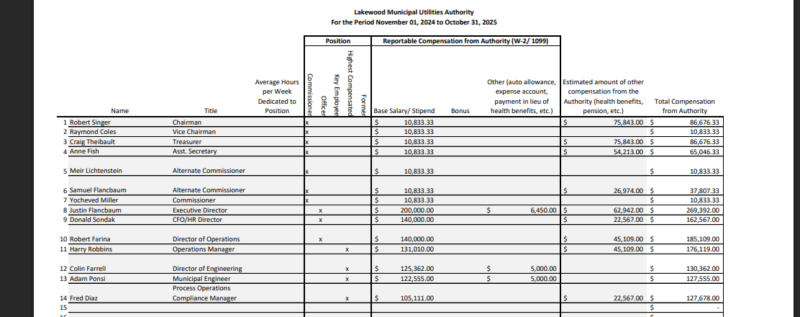
MUA Executive Director Justin Flancbaum, who also serves on the Ocean County Election Board, earns a $200,000 salary and $62,942 in benefits. Flancbaum is a reported ally of Gilmore, who chairs the same election board. CFO Donald Sandach follows with $185,567 in combined compensation.
Taxpayers question fairness and oversight
Local transparency advocates have called the practice “a misuse of public trust,” noting that MUA commissioners are appointed rather than elected and often serve in limited administrative capacities.
“This is an authority, not a full-time agency,” one Lakewood resident said after reviewing the budget. “These kinds of benefits for part-time service are unheard of for regular people — even full-time workers don’t get packages like this.”
The Lakewood MUA operates with an annual budget exceeding $30 million, funded by customer rates rather than property taxes. Critics argue that the authority’s independence from township oversight has enabled excessive compensation and poor accountability.
Other Ocean County towns cut the patronage pits and have already ended free healthcare plans
While Lakewood and Toms River continue their costly practices, several neighboring towns have already phased out healthcare benefits for part-time commissioners. Jackson, Manchester, Lacey, Plumsted, and Berkeley Township have eliminated medical benefits for new members, replacing them with modest stipends ranging from $2,500 to $5,000 annually.
Lacey Township MUA commissioners do not receive stipends or benefits.
Jackson MUA Chairman William Allman remains an exception, grandfathered under an older policy that still provides him $15,000 in benefit compensation annually.
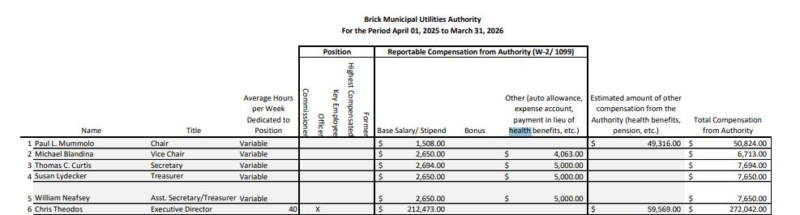
In Brick Township, officials considered offering commissioners a $5,000 cash stipend in lieu of healthcare. Former councilman Paul Mummolo is the only remaining commissioner there still receiving free healthcare — a $49,316 benefits package on top of a $1,500 stipend.
Statewide reform calls growing louder
New Jersey’s Division of Local Government Services has previously urged municipalities to curb benefit packages for part-time appointees, but enforcement has been inconsistent.
Former Governor Chris Christie’s 2010 reforms sought to end free healthcare for part-time officials statewide, though several local authorities — including Toms River’s — found workarounds to continue the practice.
Mayor Rodrick says that must change. “If they aren’t going to dissolve the MUA,” he said, “they need to immediately end free benefits to politically connected folks who just show up for work one hour per month.”
Across Ocean County, growing public attention to the issue is prompting renewed scrutiny of local authorities, many of which operate with limited transparency but wield significant financial power over essential utilities.