
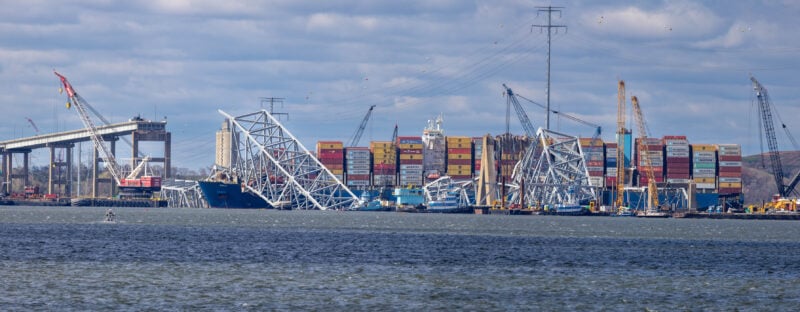
Key Bridge Rebuild Faces Billions in Cost Overruns, Years of Delays After Deadly Collapse, and won’t be completed for at least another four years.
The collapse of the Francis Scott Key Bridge in Baltimore has evolved from a sudden maritime disaster into one of the most expensive and complex infrastructure rebuilds in recent U.S. history. Nearly two years after the March 26, 2024 incident, officials now say the project will cost more than double initial estimates and take years longer than first promised, raising concerns about funding, logistics, and long-term economic impact on the region.
The disaster unfolded in the early morning hours when the container ship Dali lost power while departing the Port of Baltimore and struck a critical support pier. Within seconds, the bridge collapsed into the Patapsco River, killing six construction workers who were performing overnight roadway repairs. The incident immediately shut down one of the nation’s busiest shipping corridors and triggered a massive federal, state, and local emergency response.
In the weeks that followed, recovery crews worked to clear wreckage and reopen the port. By late spring and summer of 2024, shipping channels were gradually restored, and the disabled vessel was removed. At the same time, Maryland leaders, backed by the federal government, pledged to rebuild the bridge quickly, initially estimating a cost between $1.7 billion and $1.9 billion with a target completion date of 2028. That early optimism, however, would not hold.
As engineering and design work progressed through 2024 and into 2025, the scope of the project expanded significantly. Officials determined the replacement bridge would require enhanced safety features, including reinforced pier protection systems designed to withstand ship strikes, as well as a larger and more modern span to accommodate growing port traffic. By late 2025 and early 2026, updated projections placed the total cost between $4.3 billion and $5.2 billion, representing an increase of more than $3 billion over initial estimates.
Maryland transportation officials have pointed to several factors driving the surge. Acting Transportation Secretary Samantha Biddle said the revised figures are “directly correlated to increased material costs and… robust pier protection,” noting that highway construction expenses have risen sharply in recent years. Inflation, supply chain volatility, and a more detailed engineering process have all contributed to the ballooning price tag. Officials also acknowledged that the original estimates were based on preliminary assumptions made in the immediate aftermath of the collapse.
Alongside rising costs, the timeline for completion has also slipped. The bridge is now expected to open in late 2030, roughly two years behind the original schedule. State officials cite the complexity of the redesign, environmental permitting requirements, and the expanded scale of the project as key reasons for the delay. The design phase is currently reported to be about 70 percent complete, with full-scale construction still ramping up.
Governor Wes Moore has maintained that the state remains committed to completing the project despite the setbacks. “We will stay the course as we honor our pledge to rebuild,” Moore said, emphasizing the importance of restoring a critical transportation link. Federal transportation officials have echoed the sentiment but warned early on that rebuilding the bridge would not be “quick or easy or cheap,” a prediction that has proven accurate as the project has evolved.
Port leadership has also expressed cautious optimism about the future. Maryland Port Administration Executive Director Jonathan Daniels noted that while operations have largely rebounded since the collapse, the long-term success of the port depends on the completion of the new bridge. “We are pleased with the progress so far, but we have bigger things to come,” Daniels said, pointing to the broader economic stakes tied to the project.
Legal and financial questions remain unresolved, as government agencies continue efforts to recover costs from the ship’s owner and associated companies. Federal funding has been pledged to cover much of the rebuilding effort, but Maryland officials have acknowledged that the state still has significant financial exposure as the project continues to expand.
What began as a sudden maritime accident has now become a defining infrastructure challenge for Maryland and the federal government. With costs exceeding $5 billion and completion pushed toward the end of the decade, the Key Bridge rebuild stands as a stark example of how quickly emergency reconstruction projects can escalate in scale, complexity, and cost.