
TRENTON, N.J. — New Jersey ranks as the second-most pest-vulnerable state in the country, according to a new nationwide study that found the state’s dense neighborhoods, older housing stock, and favorable conditions for rodents and termites create a perfect environment for infestations.
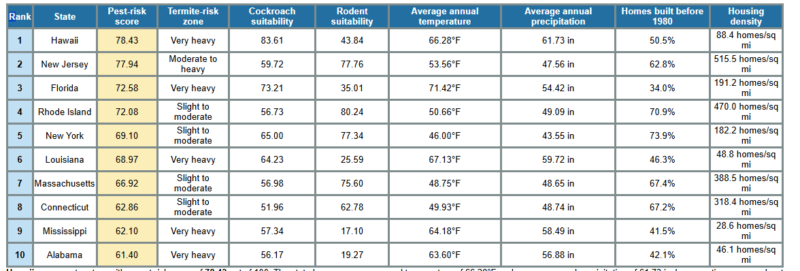
The report from Nealon Insulation gave New Jersey a pest-risk score of 77.94 out of 100, trailing only Hawaii. Researchers pointed to the state’s extremely high housing density — the highest measured in the study — along with the large percentage of older homes as major drivers behind the ranking.
More than 62% of homes in New Jersey were built before 1980, according to the study, increasing the likelihood of cracks, aging infrastructure, moisture issues, and entry points that can attract pests such as rodents, cockroaches, and termites.
The study also found New Jersey had 515.5 housing units per square mile, the highest density among all states analyzed.
Dense Housing and Older Homes Drive New Jersey’s Ranking
Researchers combined U.S. Census housing data, Census density information, NOAA climate figures, and termite-risk zones to build the pest-risk index.
Unlike rankings based on actual infestations, the index measures vulnerability — identifying states where conditions make pest problems more likely to develop or spread.
For New Jersey, experts said the combination of tightly packed housing and aging residential structures creates challenges for homeowners and renters alike.
Shared walls in apartment buildings, older basements, moisture-prone structures, and closely connected neighborhoods can allow infestations to spread more quickly between properties. Rodents and cockroaches, in particular, tend to thrive in dense urban and suburban environments where food sources and shelter are readily available.
The study also classified New Jersey within a “moderate to heavy” termite-risk zone, adding another layer of concern for homeowners.
Key Points
• New Jersey ranked second nationally with a pest-risk score of 77.94 out of 100
• Researchers cited aging homes and the nation’s highest housing density as major risk factors
• Hawaii ranked first overall, while Wyoming had the country’s lowest pest-risk score
Hawaii and Florida Also Ranked Near the Top
Hawaii topped the national rankings with a pest-risk score of 78.43. Researchers said the state’s warm temperatures, heavy rainfall, and “very heavy” termite-risk zone made conditions especially favorable for pests.
Florida ranked third with a score of 72.58, driven by its humid climate, high temperatures, and elevated termite exposure.
Several Northeastern states also appeared near the top of the rankings despite cooler weather. Rhode Island ranked fourth, followed by New York in fifth place, Massachusetts in seventh, and Connecticut in eighth.
The report noted that older housing stock played a major role in those states’ rankings. In New York, for example, nearly 74% of homes were built before 1980, while more than half of all residences were classified as multifamily housing.
Researchers said multifamily buildings can increase vulnerability because pests can move between units more easily through shared walls, plumbing systems, and ventilation pathways.
Western States Saw Lowest Risk Levels
Wyoming ranked as the least pest-prone state overall with a score of just 15.16, followed by Idaho and Montana.
The study credited lower housing density, cooler climates, and minimal termite exposure for reducing overall vulnerability in those states.
Southern states including Louisiana, Mississippi, and Alabama also landed in the top 10 because of warm, wet climates and elevated termite-risk classifications, even though their housing density was significantly lower than Northeastern states.
Nealon Insulation said the rankings should not be interpreted as confirmed infestation rates but rather as indicators of where environmental and housing conditions may create greater long-term pest pressure.
For New Jersey homeowners, the findings highlight ongoing concerns tied to aging infrastructure, moisture control, and population density — issues that can become increasingly expensive as pest prevention and home maintenance costs continue rising statewide.
