
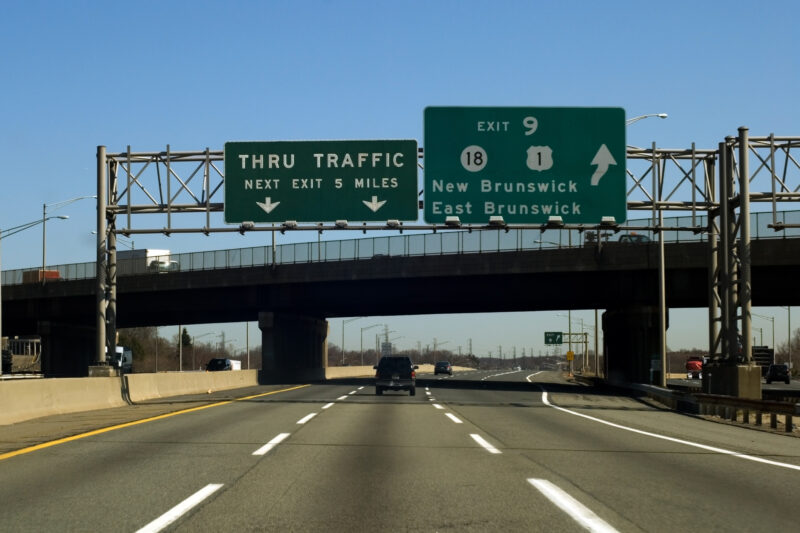
Multiple incidents across North and Central New Jersey slow commuters during peak rush hour, with lane closures and bridge congestion impacting key corridors.
Newark, New Jersey – A series of crashes, infrastructure issues, and heavy commuter congestion disrupted Friday morning travel across New Jersey, with the New Jersey Department of Transportation reporting lane closures and significant delays on major highways, bridges, and tunnels statewide. The combination of a crash in Morris County, a sewer main break in Middlesex County, and persistent congestion at Hudson River crossings created widespread slowdowns during the height of the morning commute.
According to the New Jersey Department of Transportation and Port Authority of New York and New Jersey, the most immediate disruptions included a crash on NJ 24 westbound in Chatham and a sewer main break on NJ 27 northbound in Woodbridge Township, both reducing lane capacity during peak travel times. Ongoing delays at the George Washington Bridge and Holland Tunnel further compounded congestion, underscoring the strain on key regional infrastructure.
Crash and infrastructure issues trigger lane closures
A crash reported at 7:38 a.m. on NJ 24 westbound, just west of Exit 7 near NJ 124/JFK Parkway in Chatham, closed one of two lanes, creating a bottleneck for Morris County commuters heading toward I-287 and surrounding business corridors.
At nearly the same time, a sewer main break on NJ 27 northbound south of NJ 35/St. Georges Avenue in Woodbridge Township forced the closure of one of three lanes. The incident, reported at 7:50 a.m., added pressure to an already congested Middlesex County corridor that serves as a key local and regional route.
Elsewhere, roadwork and maintenance added to delays. On the Commodore Barry Bridge connecting Logan Township, New Jersey, to Chester, Pennsylvania, two left lanes were closed for pothole repairs, with speeds reduced to 25 mph. Multiple construction zones across the state—including on I-295, NJ 70, NJ 54, and US 206—further limited capacity, particularly in South Jersey and along key commuter routes.
Bridge and tunnel delays ripple across region
Congestion at major Hudson River crossings remained a central issue throughout the morning. The George Washington Bridge saw delays on both upper and lower levels eastbound, with travel times reaching up to 30 minutes from I-80 to the Alexander Hamilton Bridge on the upper level and 15 minutes on the lower level.
The New Jersey Turnpike’s express lanes approaching the bridge experienced a two-mile delay in Leonia, directly tied to the bottleneck at the crossing. Additional slowdowns were reported on US 1&9 northbound in Fort Lee, a critical feeder route to the bridge.
At the Holland Tunnel, eastbound traffic from Jersey City into Manhattan faced delays of approximately 15 minutes from both the New Jersey Turnpike Extension (Exit 14C) and NJ 139 at Tonnelle Circle, despite all lanes remaining open.
—
Key Points
• Crash in Chatham and sewer main break in Woodbridge closed lanes during peak commute
• George Washington Bridge delays reached up to 30 minutes eastbound
• Widespread construction and repairs added to statewide congestion
—
Widespread commuter delays across key highways
Beyond major incidents, routine congestion impacted several heavily traveled roadways. Delays were reported on I-280 westbound between Harrison and Newark, as well as along NJ 21 northbound through Newark and Clifton. US 9 southbound traffic slowed significantly between Sayreville and South Amboy, reflecting typical rush-hour volume intensified by regional backups.
NJ 139 Lower eastbound in Jersey City also experienced delays approaching the Holland Tunnel, while construction zones in Cherry Hill, Hammonton, and Carneys Point Township reduced available lanes and shoulders.
Adding to travel complications, parking facilities at John F. Kennedy International Airport in New York were reported at full capacity early Friday, with both Terminal 4 (Blue) and Terminal 5 (Yellow) lots completely occupied. While outside New Jersey, the overflow has regional implications for travelers departing from or connecting through the area.
The convergence of accidents, infrastructure failures, and ongoing construction highlights a broader pattern of aging transportation systems and heavy commuter demand across the Northeast corridor. Transportation agencies continue to emphasize the importance of real-time traffic monitoring and alternative route planning during peak travel periods.
As of the latest updates Friday morning, all incidents remained active, with no immediate timelines provided for full resolution. Motorists were advised to expect continued delays and exercise caution in affected areas as crews work to restore normal traffic flow.