

A long-running cultural divide, not a three-region state, defines New Jersey identity
Trenton, NJ – The idea of “Central Jersey” has gained traction in recent years, but a closer look at geography, history, and culture suggests the Garden State has long operated as a two-region identity: North and South. From rivers to road signs—and even breakfast meat—evidence points to a binary divide rather than a three-part map.
At the center of the argument is the Raritan River, a natural boundary that has historically separated the state into two distinct spheres. North of the river, economic and cultural ties have traditionally leaned toward New York City. South of it, the pull shifts toward Philadelphia. That divide has shaped everything from commuting patterns to dialects.
Historical infrastructure reinforces that split. Early telephone area codes once divided New Jersey into just two regions: 201 in the north and 609 in the south. It wasn’t until later population growth forced the introduction of 908 and other overlays that the concept of a “central” region began to emerge—more as a logistical necessity than a cultural identity.
A divide rooted in history and identity
Prominent figures have long acknowledged the state’s dual identity. Former Gov. Brendan Byrne once remarked that New Jersey is “really two states—North Jersey and South Jersey,” a sentiment echoed in political and cultural circles for decades. The divide has influenced media markets, sports allegiances, and even voting patterns.
Geographers and historians have also pointed to colonial-era distinctions, where East Jersey and West Jersey operated as separate provinces in the 17th century—further reinforcing the idea that New Jersey’s roots are split, not tripartite.
Key Points
- Raritan River historically serves as dividing line between North and South Jersey
- Early area codes (201 and 609) reinforced a two-region structure
- Cultural identity split aligns with NYC in the north and Philadelphia in the south
The pork roll test
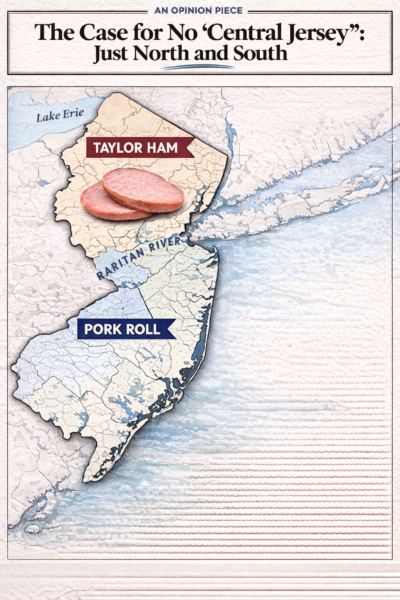
If the map still feels debatable, proponents of the two-region theory point to a simpler cultural litmus test: what residents call their breakfast meat.
North Jersey calls it “Taylor ham.” South Jersey calls it “pork roll.” There is no widely accepted third term—and no middle ground. The terminology changes abruptly depending on location, reinforcing a clear cultural boundary rather than a blended central identity. That is proof enough that there is no Central Jersey, because if there was, they could call it something else, for sure.
Supporters of this view argue that if “Central Jersey” truly existed as a distinct region, it would produce its own naming convention. Instead, it falls into one side or the other, depending on who you ask.
A two-region standard
Using geography, infrastructure, and culture together, advocates say New Jersey is best understood as a two-part state. The Raritan River provides a clear dividing line, historical systems like area codes support the split, and everyday language—down to breakfast orders—confirms it.
Under that framework, the absence of a third, distinct cultural marker becomes the argument itself: without a unique identity, “Central Jersey” is less a region and more a modern label applied to an in-between space.