
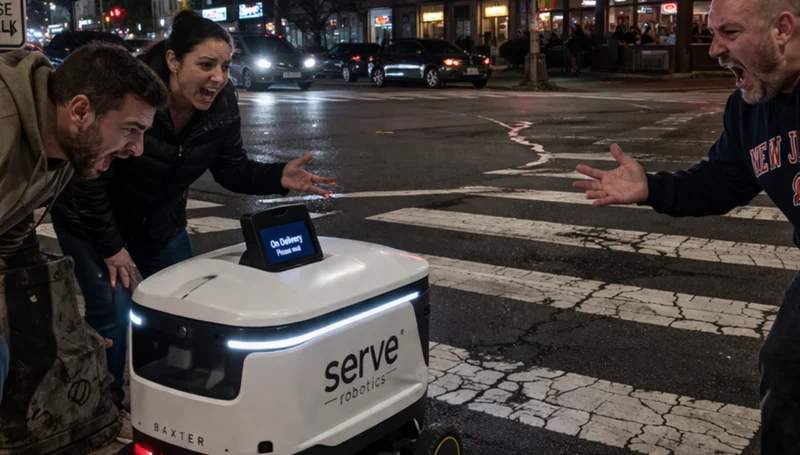
Man confronts delivery robot stalled at crosswalk in viral street encounter. Exchange highlights real-world limits of autonomous food delivery systems
Chicago, IL – A confrontation between a pedestrian and an autonomous delivery robot has drawn attention online, highlighting the practical limitations of sidewalk robotics in everyday urban environments and the replacement of human workers by faulty AI-driven robots.
In the video, a man is seen arguing with a Serve Robotics delivery unit—identified in the clip as “Mingo”—as it waits at a crosswalk, unable to proceed without a pedestrian pressing the button. The man refuses, repeatedly telling the robot to “press it yourself” and criticizing the technology for replacing human workers even as it still relies on human infrastructure to function.
The robot remains stationary throughout the exchange, unable to activate the crosswalk signal on its own despite the green traffic light.
NEW: Man completely loses his mind after a food delivery robot asked him to press the cross walk button for it pic. /shyKd5kHuH
— Crime Net (@TRIGGERHAPPYV1) March 25, 2026
Technology meets infrastructure limits
Serve Robotics operates autonomous, Level 4 delivery robots in several major U.S. cities, including Chicago, Los Angeles, Miami, and Dallas-Fort Worth. The units are designed to transport food orders—primarily through Uber Eats—within a roughly 1.25-mile radius using sidewalks and pedestrian pathways.
However, the incident highlights a key operational challenge: robots must still navigate infrastructure designed for humans. Crosswalk buttons, uneven sidewalks, and unpredictable pedestrian behavior can create obstacles that require either human assistance or advanced system workarounds.
Key Points
- Delivery robot stalled at crosswalk prompts confrontation with pedestrian
- Robots rely on human infrastructure, like crosswalk buttons to navigate
- Incident highlights broader limitations of autonomous delivery systems
Growing presence, ongoing questions
Serve Robotics has expanded rapidly, including a rollout across 14 Chicago neighborhoods in late 2025. Hundreds of units are also operating in parts of California and Florida, with additional markets launching in 2026.
The company’s model depends on fully autonomous navigation, but encounters like this illustrate the gap between controlled testing environments and real-world conditions. While the robots can avoid obstacles and follow routes, they remain dependent on systems that are not yet fully automated.
As cities continue integrating robotic delivery services, the interaction between human behavior and machine limitations is expected to remain a key factor in how widely the technology can scale.
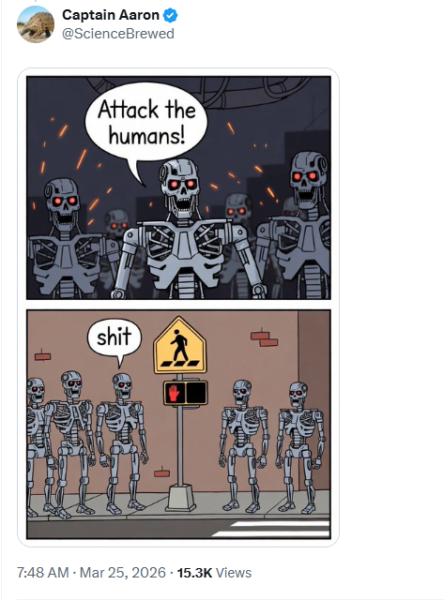
At this time, there is no progressive movement to make AI bots a protected class under local and state hate crime laws…but it’s early.