
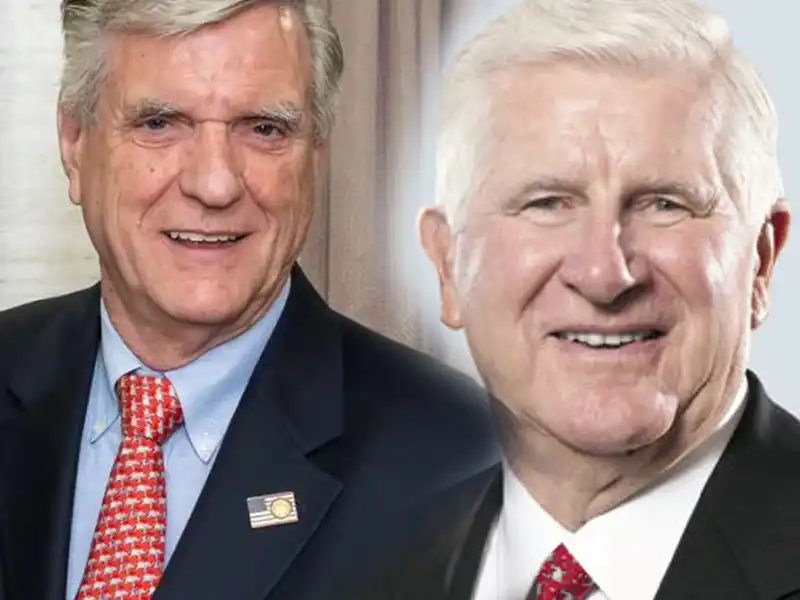
TOMS RIVER, N.J. – Toms River council members aligned with former Mayor Mo Hill have voted to block Mayor Dan Rodrick’s attempt to save hundreds of thousands of dollars and cut ties with an insurance broker under investigation by the state of New Jersey, whose CEO was indicted for racketeering.
In a contentious decision that has drawn scrutiny from both local taxpayers and state watchdogs, the Toms River Township Council voted 4–3 this week to renew the town’s membership in the Ocean County Joint Insurance Fund, a move that keeps the township’s four million-dollar insurance portfolio under the management of a firm connected to Democratic power broker George E. Norcross III.
It was great news for Ocean County GOP Chairman George Gilmore who works as a political lobbyist for Norcross’ brother Phillip and has a close relationship with company chairman Joseph Buckelew.
Toms River Mayor Dan Rodrick, a Republican, and his fellow Republicans on the council, Lynne O’Toole, Harry Aber, and Craig Coleman, voted against renewing the policy with the politically connected firm, which is under state investigation over allegations of unfair and potentially unethical government contracting services.
The vote followed weeks of debate over whether the township should sever ties with the fund in light of ongoing investigations into its management company, PERMA Risk Management Services, and its affiliated insurance brokerage, Conner Strong & Buckelew. Both firms were named in a 2025 report by the New Jersey Office of the State Comptroller (OSC), which accused them of undisclosed conflicts of interest and improper contracting practices involving public health insurance funds across the state.
Mayor Dan Rodrick urged the council to shift to a different joint insurance fund, claiming that doing so could save Toms River between $900,000 and $1.5 million over the next three years.
“We have a responsibility to taxpayers to ensure every dollar is spent transparently and effectively,” Rodrick said during the meeting. “There are other options available that are both compliant and cost-effective.”
Despite those concerns, four members of the council—three of whom were newly elected in November—voted to stay with the Ocean County Joint Insurance Fund, joining veteran councilman Tom Nivison to form the majority.
At the heart of the controversy is the relationship between PERMA and Conner Strong & Buckelew, two firms that, according to the OSC, have long operated as “separate” entities while effectively functioning as a single business enterprise. The September 2025 report detailed how employees of both companies allegedly shared roles, resources, and clients, blurring the lines between public fund administration and private brokerage services.
That firm has strong ties to local GOP power brokers, convicted Ocean County GOP Chairman George Gilmore, his mentor, retired GOP Chairman Joe Buckelew and former township business administrator Paul Shives, according to Rodrick.
Multiple former GOP elected officials have told Shore News Network that they suspect Chairman Gilmore receives financial incentives for towns who stay with the company.
The comptroller’s investigation found that a PERMA employee, who was also a shareholder in Conner Strong, oversaw procurement processes that directed lucrative insurance contracts to Conner Strong.
The report concluded that this structure created a “covert takeover” of public insurance operations by a private entity, eliminating competition and placing public funds at risk.
Further, the OSC criticized the joint insurance funds involved for failing to adopt required corrective action plans within 60 days of the report’s release. In November, a follow-up letter from the comptroller noted that no substantial reforms had been made to address the conflicts of interest or improve transparency in contract oversight. As a result, the matter was referred to the New Jersey Departments of Banking and Insurance and Community Affairs for additional review.
The Ocean County Joint Insurance Fund, like many others in the state, was established to help local governments collectively manage risk and share the cost of insuring municipal employees and properties. Toms River has participated in the program for years, paying millions annually in premiums and administrative fees.
Now, it is a monopoly, operated by some of the most influential Democrat lobbyists and powerbrokers in New Jersey, according to the state.
Representatives for Conner Strong & Buckelew and PERMA have consistently denied any wrongdoing. In statements issued after the comptroller’s report, the firms called the findings “false, politically motivated and misleading,” arguing that the OSC “misunderstood the structure and purpose of joint insurance funds.” The companies also said that previous reviews by state regulators found them in compliance with existing laws and contracting standards.
George E. Norcross III, the founder of Conner Strong & Buckelew, is one of New Jersey’s most influential Democratic figures, long regarded as a central player in the state’s political and business circles. His company manages billions in insurance assets for public and private clients across New Jersey, Pennsylvania, and Delaware.
While Norcross himself was previously indicted on unrelated corruption charges—charges he has vigorously denied—the insurance firms have continued to operate and expand, maintaining offices in Camden, Philadelphia, and New York.
The vote leaves Toms River aligned with dozens of other New Jersey municipalities that continue to rely on PERMA-managed insurance funds despite the ongoing oversight by the state. The comptroller’s office has not announced any further enforcement actions but has indicated that it continues to monitor compliance efforts among the affected funds.
As the township enters a new fiscal year, the debate over how to balance fiscal responsibility with transparency in public contracting is likely to persist. For now, the council’s decision ensures that Toms River’s insurance coverage will remain under the same management structure that has drawn scrutiny from state investigators and watchdog groups alike.