
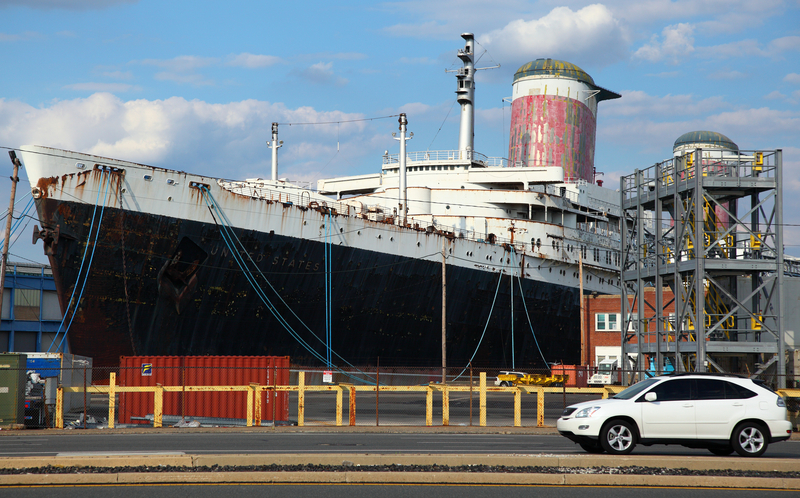
Philadelphia Police are searching for suspects involved in a burglary aboard the historic S.S. United States on Pier 82. The incident occurred in the early hours of October 2, 2024, at around 1:40 AM. According to surveillance footage, the suspects were seen accessing the ship at 2205 S. Christopher Columbus Boulevard without authorization.
The suspects spent approximately three hours inside the vessel before being recorded leaving with several stolen items. Authorities have yet to release further details about what was taken, but they urge anyone with information to come forward.
The S.S. United States, once the fastest ocean liner in the world, has been docked in Philadelphia for decades and is a National Historic Landmark. Burglary at such a significant site adds a layer of urgency to the investigation.
If you have any tips, contact the Philadelphia Police Department’s 3rd District or submit an anonymous tip online.
SS United States: A Record-Breaking Liner’s Rise and Decline
Once the pride of American maritime engineering, the SS United States captured the world’s attention during her maiden voyage from July 3 to July 7, 1952. The sleek liner shattered the eastbound transatlantic speed record, covering the distance from New York Harbor to Bishop Rock, off the coast of Cornwall, UK, in 3 days, 10 hours, and 40 minutes. Averaging a speed of 35.59 knots (65.91 km/h; 40.96 mph), she surpassed the record held by the British liner RMS Queen Mary for the previous 14 years by more than 10 hours, earning the coveted Blue Riband for the fastest Atlantic crossing.

Upon her return voyage to New York, United States broke the westbound transatlantic speed record as well, completing the trip in 3 days, 12 hours, and 12 minutes, at an average speed of 34.51 knots (63.91 km/h; 39.71 mph). This double triumph was celebrated upon her arrival in New York, where a flotilla of boats, helicopters, and thousands of onlookers greeted her. The ship’s owners were awarded the Hales Trophy, a symbol of Blue Riband achievement.
The United States‘ success was carefully managed. William Francis Gibbs, the ship’s designer, instructed the crew not to push the ship to its maximum speed during the maiden voyage, breaking the record by a “reasonable amount” of speed to leave room for a future, even faster record. Concerns over safety also played a role in holding back the ship’s true capabilities, as the operators took lessons from past maritime disasters like the sinking of the Titanic.
Peak Popularity and Prestige
Throughout the 1950s and early 1960s, the SS United States became the dominant transatlantic liner, offering luxury and speed on regular voyages between New York, Southampton, and Le Havre, with occasional stops in Bremerhaven. Her passenger list boasted celebrities such as Marilyn Monroe, Judy Garland, and Duke Ellington. Walt Disney even featured the ship in his 1962 film Bon Voyage!.
United States Lines, the ship’s operator, hoped to build on this success by adding a “running mate” liner to its fleet. However, the plan to construct SS President Washington fell through due to a lack of government funding. Despite the ship’s fame and profitability, the rapid rise of air travel, specifically jet aircraft, began to erode the dominance of ocean liners. By 1957, more passengers crossed the Atlantic by air than by sea.
Decline Amidst Changing Times
As passenger numbers declined, SS United States faced increasing challenges in the 1960s. Strikes by unions such as the Masters, Mates, and Pilots Union disrupted voyages, damaging the ship’s reputation. The U.S. government’s decision to stop using ocean liners to transport military personnel and their families in 1961 dealt a significant blow, with air travel deemed a safer and faster option.
In an effort to stay competitive, United States Lines explored converting United States into a cruise ship, offering Caribbean voyages during the winter months. However, the company’s financial situation prevented significant refurbishments, and the ship struggled to compete with newer, more modern liners like SS France. By the late 1960s, the SS United States was operating at a loss.
In 1969, after completing her 400th voyage, the ship was laid up in Newport News, Virginia, and taken out of service. The ship’s unexpected retirement came as a shock to passengers and crew alike. All of the ship’s furnishings were left in place, and her funnels were only half-painted before work suddenly stopped.
An Uncertain Future
In the years following her retirement, various plans to repurpose the SS United States were proposed but ultimately failed. In the 1970s, the U.S. Navy considered converting the ship into a hospital ship, but the project was deemed too expensive. In the 1980s, the ship was sold to a developer who planned to transform her into a floating condominium, but the venture collapsed. The ship’s interior was stripped during asbestos removal in the 1990s, leaving her a hollow shell.
Despite several attempts to save her, including preservation efforts by the SS United States Conservancy, the ship remains laid up in Philadelphia, deteriorating after years of neglect. She continues to stand as a symbol of America’s maritime past, with many hoping for her eventual restoration and revival.