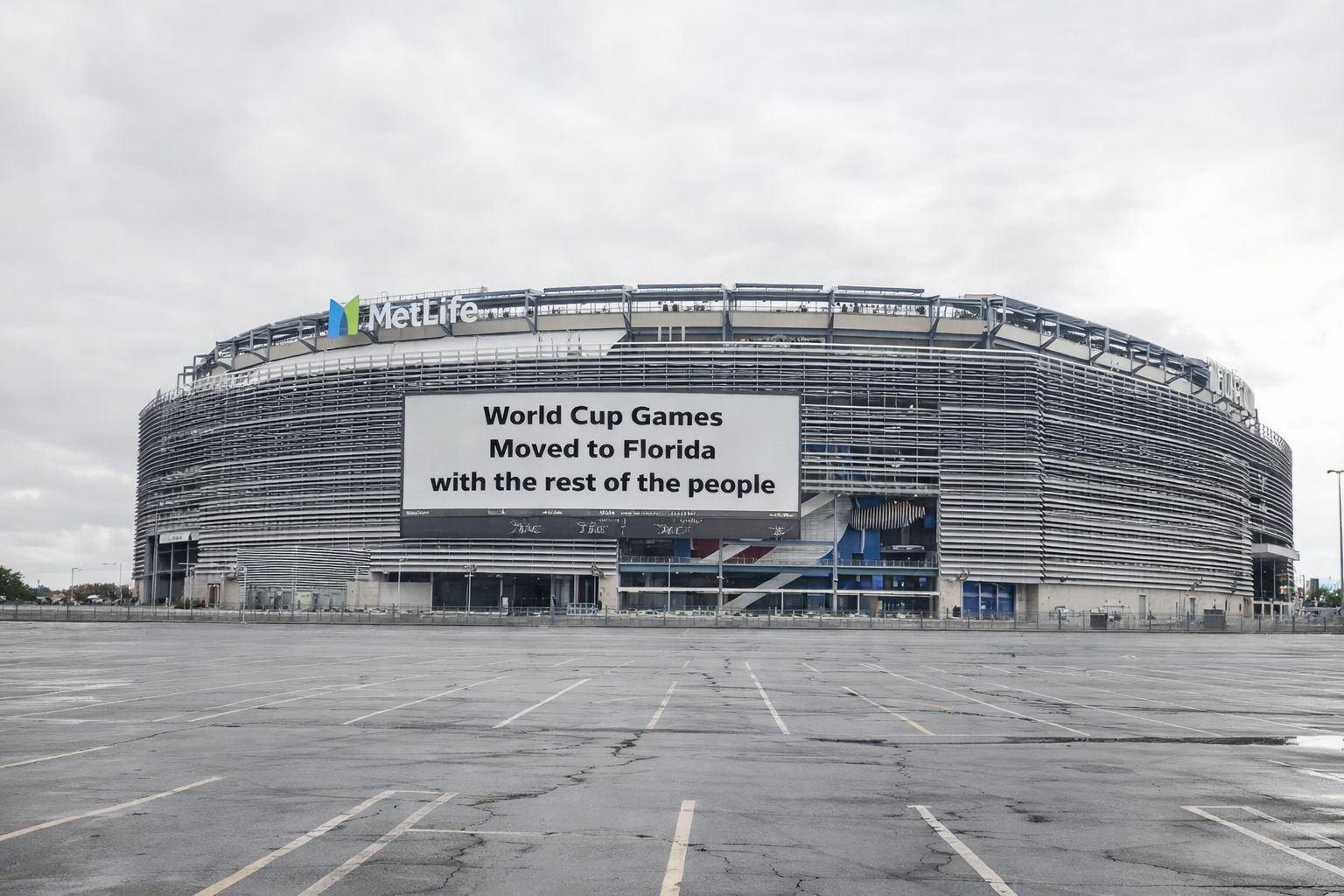
FIFA faces growing pressure over New Jersey World Cup deal after Sherrill challenges transport costs and FIFA ‘surprised’ by governor’s war of words in the public.
East Rutherford, New Jersey — A high-stakes dispute between FIFA and New Jersey over World Cup transportation funding is testing the limits of host city contracts, raising a consequential question for the 2026 tournament: how much leverage does the governing body actually have if a host pushes back publicly—and politically—on its obligations.
At the center of the conflict is New Jersey Governor Mikie Sherrill’s unusually direct criticism of the existing host city arrangement, particularly the expectation that local authorities shoulder tens of millions in transportation costs tied to matches at MetLife Stadium. FIFA, in turn, has signaled that it views those responsibilities as already agreed upon within the Host City Agreement framework, expressing surprise at the state’s public stance.
A contract built on obligations—and enforcement
The legal backbone of FIFA’s position lies in the Host City Agreement (HCA), a dense and largely non-public contract that governs every aspect of tournament delivery. While no single clause explicitly states that FIFA can “drop” a host city at will, the authority emerges from a combination of enforcement mechanisms embedded throughout the agreement.
Chief among them is a “termination for default” structure. Under this framework, FIFA can take action if a host city fails to meet what the contract defines as a “material breach”—a failure significant enough to jeopardize the ability to stage matches according to FIFA standards.
Transportation falls squarely within those obligations. FIFA categorizes it under “mobility and accessibility requirements,” which encompass not only moving fans efficiently but ensuring the broader operational flow of the event.
The process is not arbitrary. It follows a structured escalation:
- FIFA identifies a material breach
- A formal “notice to cure” is issued
- The host is given a defined period to fix the issue
- Failure to resolve can trigger withdrawal of matches or termination
Language in past agreements reinforces this authority, including provisions allowing FIFA to “revoke the right to host matches” or “relocate matches to another venue” if requirements are not met.
Just as important is the so-called “FIFA supremacy” clause, which effectively places tournament requirements above local policy conflicts when those conflicts interfere with delivery.
The dispute: cost, fairness, and public pressure
What makes the New Jersey situation unusual is not the existence of these clauses—it’s the willingness of state leadership to challenge the deal in public, rather than negotiate quietly behind closed doors.
Sherrill has framed the issue as a matter of taxpayer protection, arguing that the current arrangement forces residents to subsidize a massively profitable global event.
“Our administration inherited an agreement where FIFA is providing zero dollars for transportation,” she said. “I won’t stick New Jersey commuters with that tab for years to come. That’s not fair.”
She has gone further, stating: “FIFA should pay for the rides, but if they don’t, I’m not gonna let New Jersey commuters get taken for one.”
The financial stakes are not trivial. The state faces an estimated $48 million transportation burden tied to eight matches. Proposed fare increases—reportedly rising to around $100 per train ticket from roughly $12.90—have intensified the political pressure, especially in a region where public transit is essential to event access.
Federal voices have joined the criticism. Senator Chuck Schumer has called on FIFA to absorb transportation costs, arguing that fans should not face inflated prices to attend matches tied to an organization projected to generate approximately $11 billion in revenue.
From a political standpoint, the framing is clear: local taxpayers versus a global sports entity with vast commercial earnings.
FIFA’s position: obligations already accepted
FIFA’s response has been more restrained but no less pointed. A spokesperson indicated the organization was “surprised” by New Jersey’s approach, emphasizing that transportation responsibilities were part of the original hosting commitments.
The governing body has also highlighted a key contractual evolution. Earlier host agreements required free public transportation for fans, while a 2023 adjustment allowed transport to be provided “at cost.” That change, FIFA suggests, already reflects flexibility in response to financial pressures.
In other words, from FIFA’s perspective, this is not a new demand—it is an existing obligation that has already been modified once to accommodate host concerns.
———
Key Points
• FIFA contracts allow match relocation only after a formal breach and cure process
• New Jersey faces an estimated $48 million transportation cost for eight matches
• Political leaders argue FIFA should cover costs given projected $11 billion revenue
———
Can FIFA realistically drop New Jersey?
The legal answer is yes—but only under extreme and highly structured conditions. The practical answer is far more constrained.
To invoke its contractual rights, FIFA would need to demonstrate that New Jersey is either unable or unwilling to provide functional transportation in a way that materially impacts tournament operations. A political disagreement over funding, by itself, does not meet that threshold.
Even if tensions escalated, the cure process would provide time—and pressure—for a resolution before any drastic action.
More importantly, the strategic reality makes removal extraordinarily unlikely.
MetLife Stadium is not just another venue; it is slated to host the 2026 World Cup final. That designation carries enormous weight, tying the location to global broadcast infrastructure, sponsorship activations, security planning, and international logistics.
Relocating the final would trigger cascading complications:
- Reworking international travel and accommodation systems
- Reconfiguring broadcast operations and technical infrastructure
- Adjusting security coordination across federal, state, and local agencies
- Renegotiating commercial agreements tied to the New York media market
The financial and reputational cost of such a move would be immense—not just for FIFA, but for partners and stakeholders across the tournament ecosystem.
The leverage game behind the headlines
What is unfolding is less a countdown to removal and more a high-profile negotiation playing out in public.
FIFA’s leverage comes from contractual authority and the implicit threat—however unlikely—of enforcement. New Jersey’s leverage comes from political pressure, public opinion, and the logistical centrality of its venue.
Neither side benefits from escalation to the point of rupture.
For FIFA, losing the New York/New Jersey market would undermine one of the tournament’s most valuable commercial anchors. For New Jersey, walking away from hosting—or failing to meet obligations—would carry its own economic and reputational consequences.
That dynamic typically leads to compromise.
Historically, disputes surrounding mega-events like the World Cup or Olympics often follow a familiar pattern: public posturing, political intervention, and eventual behind-the-scenes negotiation resulting in shared costs, adjusted terms, or external funding support.
What happens next
The most likely outcome is not termination, but recalibration.
Options on the table could include:
- Cost-sharing arrangements between FIFA and local authorities
- Federal or regional subsidies to offset transportation expenses
- Adjusted fare structures that balance affordability with cost recovery
What remains clear is that the dispute has exposed a broader tension inherent in global sporting events: the balance between private profit and public cost.
New Jersey’s challenge has brought that tension into sharper focus than usual, forcing FIFA to defend not just its contracts, but its expectations of host cities in an era of increasing financial scrutiny.
For now, the tournament remains on track, and MetLife Stadium’s role as the World Cup final venue is unchanged. The contract mechanisms exist, but they are designed as last resorts—not first responses.
The case’s current status is an active political and contractual dispute, with no formal breach declared and no indication that FIFA has initiated enforcement proceedings.