
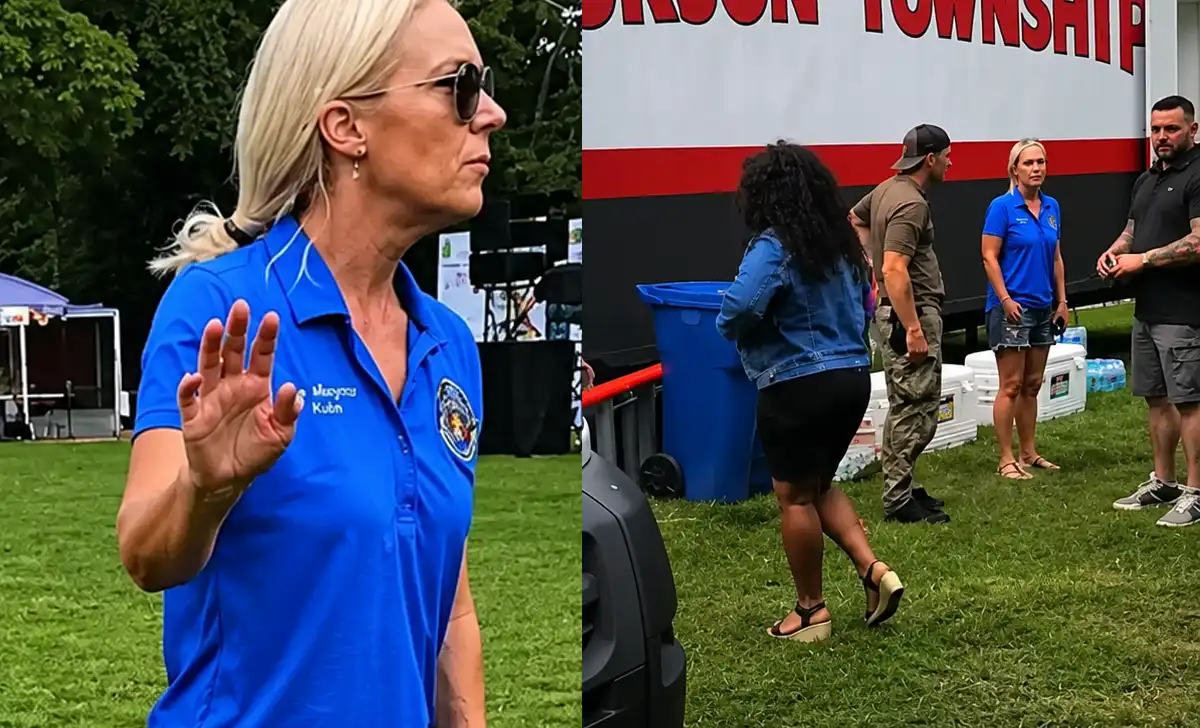
JACKSON TOWNSHIP, N.J. – What started out as a simple question asked at a public event inside a public park in Jackson Township escalated when Interim Mayor Jen Kuhn called the police on a disabled Marine Corps veteran who just wanted an answer to a simple question.
“Can you help me?”
That’s all Steven Wronko, a U.S. Marine who holds municipal government officials accountable statewide, wanted an answer. Instead, Kuhn got on her radio and called for police to dispatch one of the state’s most notorious defenders of the Open Public Records Act, and political corruption fighters.
Kuhn said she felt threatened by the disabled veteran, citing that Jackson Day was not the place to ask such questions. Prior to the event, Kuhn and her team, which includes two retired police officers, John Pejoski and Brian McCarron, invited the public to come to Jackson Day and ask them questions.
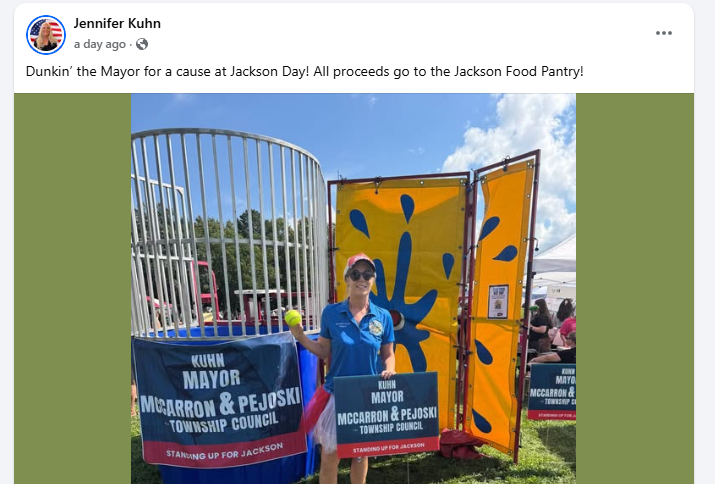
The encounter unfolded Sunday during Jackson Day, where Kuhn was greeting residents while also campaigning for reelection alongside council candidates John Pejoski and Brian McCarron.
Wronko, a disabled Marine Corps veteran known statewide for public-records litigation, approached the mayor to ask about an OPRA request seeking records related to her Facebook page that had been denied by the township.
On Monday, Wronko explained to Podcaster Michael Caldarise on the Caltrops podcast why he wanted those records. Wronko believes that township employees are being paid to manage and post on Kuhn’s personal Facebook account. That account routinely posts about politics and municipal events. Under case law, brought by Wronko himself, that account is subject to the rules of the New Jersey Open Public Records Act.
Wronko said he came to Jackson to meet the people in Jackson who were upset over how Kuhn was running the town, but wasn’t planning on meeting or questioning Kuhn until he saw her, so he asked her, “Will you help facilitate that denied OPRA request?”
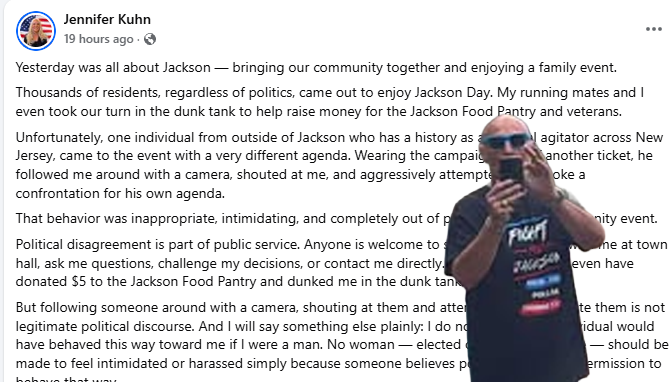
The interaction remained entirely verbal, but Kuhn told Wronko she felt threatened and summoned law enforcement. Officers questioned Wronko, directed him away from an area near an emergency command vehicle, and later responded to his request to file an Internal Affairs complaint. No arrests, summonses, or criminal charges resulted from the incident.
“They told me it was a restricted area, but kids are all walking through,” Wronko said on the podcast. “It was selective enforcement.”
He also said the cops who interacted with him were not wearing Body Worn Cameras, which is a violation of state law under the New Jersey Attorney General’s guidelines. He is now requesting an internal affairs investigation and access to the body worn camera footage worn by other officers who witnessed the interaction.
At one point, Kuhn ran for shelter inside the Ocean County Sheriff’s Department OEM Mobile Command Center and snapped a photo. Wronko is now requesting access to Kuhn’s phone for other photos she may have taken of him from inside that center and texts she may have sent.
A Simple Question About Public Records
According to Wronko, his goal was straightforward.
“At Jackson Day, I approached Mayor Kuhn and asked a simple question: could she facilitate getting the record responsive to my OPRA request to the appropriate records custodian?” Wronko later wrote in a detailed statement following the encounter.
“At first, there was no issue. I was not recording, yelling, threatening, or acting aggressively.”
Video of the encounter shows Wronko initially speaking casually with Kuhn about a church event before asking, “So, can you facilitate me getting your Facebook stuff?”
Kuhn immediately responded, “You’re getting in my face and I feel very attacked.”
Wronko replied, “I’m five feet away.”
The mayor answered, “You weren’t before you started recording.”
As the discussion continued, Wronko repeatedly returned to the same question.
“Can you facilitate that so I can get it?”
Kuhn responded, “Sir, this is not the time or the place.”
Wronko answered, “Sure it is. This is a Jackson event. This is a question of the mayor. It’s a redress of my government.”
Shem-tov responds
Elliott Shem-Tov who is running against Kuhn for mayor said the interim mayor completely mishandled the situation and instead of de-escalting the incident, escalated it unecessarily.
“I wouldn’t have responded like that. I would have told him nicely that he can call my office on Monday, we’ll discuss it,” Shem-Tov said. “She could have de-escalated it, shaken his hand, and walked away.”
Shem-Tov said he also has questions about the mayor’s Facebook pages which were created using township resources and staffed by township employees.
What is Wronko v. Carteret?
A New Jersey judge ruled that Carteret Mayor Daniel Reiman’s personal Facebook page was subject to the state’s Open Public Records Act (OPRA) because he used it to conduct official government business, and ordered the borough to hand over a list of users the mayor had blocked.
Many in Jackson speculate that Jackson Township Council President Mordechai Burnstein also has access to Kuhn’s mayoral Facebook page, an accusation Burnstein denied.
Shore News Network can independently confirm that a secretary who works in Kuhn’s real estate office had administrative access to the mayor’s official township account when it was created and posted as the mayor. That secretary was reportedly hired by the mayor as her secretary inside the town hall afterward.
Why the Facebook Records Matter
The disagreement centers on records associated with Facebook pages Wronko said are being used to conduct official township business.
“When I mentioned the Facebook record, she responded, ‘My personal Facebook page?'” Wronko wrote afterward.
“Calling a Facebook page ‘personal’ does not automatically make records connected to official government activity private.”
He argues that when elected officials use social media “to discuss township business, promote government events, communicate official information, or interact with the public in an official capacity, records associated with that activity may be subject to public-access requirements.”
That legal question remains unresolved in Jackson Township.
The township denied Wronko’s OPRA request, while Wronko maintains the records should be produced because the page is used for governmental purposes.
No Stranger to OPRA Litigation
Wronko is not simply another resident filing an OPRA request.
The disabled Marine Corps veteran has spent years litigating public-records disputes throughout New Jersey and has developed a reputation for prevailing in court against municipalities that improperly deny records.
One of those municipalities was Jackson Township.
In 2017, Wronko successfully sued Jackson after officials denied one of his OPRA requests. The Superior Court ruled in his favor, finding the township improperly withheld public records and ordering compliance with the law.
Even more significant is Wronko v. Borough of Carteret, an appellate decision that has become part of New Jersey OPRA case law.
The case is routinely cited by attorneys and courts in disputes involving electronic public records and government communications maintained through modern technology. A class on Wronko’s lawsuit is taught annually at the League of Municipalities event in Atlantic City.
During Sunday’s encounter, Wronko referenced that precedent while discussing Kuhn’s Facebook page.
“Wronko v. Borough of Carteret is one New Jersey matter addressing social-media records in the public-records context,” he wrote.
The Conversation Changed
According to Wronko, the tone shifted once Kuhn recognized him.
“The interaction changed when Mayor Kuhn realized who I was.”
“She then said Jackson Day was not the appropriate place to ask questions.”
Wronko disagreed.
“But she was there as Mayor, walking around a public event, interacting with residents and answering questions.”
“Jackson Day was held in a public park, a traditional public forum for speech and assembly.”
He continued asking one question.
“I continued pressing one question: could she facilitate getting the requested public record to the proper custodian?”
“I was not loud. I was not aggressive. I did not threaten her.”
Police Called to the Scene
Video shows Kuhn walking away from the conversation and requesting assistance.
Wronko says that was the point he decided to begin recording.
“Mayor Kuhn then went to a golf cart, picked up a radio, and requested law-enforcement assistance. At that point, for my own protection, I began recording.”
As officers approached, Wronko continued explaining why he believed he had done nothing wrong.
“I’m asking her a question,” he said in the recording.
“How come I can’t get an open request?”
“It’s supposed to be a fun day. So I can’t get an open request?”
“I’m asking you for information.”
He later remarked into the camera, “Here she is running away. She doesn’t want to answer questions. She doesn’t want to facilitate me getting a public records request.”
Conflicting Accounts
Kuhn later described the encounter much differently as is her normal style. She attacked Wronko and accused him of stalking her.
On Facebook, she wrote that Wronko “followed me around with a camera, shouted at me, and aggressively attempted to provoke a confrontation for his own agenda.”
“That behavior was inappropriate, intimidating, and completely out of place at a family community event.”
She also stated, “I do not believe this individual would have behaved this way toward me if I were a man.”
Wronko later disputed that claim noting that his activism is about holding public officials accountable regardless of their gender, race, or political affiliation.
“No woman — elected official or otherwise — should be made to feel intimidated or harassed simply because someone believes politics gives them permission to behave that way,” Kuhn wrote, declaring herself a victim.
Wronko disputes every one of those allegations.
“She later characterized me as being ‘in her face,’ intimidating her, harassing her, shouting, and aggressively attempting to provoke a confrontation.”
“I dispute those claims.”
He challenged viewers to reach their own conclusions.
“Watch the video. Listen to my voice. Look at the distance between us. Identify the threat. Identify the yelling. Identify the intimidation.”
“Produce the Evidence”
Wronko is now publicly calling on township officials to preserve every record connected to the encounter.
“If evidence exists supporting those allegations, preserve it and release it: body-worn-camera footage, radio communications, dispatch records, photographs, incident reports, event video, and security plans.”
He added, “Those are serious claims.”
“Now produce the evidence.”
Police Interaction Raises Additional Questions
The encounter did not end after officers arrived. One officer advised Wronko that the area near the command vehicle was restricted.
Wronko repeatedly questioned that assertion.
“Where’s the sign? There’s no sign.”
“This is Jackson Day.”
“You have to have a sign.”
When the officer replied that it was a restricted area for the event, Wronko responded, “Show me the restricted area. Show me the signs.”
Later, another officer acknowledged that Jackson Day was being held in a public park. According to Wronko, those differing explanations only increased his concerns.
“Another officer later acknowledged that it was a public park and that people could move through it.”
“If there was a legitimate restricted area established before my interaction with the Mayor, show the security plan, signs, barriers, maps, instructions, and consistent enforcement.”
Internal Affairs Complaint
The police interaction then turned to body-worn cameras.
After noticing one officer’s camera was not activated, Wronko requested to file an Internal Affairs complaint.
“I’d like to do an IIA,” he told officers, referencing Attorney General guidelines requiring acceptance of Internal Affairs complaints.
Initially, Wronko said he was told to go to police headquarters.
He objected.
“The law says you have to take one at any time with anybody.”
Eventually, a detective advised him that a supervisor would respond and that the complaint process could begin at Jackson Day.
Wronko later praised that detective’s response.
“That’s the appropriate way to do an IIA,” he said during the recording.
Wronko later said that with few exceptions, the Jackson Police Department, once centered away from Kuhn’s inner circle of protective officers, handled the matter professionally and in accordance with state guidelines and commended them for their professionalism.
First Amendment Concerns
For Wronko, the incident extends beyond a denied records request.
“The First Amendment does not protect only agreeable speech. It protects criticism of government,” he said. “An elected official being uncomfortable with a question is not the same thing as a citizen threatening that official.”
“Persistence is not automatically harassment.”
“Recording is not automatically intimidation.”
“Criticism is not a crime.”
“This Could Have Ended in Seconds”
Wronko believes the confrontation never needed to happen.
“This entire encounter could have ended in seconds.”
“I asked: Can you facilitate getting the public record responsive to my OPRA request to the appropriate records custodian?”
“The Mayor could have said yes, no, or ‘contact the clerk.'”
“Instead, police became involved.”
That would have been the end of it. Now, the matter has escalated to a degree that Jackson Township and the mayor could not have imagined. Wronko is a known fighter and will not stop until the truth is revealed. If he was wrong, he would admit it. He feels he was right and will now pursue the matter, which he said Monday night, should not have gone that far.
Podcast Appearance
During an appearance Monday evening on the Caltrops podcast hosted by Michael Caldarise, Wronko reiterated that he was not attempting to create a confrontation.
According to Wronko, his only objective was obtaining access to records he believes are public under New Jersey law. He said he approached Kuhn seeking assistance in moving the OPRA request through the proper channels and maintained the situation escalated only after the mayor requested law enforcement intervention.
Why It Matters
The disagreement between Kuhn and Wronko reflects a broader legal issue confronting governments across New Jersey as elected officials increasingly conduct official business through social media.
Jackson has two options. The first is to simply comply with the OPRA request and admit fault. The second is to fight Wronko in court, in a case he will undoubtedly win, and Kuhn and Jackson Township will further solidify the case law settled in Wronko. vs. Carteret.
“How many more lawsuits is she going to get us in?” asked one concerned resident on Facebook. Since taking office Kuhn is the source of multiple civil rights complaints, lawsuits by employees who accuse her of abusing her power and mistreating employees, and even a tort claim where she falsely accused Shore News Network of “Blackmailing” her over a video which she provided the network which shows her in a physical argument with a family member. In that video Kuhn can be seen escalating a simple verbal disagreement into a physical assault which ended with her on the floor in her own kitchen, being pummeled by another woman.
Shore News Network recieved that video from the mayor who was fearful that her opponent would release it and wanted our opinion on how it would play out in the public eye.
We advised the mayor that it would probably not be a big deal, if anything, it could garner sympathy for the viciousness of the attack. It was the last time Shore News Network spoke to the mayor on the matter.
Months later, after Shore News Network wrote articles about the mayor using a township attorney for a private civil case, and other reports legal issues with the township, Kuhn falsely stated that I ‘blackmailed’ her and she played the victim. At that point it was nearly three months since I had a conversation with Kuhn. Despite multiple attempts to have her admit she fabricated the slanderous claim, she refuses to retract her comment.
That case will soon be brought to court, where Shore News Network will be suing Kuhn in her personal capacity, as the post had nothing to do with her mayoral duties and functions.
As for the Wronko matter, it was another case of Kuhn freaking out and overexaggerating because she was publicly challenged on municipal issues.
Whether records associated with a personally controlled Facebook account become government records depends largely on how the account is used rather than simply who owns it. Courts have increasingly examined whether communications involving official government business conducted through private accounts, personal phones, text messages, or social media platforms fall within public-records laws.
As Wronko put it, “Government business does not necessarily become private merely because it occurs through a personally controlled Facebook account, personal phone, text messages, or another non-government platform.”
“That issue should be resolved through the public-records process — not by labeling the requester an agitator.”
For now, the legal dispute remains unresolved. The requested records have not been released, no court has ruled on the current OPRA request, and both sides continue to stand firmly behind sharply different accounts of what happened at Jackson Day.