
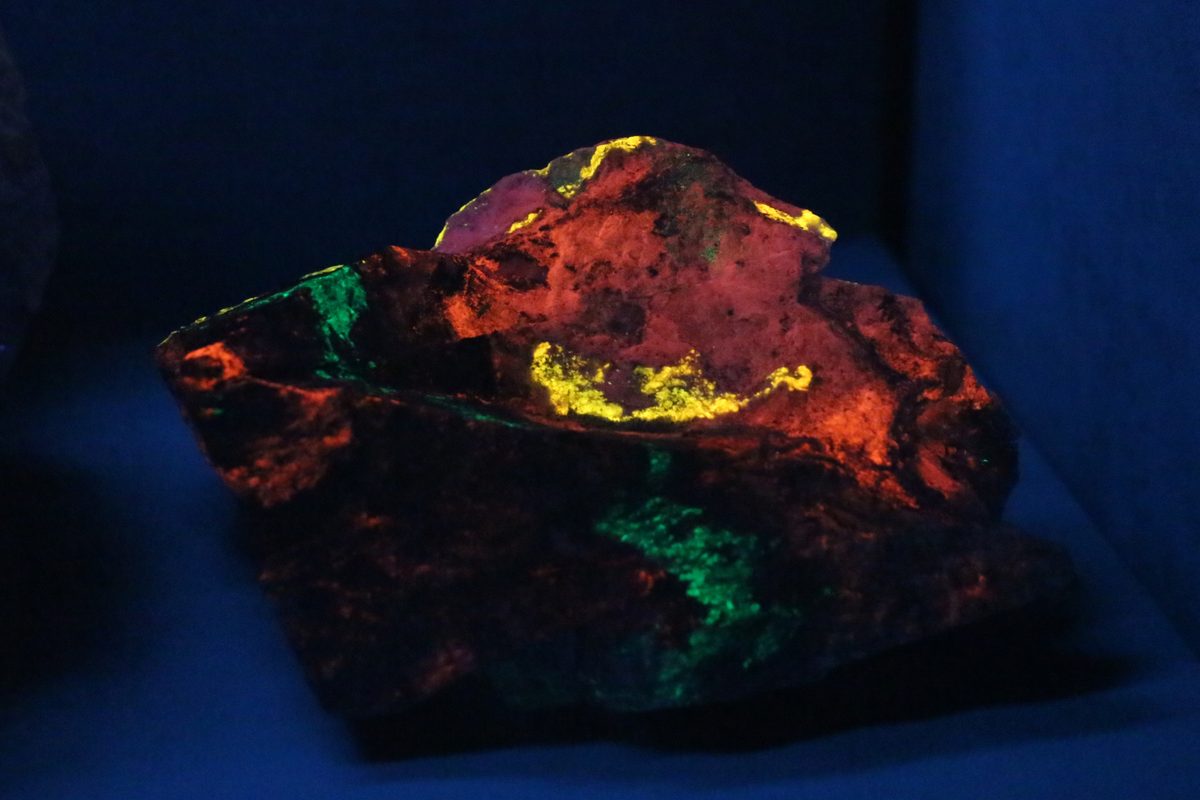
OGDENSBURG, N.J. – Deep inside an old Sussex County zinc mine, turn off the ordinary lights and New Jersey’s distant past suddenly glows.
At the Sterling Hill Mining Museum in Ogdensburg, ultraviolet light transforms otherwise ordinary-looking rock into brilliant greens and reds. The famous fluorescent minerals are remnants of geological processes that began about 1.3 billion years ago — long before dinosaurs, forests or even complex life appeared on land.
- Sterling Hill and nearby Franklin contain more than 360 identified mineral species, including roughly 90 known to fluoresce.
- The rocks containing the zinc deposits trace their origins to an ancient shallow sea about 1.3 billion years ago.
- Visitors can still walk through part of the former mine and see fluorescent ore glowing inside the Rainbow Tunnel.
An Ancient New Jersey Hidden Underground
The story of Sterling Hill starts on a New Jersey landscape that would be completely unrecognizable today.
About 1.3 billion years ago, the area was associated with a shallow sea where carbonate mud accumulated on the seafloor. Hot, metal-rich fluids moving through fractures in the Earth’s crust discharged into that environment, according to the geological history presented by the Sterling Hill Mining Museum.
When those hot fluids encountered colder seawater, dissolved metals precipitated and accumulated in layers among the carbonate sediments.
That was only the beginning.
Later continental collisions buried the rocks miles beneath the surface. Temperatures reached roughly 750 to 800 degrees Celsius under enormous pressure, transforming the original limestone into Franklin Marble and altering the metal-rich layers into the unusual zinc ores eventually mined at Sterling Hill and Franklin.
Those rocks were later uplifted and exposed through hundreds of millions of years of geological change.
Today, visitors can walk directly through part of that history.
Why Sterling Hill’s Rocks Glow
The most memorable moment for many visitors comes inside the Rainbow Tunnel.
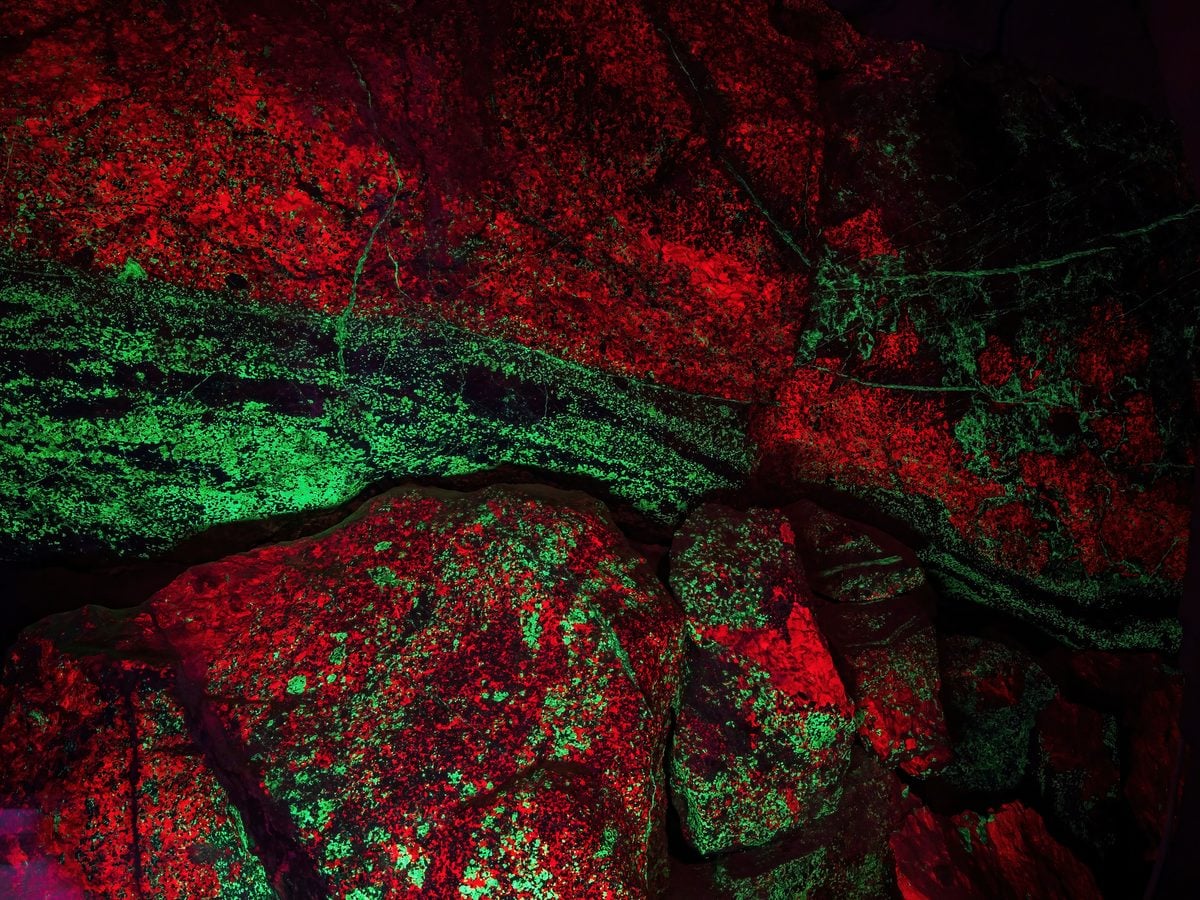
Under normal illumination, the exposed rock can look relatively subdued. When shortwave ultraviolet lights come on, sections of the mine suddenly blaze red and green.
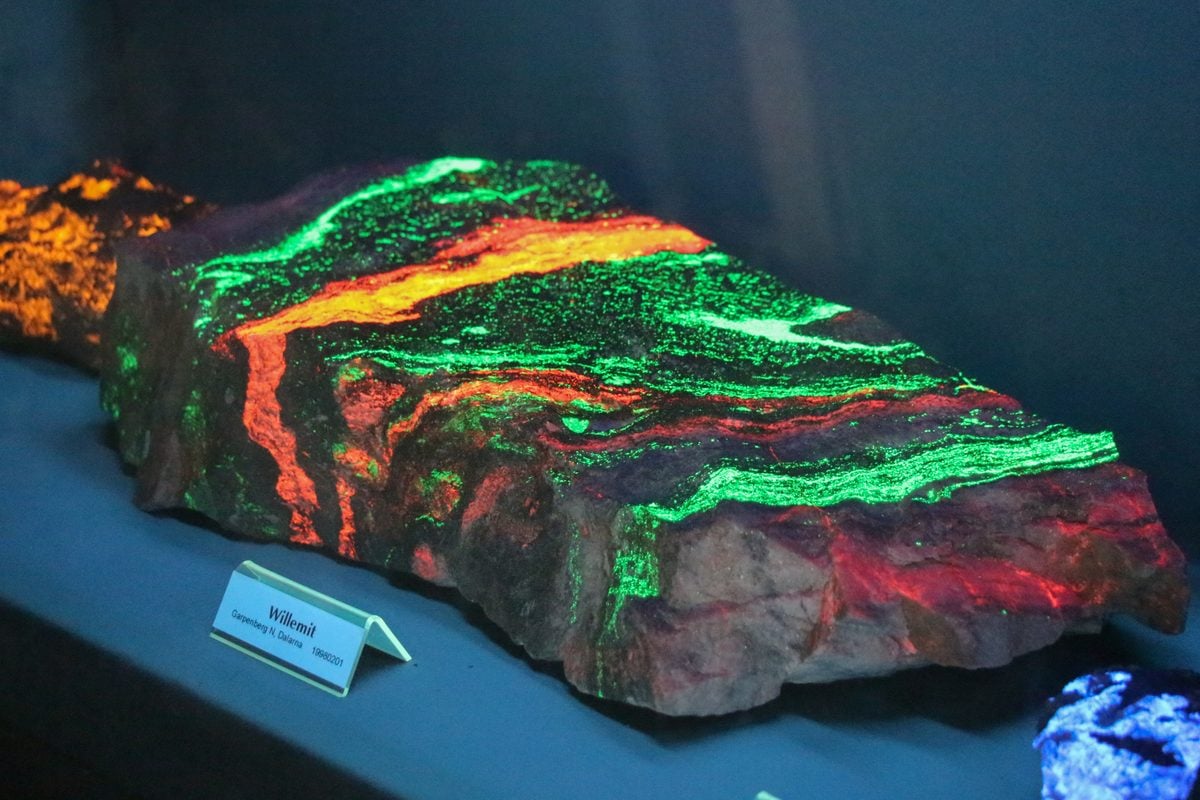
The green is primarily associated with willemite, one of the important zinc ore minerals once mined there. Red fluorescence comes from calcite.
The minerals aren’t producing that light continuously.
Ultraviolet energy excites electrons within certain minerals. As those electrons return to lower-energy states, some of the absorbed energy is released as visible light — the phenomenon known as fluorescence.
In willemite, manganese can play an important role in producing its striking green response.
And Sterling Hill has an extraordinary concentration of minerals capable of putting on that show.
Together, Sterling Hill and the nearby Franklin deposit have yielded more than 360 different mineral species. About 90 are fluorescent, and more than two dozen minerals from the area have been found nowhere else on Earth, according to the museum.
That mineral diversity has made the Franklin-Ogdensburg area internationally famous among geologists and mineral collectors.
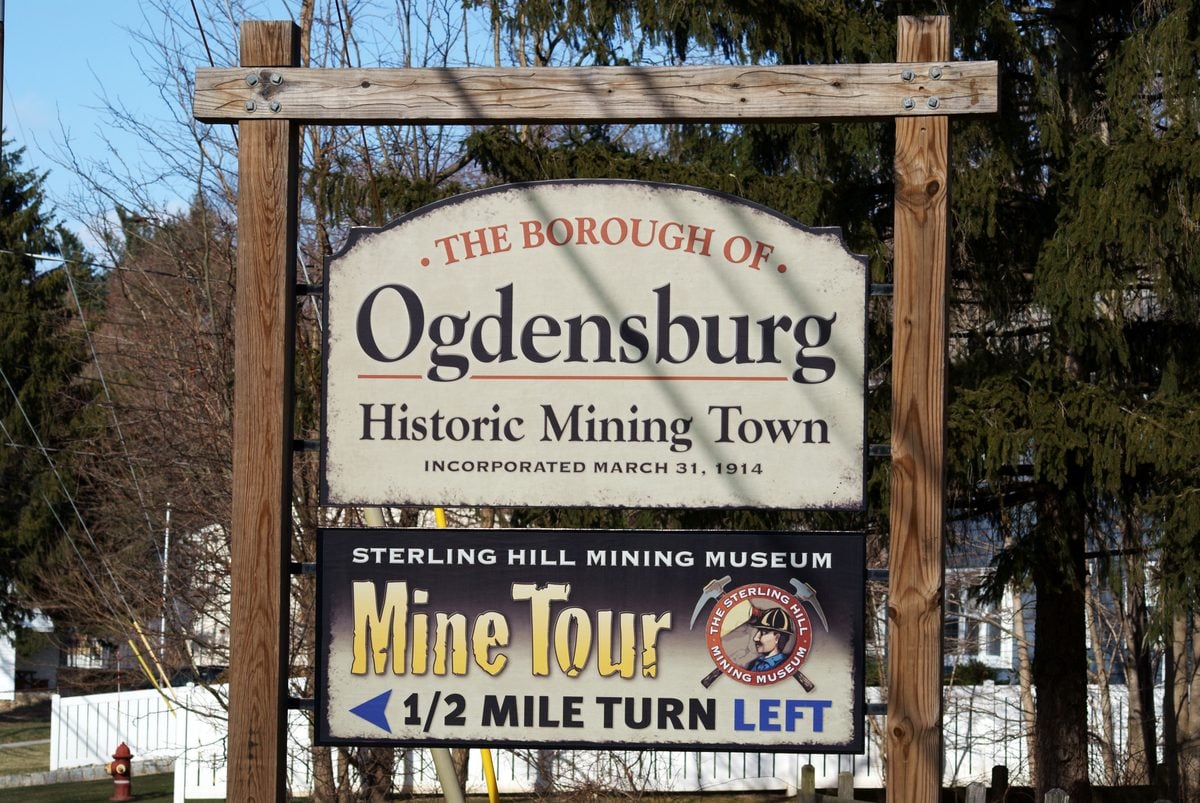
From Zinc Mine to Underground Museum
People didn’t initially understand what they had found at Sterling Hill.
Early attempts were made to extract iron and copper from local ores. By the 1800s, the importance of the area’s zinc deposits was becoming clear, and large-scale mining eventually followed.
The New Jersey Zinc Company consolidated properties in 1897 and developed Sterling Hill into a major zinc operation.
By the time the mine closed in 1986, it extended 2,675 feet underground and contained approximately 35 miles of tunnels. More than 11 million tons of zinc ore had been produced from Sterling Hill.
Most of that underground complex is now flooded.
The upper portion survived as something very different.
After the property was purchased by brothers Richard and Robert Hauck (author’s uncle) in 1989, Sterling Hill was developed as a museum dedicated to preserving the mine and teaching visitors about geology, mining and earth science.
Today’s guided underground experience takes visitors through roughly 1,300 feet of tunnel. Old mine galleries, equipment and working areas remain along the route.
Then comes the Rainbow Tunnel — where the rock itself becomes the exhibit.
One of New Jersey’s Strangest Natural Treasures
Sterling Hill’s collection extends well beyond what visitors see underground.
The Warren Museum of Fluorescence contains more than 700 fluorescent minerals and objects. Its centerpiece includes a 16-foot-wide display where specimens are illuminated under different ultraviolet wavelengths before the lights go dark to reveal the lingering afterglow of phosphorescent specimens.
Visitors interested in collecting can also search through Sterling Hill material at the Mine Run Dump. The local pile contains zinc ore taken from the mine, including material rich in fluorescent minerals.
That means a seemingly unremarkable rock picked from a pile in Sussex County can look completely different once placed beneath ultraviolet light.
And the colors are more than a novelty.
They are the visible result of atomic processes occurring inside minerals formed through a geological story stretching back roughly 1.3 billion years.
Long before there was a New Jersey, the ingredients for one of its most unusual natural attractions were already accumulating beneath an ancient sea.
Sterling Hill’s rocks are about 1.3 billion years old.
The zinc deposits are encased within ancient Franklin Marble, with their origins traced to metal-rich material deposited in a shallow marine environment.
The famous green and red colors come from fluorescent minerals.
Shortwave ultraviolet light causes willemite to glow bright green while calcite produces vivid red fluorescence inside the mine’s Rainbow Tunnel.
Visitors can still enter part of the historic zinc mine.
The museum’s guided tour covers about 1,300 feet of underground tunnel, while the deeper portions of the former 2,675-foot mine are flooded.
Sources: Sterling Hill Mining Museum; New Jersey Geological Survey; New Jersey State Museum