
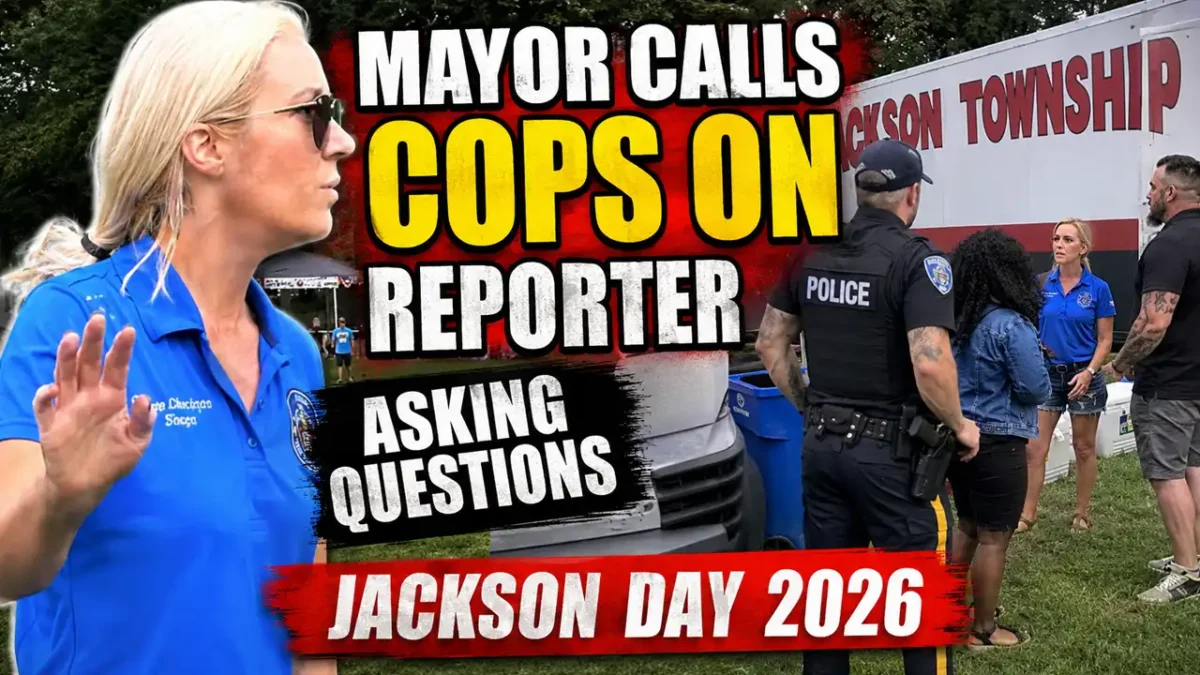
JACKSON TOWNSHIP, N.J. — The questions were about Facebook records. Then police entered the picture.
An independent journalist was pressing Jackson Mayor Jennifer Kuhn about denied public-records requests involving her mayoral Facebook page when Kuhn said she felt threatened and sought assistance from law enforcement.
What began as a verbal exchange at Jackson Day soon expanded into a dispute involving police, access to a public area and an Internal Affairs complaint request.
The Question That Sparked the Encounter
Video published by the independent YouTube channel In This Day & Age shows the reporter approaching Kuhn and asking whether she would help facilitate access to records associated with her mayoral Facebook page.
The reporter said previous requests under New Jersey’s Open Public Records Act, or OPRA, had been denied.
Kuhn asked whether he meant her “personal Facebook page.”
The reporter disputed that characterization, pointing to posts involving township business, municipal events and official announcements.
He also cited Wronko v. Borough of Carteret while arguing that a public official’s social media activity can, under certain circumstances, implicate public-records requirements.
Kuhn Says Jackson Day Isn’t the Place
As the reporter continued asking whether Kuhn would help obtain the records, the mayor repeatedly said the township celebration was not the appropriate setting for the discussion.
“This is Jackson Day,” Kuhn said during the encounter.
She told the reporter she wanted to be left alone and stated that she felt threatened.
The exchange shown in the video remained verbal. The reporter later denied being loud or aggressive and said he was simply continuing to press an elected official about records he believed should be public.
Then Law Enforcement Became Involved
After ending the conversation, Kuhn walked toward retired Jackson Police Officer Fred Meabe, who serves as the township’s Recreation Department and Special Event Coordinator.
She later entered an Ocean County Sheriff’s Office Office of Emergency Management command vehicle.
Moments later, several officers approached the reporter and began questioning him about what had happened.
That changed the nature of the encounter.
A dispute that had started with questions about Facebook records was now also raising questions about where the reporter could stand and how police would handle his presence at the public event.
A New Dispute Over Where He Could Stand
Officers directed the reporter away from the area surrounding the command vehicle, describing it as restricted.
But during the ensuing discussion, another officer acknowledged that Jackson Day was taking place in a public park.
The reporter challenged what he viewed as conflicting explanations, particularly after police tape was put up while other adults and children appeared to continue moving through the area.
He repeatedly questioned why he was being directed elsewhere if members of the public could still pass through.
Reporter Pushes Back on Mayor’s Version
In comments accompanying his video, the journalist rejected the suggestion that his conduct had been threatening.
“I spoke to her at a normal distance, not loud, not aggressive,” he wrote, adding that he had pressed Kuhn to help him obtain what he considered a public record.
He also alleged that Kuhn characterized him as having been “in her face,” an account he disputed.
Kuhn’s position during the encounter was clear: she said she felt threatened, wanted the questioning to stop and did not consider Jackson Day the proper venue for the discussion.
The reporter maintained that he was exercising his rights to question an elected official in a public place.
The Encounter Takes Another Turn
The police interaction then produced another dispute.
The reporter asked to file an Internal Affairs complaint, alleging that one officer had interacted with members of the public without an activated body-worn camera and that another initially declined to accept his complaint.
After further discussion, a detective told him that a supervisor would respond and that the complaint process could begin at Jackson Day rather than requiring him to travel to police headquarters.
No information provided about the incident indicates that the reporter was arrested, charged or issued a summons.
Why the Facebook Records Matter
At the center of the confrontation is a larger question: When does an elected official’s social media account become subject to public-records requirements?
The reporter contends Kuhn’s page was created using township resources in 2025 and managed by township employees or contractors.
He also points to its use for posts concerning township business, public events and official announcements as evidence that it functions as more than a purely personal account.
Those assertions form the basis of his argument that records associated with the page should be accessible under OPRA.
The article’s available information does not independently establish that the page legally qualifies as a government record; that remains the underlying point of dispute.
Politics Added Another Layer
The confrontation unfolded with Kuhn appearing at Jackson Day not only as mayor but also as a candidate for reelection.
She was staffing a campaign table alongside council candidates John Pejoski and Brian McCarron, both former Jackson police officers.
That setting added another dimension to an already contentious encounter involving an elected official, a journalist, public-records questions and law enforcement.
What the Video Does — and Doesn’t — Show
Based on the video and information provided, the confrontation did not become physical.
Kuhn said she felt threatened.
The reporter denied behaving aggressively.
Police responded after the mayor sought assistance, questioned the reporter and directed him away from an area near the command vehicle.
And the original question — access to records connected to the mayor’s Facebook page — remained unresolved.