



JACKSON, N.J. — As Yom Kippur approaches, a disputed 2019 animal-cruelty ordinance is again raising questions in Jackson Township: Did local officials actually ban Kaporos?
The short answer is no. While township officials tried to, religious leaders in the community put pressure on then council members, who made an exemption to the proposed ordinance banning animal cruelty.
Jackson’s Township Council adopted Ordinance 29-19, known as the Humane and Ethical Animal Rules and Treatment, or HEART, Ordinance, in November 2019. The measure established local animal-cruelty rules but included an express exemption for ritual slaughter conducted according to the requirements of a recognized faith.
The council approved the ordinance 4-1, with then-Council President Robert Nixon casting the opposing vote.
Early emails warned of a ‘Kapporos ban’
Emails obtained through a public-records request show that people reviewing early versions of the ordinance feared it could prohibit or restrict the Orthodox Jewish practice.
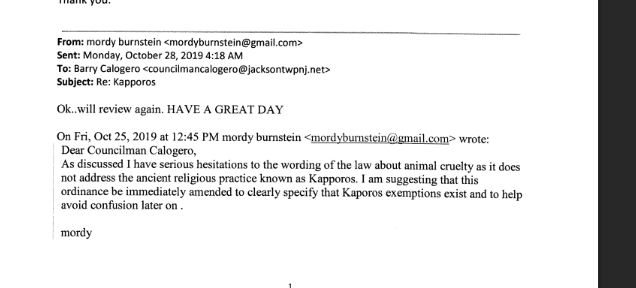
In an Oct. 25, 2019, email to township officials, Jackson resident Yehuda Tomor called the proposal a “Kapporos Ban” and warned it could amount to religious harassment if enacted without adequate protections.
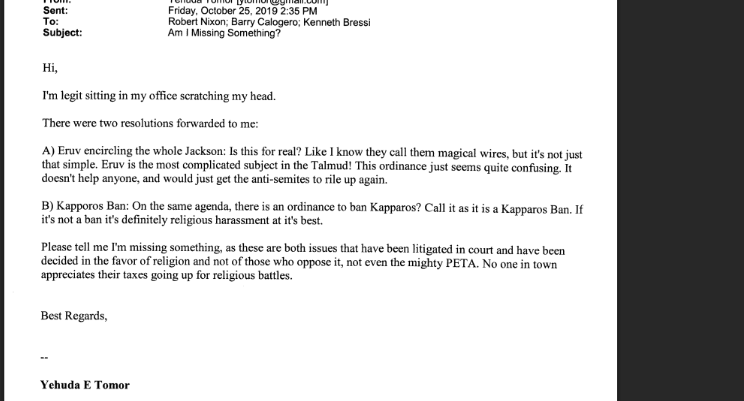
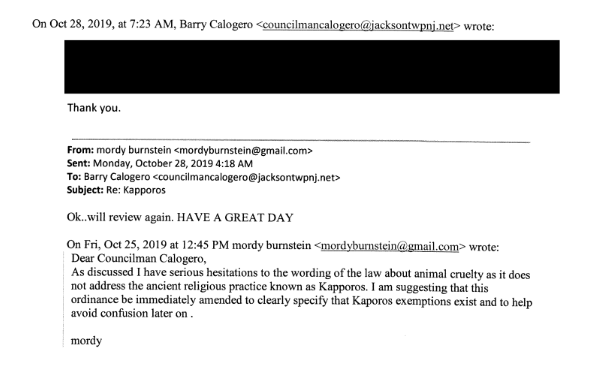
Another resident, Mordy Burnstein, wrote to then-Council Vice President Barry Calogero that the ordinance’s animal-cruelty language did not clearly address Kaporos. Burnstein urged the council to add an explicit exemption to avoid confusion and potential litigation.
The records also show the draft moving among then-Councilman Alex Sauickie, township administrators and attorney Sean D. Gertner. An Oct. 11 email referenced a fifth redlined version of the proposal.
Portions of Gertner’s legal correspondence were withheld or blacked out. The redactions appear to involve attorney-client communications, but the released pages do not disclose the substance of his advice. They therefore cannot establish whether Gertner recommended banning, restricting or expressly protecting Kaporos.
The final ordinance protected ritual slaughter
Whatever may have appeared in earlier drafts, the version introduced as Ordinance 29-19 contained direct religious-liberty language.
Section 98-62 states that nothing in the chapter may be interpreted to “prohibit, abridge, or in any way hinder” religious freedom. It exempts ritual slaughter and the preparation of livestock for ritual slaughter from the ordinance’s other provisions.
The ordinance also recognized slaughter performed under the requirements of a recognized faith by a recognized practitioner. That language was grounded in the U.S. Supreme Court’s 1993 ruling in Church of the Lukumi Babalu Aye v. City of Hialeah, which struck down local laws targeting religious animal sacrifice.

Those protections remain visible in Jackson’s codified animal regulations.
That means it would be inaccurate to say Jackson passed a ban on Kaporos or Yom Kippur. Officials considered—and ultimately adopted—a broad animal-treatment ordinance that generated serious concerns because of its potential effect on the ritual. The final text, however, included an exemption designed to prevent that result.

A 2019 Shore News Network report published when the ordinance was introduced also documented that exemption and the controversy surrounding it.
What Kaporos means before Yom Kippur
Kaporos, also spelled Kapparot or Kapporos, is not itself a Jewish holiday. It is a customary atonement ritual practiced by some Orthodox Jewish communities during the days before Yom Kippur, the Jewish Day of Atonement.
In the traditional version, a participant passes a chicken over the head while reciting a prayer. The bird is then slaughtered according to Jewish dietary law, and its value or meat is intended for charity. Many Jewish families instead perform the ritual with money, which is donated to people in need.
According to Chabad’s explanation of the custom, Kaporos is commonly performed in the early morning before Yom Kippur, though it may take place during the Ten Days of Repentance.
Yom Kippur begins at sunset on Sunday, Sept. 20, 2026, and ends after nightfall on Monday, Sept. 21.
The use of live chickens remains controversial. Animal-welfare advocates have challenged the handling, transportation and slaughter of the birds, while religious-liberty advocates maintain that governments cannot single out a faith-based practice for prohibition.
Jackson’s 2019 debate unfolded directly along that fault line.
What the historical record establishes
The available documents support three firm conclusions:
First, township officials worked on several drafts of a proposed animal-cruelty ordinance in October 2019.
Second, residents and religious-community representatives feared the initial language might interfere with Kaporos and pressed the council to include an exemption.
Third, the council passed Ordinance 29-19 only after the published version expressly protected qualifying ritual slaughter.
The withheld legal advice leaves part of the drafting history concealed. It does not change the language that was publicly introduced, adopted and placed into Jackson’s municipal code.
More coverage of the township and the surrounding Orthodox Jewish community can be found through SNN’s Jackson, Ocean County and religion archives.