
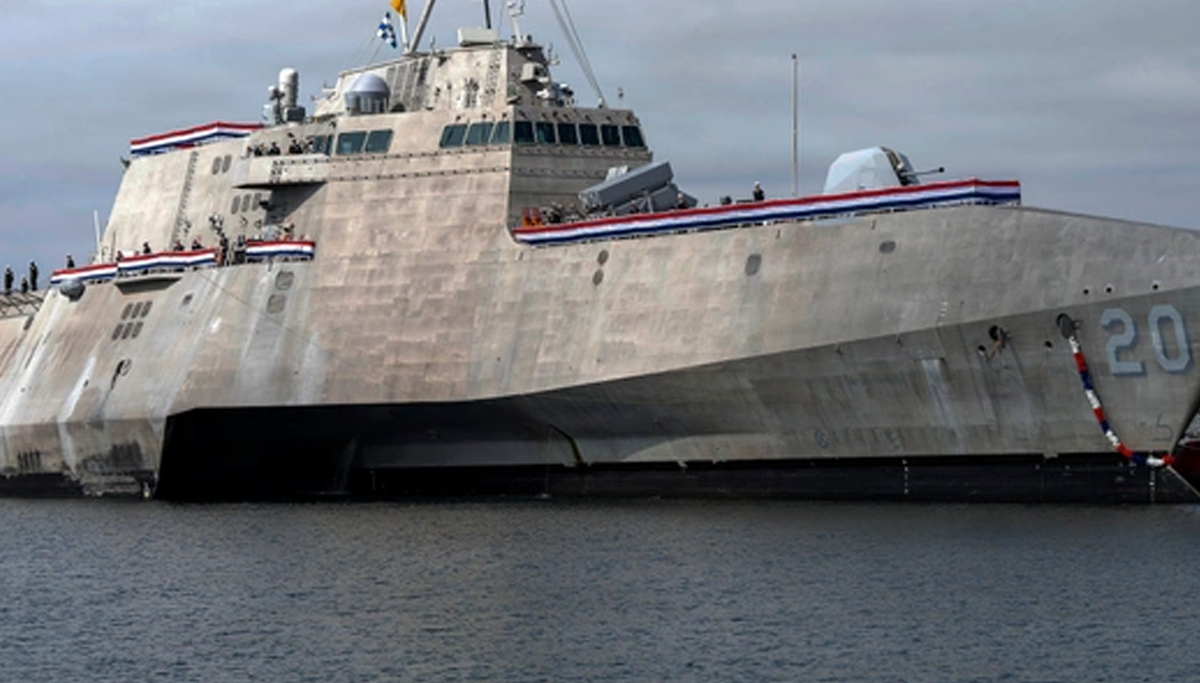
Images of retired U.S. Navy minesweepers being transported up the Delaware Bay sparked online rumors that the United States no longer has mine-clearing capability, but the Navy has already transitioned to newer Littoral Combat Ship systems designed for the mission.
Philadelphia, PA – Photos of several retired U.S. Navy minesweeper ships being transported toward Philadelphia have circulated widely online this week, fueling claims that the United States no longer has the ability to clear naval mines in strategic regions such as the Persian Gulf.
The images show the heavy transport vessel Seaway Hawk carrying four decommissioned Avenger-class Mine Countermeasures ships — USS Devastator, USS Dextrous, USS Gladiator, and USS Sentry — through the Delaware Bay on March 9.
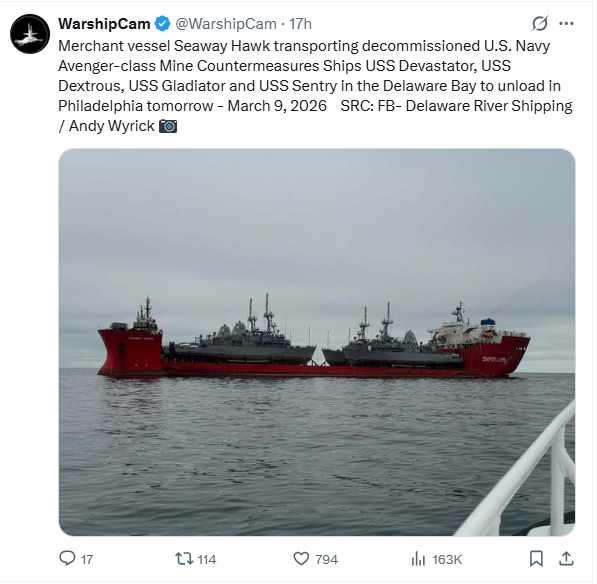
But defense officials and naval analysts say the ships shown in the photo represent the retirement of an aging platform, not the loss of U.S. mine-clearing capability.
Key Points
• Photos of retired Avenger-class minesweepers sparked online rumors about U.S. mine-clearing capability.
• The ships are being retired as the Navy shifts to Littoral Combat Ship mine countermeasure systems.
• The U.S. Navy currently operates 22 Littoral Combat Ships capable of supporting mine warfare missions.
Photo shows retirement of legacy minesweeper fleet
The Avenger-class vessels carried on Seaway Hawk were part of the Navy’s dedicated mine countermeasures fleet for decades.
Built primarily from wood and fiberglass to reduce magnetic signatures, the ships were designed to locate and neutralize naval mines in shallow coastal waters.
However, the Navy has been gradually retiring the aging class as it moves toward modern mine warfare systems that rely heavily on unmanned vehicles and remote sensing technology.
Littoral Combat Ships replacing traditional minesweepers
The Navy’s replacement capability centers on the Littoral Combat Ship (LCS), a fast and modular warship designed to operate close to shore against modern maritime threats.
The Navy currently has 22 commissioned LCS vessels, split between two variants:
• Freedom-class (10 ships) built by Lockheed Martin
• Independence-class (12 ships) built by Austal USA
These ships are assigned to two operational squadrons:
• LCSRON ONE based in San Diego
• LCSRON TWO based in Mayport, Florida
Several of the vessels regularly deploy to U.S. Fourth Fleet and Seventh Fleet regions for maritime security operations.
Modern mine warfare now relies on unmanned systems
Instead of using a single dedicated minesweeper ship, the LCS deploys a Mine Countermeasures Mission Package, which achieved Initial Operational Capability in March 2023.
The system allows the crewed ship to remain outside a minefield while unmanned systems perform detection and neutralization operations.
Key components include:
• Knifefish Unmanned Underwater Vehicle for detecting buried mines
• Unmanned Influence Sweep System that triggers mines by simulating ship signatures
• AN/AQS-20C Towed Sonar for high-resolution mine detection
• Airborne Laser Mine Detection System carried by MH-60S helicopters
• Common Unmanned Surface Vessel drone boats used to deploy minesweeping equipment
Naval planners describe the approach as a “standoff” method that keeps crewed ships farther from danger while unmanned systems conduct the hazardous work.
Shift reflects broader modernization strategy
Littoral Combat Ships can travel at speeds exceeding 40 knots, significantly faster than most traditional warships, and operate with a crew of roughly 40 sailors.
The platform is designed to support multiple mission modules including:
• Mine Countermeasures
• Anti-Submarine Warfare
• Surface Warfare
While images of retired minesweepers circulating online have sparked speculation, analysts say the Navy’s modernization effort reflects a broader shift toward unmanned and modular naval warfare systems rather than a reduction in mine-clearing capability.