
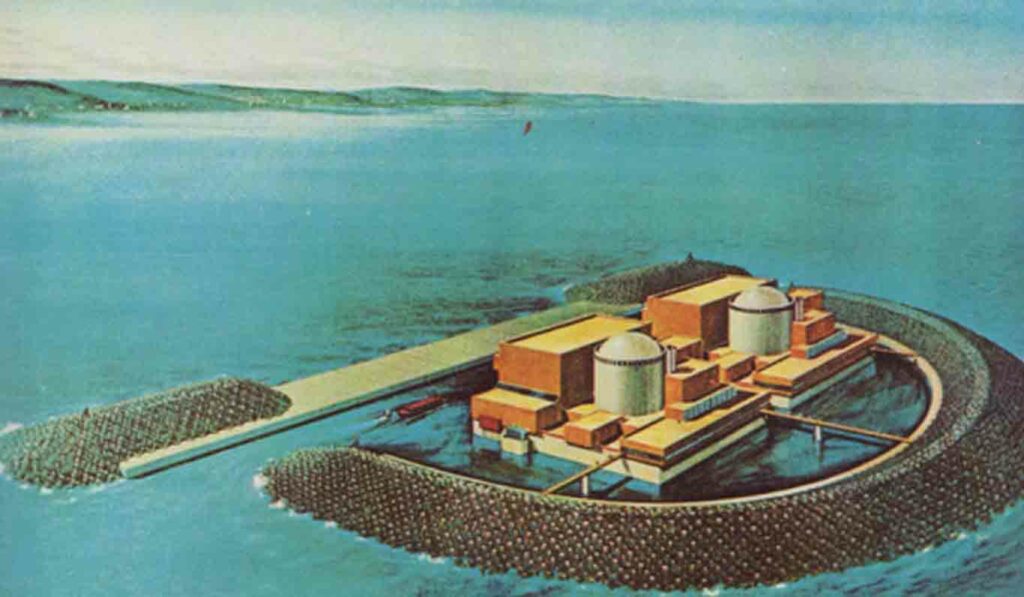
A half-century before New Jersey’s current offshore wind farm debate, an audacious plan for a floating nuclear power plant captivated and divided the Jersey Shore community.
In the early 1970s, the Atomic Energy Commission, in conjunction with PSE&G and Westinghouse, proposed building a $1 billion nuclear power plant on a manmade island 10 miles off the coast between Long Beach Island and Atlantic City. Named the Atlantic Nuclear Power Plant, the project aimed to install four 1,150 megawatt Westinghouse reactors on floating platforms surrounded by massive concrete breakwaters.
Carl Valore, Jr., chairman of the Atlantic County Planning Board at the time, expressed safety concerns regarding the project. He warned the county that a powerful storm could cause a catastrophic incident, endangering both human life and the marine ecosystem. “Even a small mishap could pollute our oceans off Atlantic County for hundreds of years,” Valore noted.
The project sparked division among Jersey Shore officials and residents, many of whom initially entertained the proposal. Opposition grew as concerns about safety and environmental impact mounted. Dr. Ira Ross, a representative of the Medical Society of New Jersey, criticized PSE&G’s PR efforts, calling them public propaganda aimed at promoting a dangerous offshore atomic facility.
In 1974, the project came under public scrutiny through a referendum. Voters rejected the plan with a count of 25,539 to 14,976. Financial setbacks followed, leading investors Tenneco and Westinghouse to withdraw from the Offshore Power Systems venture. As a result, the corporation laid off 60% of its workforce that same year.
PSE&G sought to recoup losses by appealing for rate hikes through the Board of Public Utilities in 1981, leading to further public disdain. The final blow to the project came in 1979 with the Three Mile Island incident, prompting a full shift in focus to land-based nuclear facilities.
Today, the only operational floating nuclear power plant exists in Russia, serving as a reminder of the complexities and challenges associated with such offshore endeavors.