Trenton, NJ — Once considered a tax-friendly state that helped fuel its postwar economic rise, New Jersey now ranks 47th in overall freedom nationwide, with new analysis highlighted by Fox News showing decades of rising regulation and taxes reshaping its standing, according to the Cato Institute. I
The latest “Freedom in the 50 States” report underscores a sharp long-term shift: New Jersey, which ranked 10th in fiscal policy as recently as 2000, now sits at 34th in that category and last in regulatory freedom.
New Jersey maintains a patchwork of unusual restrictions that often surprise residents and visitors. Drivers still cannot legally pump their own gas under the state’s decades-old full-service requirement, and most consumer fireworks remain banned outside of limited novelty items. Retail alcohol sales are tightly controlled—grocery stores and convenience stores generally cannot sell beer, wine, or liquor unless they hold one of the state’s limited licenses, which are capped by population. Single-use plastic bags have been banned in most retail settings, and the state has imposed strict rules on items like plastic utensils. Even toy weapons can draw scrutiny: realistic-looking toy guns, BB guns, and airsoft guns are heavily regulated and can be treated similarly to real firearms under certain circumstances. They can’t even be bought and shipped to New Jersey through Amazon.
In the future, the state wants to ban gas powered yard tools, gas powered cars, and gas powered heating systems.
New Jersey politicians seem to want to ban almost everything that is free and allowed in most of America. Some people even call the state “New Germany” a reference to early 20th century Nazi Germany.
Other restrictions reflect a mix of safety laws and older regulatory choices. Certain knives and weapons are restricted, and carrying items that could be considered weapons—even if marketed as tools—can lead to legal issues depending on intent. Fireworks laws remain among the stricter in the country despite some loosening in 2017, and open-container alcohol rules are tightly enforced. New Jersey also maintains extensive licensing requirements across many professions, limits on direct-to-consumer alcohol shipping, and strict zoning rules that affect everything from housing development to home-based businesses. While not all of these are outright bans, together they contribute to the state’s reputation for heavy regulation compared with much of the rest of the country.
From tax haven to high-cost state
Roughly 60 years ago, New Jersey built a reputation as a relatively low-tax, business-friendly state, a status that contributed to rapid suburban growth and rising household wealth. That positioning began to erode gradually, but the steepest decline has come over the past two decades.
State-level taxes, once near the national average, have climbed to 7.4 percent. Local taxes moved in the opposite direction, falling to 4.9 percent, but still remain well above the U.S. average of 3.7 percent.
The combined burden places New Jersey among the more expensive states, though it remains slightly less costly than neighboring New York—historically a key factor in drawing residents across the Hudson River.
New Jersey’s fiscal structure still carries some strengths. Government debt has dropped to 14.7 percent of personal income, slightly below average, and the share of the economy tied to government employment has improved since the Great Recession.
Key Points
• New Jersey fell from 10th in fiscal policy in 2000 to 34th, and now ranks 47th overall
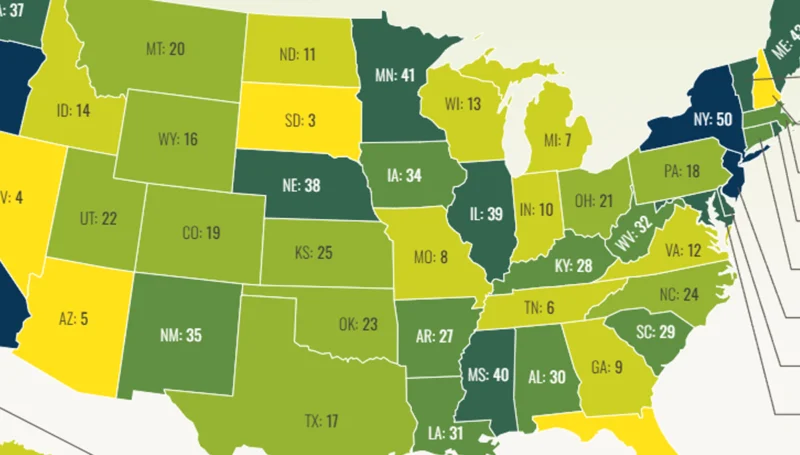
• The state ranks 50th in regulatory freedom, with strict zoning, labor, and business rules
• Personal freedom improved to 35th, driven by criminal justice and cannabis reforms
Regulations drive steepest decline
The most significant factor behind New Jersey’s ranking is its last-place position in regulatory policy. The Cato Institute points to strict land-use rules as the single worst-performing category, limiting housing development and contributing to higher living costs.
Local governments retain authority to impose rent control, while zoning laws often restrict density. At the same time, the state has expanded mandates affecting employers and insurers, including paid family leave, short-term disability coverage, and a state-level individual health insurance requirement enacted in 2018.
Minimum wage increases since 2013, strict workers’ compensation rules, and the absence of a right-to-work law further shape the labor environment.
Energy policy also factors into the ranking. Aggressive renewable energy requirements—among the highest nationwide—have contributed to elevated electricity prices, according to the report.
Regional competition and shifting migration
New Jersey’s decline has unfolded alongside growing competition from both neighboring and southern states.
While it still attracts some residents leaving New York due to relatively lower taxes, migration patterns have shifted. Increasingly, New Yorkers are relocating to states like Florida instead. Meanwhile, Connecticut—long a regional peer—has begun to outpace New Jersey in overall freedom rankings.
One unique feature remains: New Jersey offers more local government choice than any other state, with 6.3 competing jurisdictions per 100 square miles. The report suggests this fragmentation may allow residents to select preferred service levels, even if it sustains higher taxes.
Gains in personal freedom offset broader slide
Despite its low overall ranking, New Jersey has made measurable gains in personal freedom, climbing to 35th from 47th in recent years.
Criminal justice reform stands out. The state ranks 12th in that category, with declining incarceration rates and fewer arrests for nonviolent offenses. Policy changes include reducing prison phone costs in 2015 and ending driver’s license suspensions for non-driving drug offenses in 2019.
Voter approval of marijuana legalization in 2020 marked another major shift, improving the state’s standing on cannabis policy.
Still, other areas continue to weigh on the score. Asset forfeiture laws rank near the bottom nationally, while gun rights and tobacco regulations remain among the most restrictive.
A mixed legacy of innovation and constraint
New Jersey’s policy record reflects both expansion and restriction. The state played a national role in legalizing sports betting, winning a U.S. Supreme Court case that opened the door for broader adoption.
At the same time, it maintains complex rules in areas like alcohol sales and direct wine shipping. Education freedom also lags overall, despite relatively light regulation of homeschooling and private schooling, due in part to the absence of a comprehensive school choice system.
Healthcare mandates remain extensive, though recent participation in multistate licensing agreements for nurses signals incremental reform.
Looking ahead
The trajectory from mid-20th-century tax haven to a bottom-tier freedom ranking highlights a long-term policy transformation rather than a sudden shift. While some fiscal indicators have stabilized or improved, the report identifies regulatory reform as the central issue affecting New Jersey’s competitiveness.
Without significant changes to land-use policy, labor regulations, and tax structure, the state is likely to remain near the bottom of national rankings—even as it continues to implement targeted reforms in areas like criminal justice and cannabis.
Current status: New Jersey remains ranked 47th overall in the latest Cato Institute index, reflecting decades of policy changes that have moved it from a top-tier fiscal environment to one of the most regulated states in the country.