
Trenton, NJ – For nearly eight years, New Jersey has aggressively marketed itself as Hollywood East.
Under Gov. Phil Murphy, the state revived its film tax credit program, recruited some of the entertainment industry’s biggest names, and celebrated more than $1 billion in private studio investments that transformed former military bases and industrial properties into major production campuses.
Now, one of those companies Murphy lured to New Jersey is being sued by Governor Mikie Sherrill.
Welcome to New Jersey.
Now, under Gov. Mikie Sherrill’s administration, New Jersey finds itself taking legal action against two of the very studios the state spent years courting.
Attorney General Jennifer Davenport announced this week that a federal judge in California granted a temporary restraining order blocking the proposed $110 billion merger between Warner Bros. Discovery and Paramount Skydance while litigation continues.
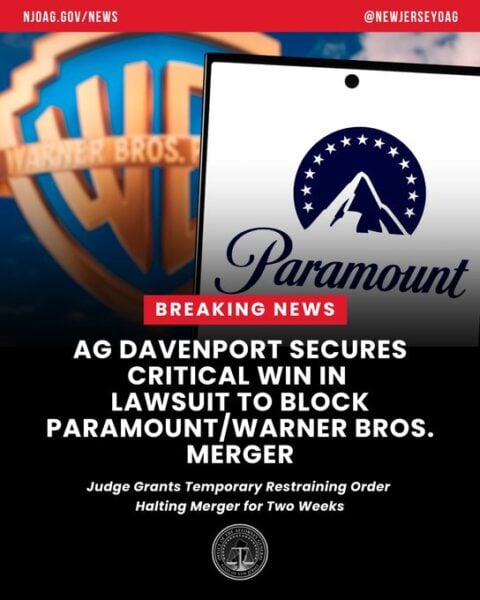
The lawsuit, joined by attorneys general from 12 states, argues the merger would illegally reduce competition in violation of federal antitrust law.
Murphy made New Jersey a destination for film production
When Murphy took office in 2018, one of his administration’s economic development priorities was rebuilding New Jersey’s once-thriving film industry.
The state reinstated and significantly expanded its Film and Digital Media Tax Credit Program, making New Jersey one of the nation’s most competitive locations for film and television production.
The strategy quickly attracted major investment.
Netflix committed approximately $1 billion toward developing a sprawling production campus at the former Fort Monmouth military base, a project expected to include a dozen soundstages across nearly 300 acres.
Lionsgate selected Newark for a major production studio intended to support film production while driving redevelopment and job creation in the state’s largest city.
Paramount Pictures also signed a long-term lease at Bayonne’s 1888 Studios, committing to approximately 250,000 square feet under a 10-year agreement.
Together, the projects represented one of the largest expansions of film production infrastructure in New Jersey’s history.
State officials frequently promoted the developments as evidence that New Jersey had successfully reestablished itself as a national production hub capable of competing with Georgia, California, and New York.
New administration joins antitrust lawsuit
Despite those investments, New Jersey is now part of a coalition seeking to stop one of Hollywood’s biggest proposed corporate consolidations.
Attorney General Davenport said the temporary restraining order preserves competition while the court considers whether to issue a preliminary injunction.
“Today’s order, which temporarily blocks this unlawful merger while our case continues, is a major win for consumers,” Davenport said.
“It is the first step in what I hope will be a total victory for New Jerseyans, who can ill-afford another price hike caused by opportunistic billionaires.”
The lawsuit argues combining Warner Bros. Discovery and Paramount would eliminate competition between two of Hollywood’s five largest movie distributors and two of the five largest basic cable companies.
According to the complaint, the merged company would control roughly one-third of theatrical film distribution and nearly one-third of basic cable programming in the United States.
State argues merger would hurt consumers
The coalition contends the transaction violates Section 7 of the Clayton Act, which prohibits mergers that may substantially lessen competition or create monopolies.
According to the lawsuit, consumers could ultimately face:
- Higher subscription prices
- Fewer theatrical releases
- Less competition among movie studios
- Reduced content quality
- Less bargaining power for movie theaters and cable distributors
Besides New Jersey, the lawsuit includes California, Arizona, Colorado, Connecticut, Massachusetts, Minnesota, Nevada, New Mexico, New York, Oregon, and Washington.
Investment versus consolidation
The case presents an unusual contrast in New Jersey’s economic policy.
Murphy’s administration spent years encouraging major studios to build facilities, hire New Jersey workers, and produce content in the state through generous tax incentives.
Those efforts produced billions in announced investment and thousands of anticipated construction and entertainment jobs.
The current lawsuit does not target film production in New Jersey or seek to reverse those investments.
Instead, state officials argue that while encouraging studios to invest locally promotes economic growth, allowing already dominant media companies to merge into even larger corporations could ultimately reduce competition nationwide.
What happens next
The temporary restraining order issued by the U.S. District Court for the Northern District of California temporarily blocks the merger while the court considers whether to issue a preliminary injunction that would halt the transaction for the duration of the litigation.
If the coalition ultimately prevails, the merger could be permanently blocked under federal antitrust law.
If the studios succeed, Warner Bros. Discovery and Paramount would be free to proceed with one of the largest entertainment mergers in recent history.
For New Jersey, the lawsuit marks a notable shift from the Murphy administration’s efforts to recruit Hollywood studios. The state continues to support film production and studio investment through tax incentives and infrastructure development while simultaneously arguing in federal court that further consolidation among major entertainment companies would reduce competition and harm consumers.
Here's what else is happening