
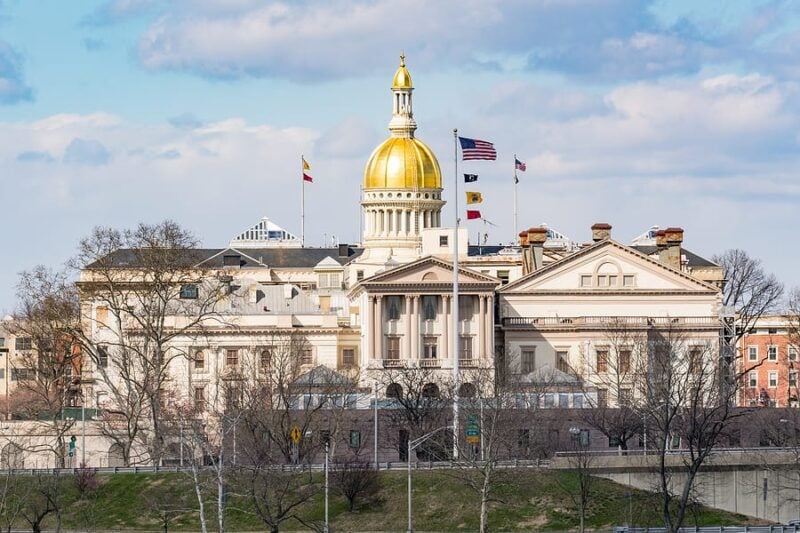
TRENTON, N.J. – Just three years after completing a massive $300 million renovation of the New Jersey State House, lawmakers are now turning their attention to the building’s long-term environmental footprint with a new proposal to modernize its operations and reduce emissions.
The nearly six-year restoration, completed in March 2023, transformed the State House from what officials once called a “fire trap” into a fully restored and functional government hub. The $283–$300 million project repaired the dome, replaced outdated electrical and HVAC systems, added sprinklers and elevators for ADA compliance, and restored the building’s early 20th-century architectural details. Financed through state bonds under former Gov. Chris Christie’s administration, the project sparked controversy over cost, transparency, and the long-term debt burden, but ultimately returned the Governor’s Office and press operations to the renovated executive wing.
Now, Senate Bill 199 seeks to build on that work by requiring the State Capitol Joint Management Commission to adopt and implement an environmental sustainability plan for the entire Capitol Complex. The plan would focus on energy efficiency upgrades, water conservation, carbon emission reductions, and waste minimization. It would also integrate U.S. Green Building Council principles and develop measurable performance standards, with annual progress reports to be published online by the Governor’s Office and the Legislature.
The measure mandates that the commission update the sustainability plan at least every four years and establish an advisory panel of environmental experts to guide future improvements. It also amends current law to ensure that all contracts and management decisions at the State House consider sustainability in procurement and daily operations.
Lawmakers say the initiative is designed to ensure that the restored State House remains efficient, environmentally responsible, and cost-effective for decades to come—continuing investment in an aging but iconic government structure that has already undergone one of the largest capital projects in state history.