

NEWARK, NJ – A chaotic Monday morning left thousands of New Jersey commuters stranded or delayed after an Amtrak power failure shut down two of NJ Transit’s busiest rail lines — the Northeast Corridor and North Jersey Coast Line — igniting a fiery political response from Governor Mikie Sherrill.
Sherrill, in a statement posted to social media, blasted former President Donald Trump while demanding urgent federal approval for the long-stalled Gateway Tunnel project. “These delays are unacceptable,” she said, linking the morning’s rail gridlock to years of federal inaction on infrastructure funding. “President Trump needs to stop playing games and let us build the Gateway Tunnel.”
No evidence suggests that there is a connection between today’s transit issues and the Gateway Tunnel project or that those issues could have been avoided or would not have happened even if the Gateway Tunnel was open and completed prior to today’s problems.
Those problems were system-wide weather-related problems, the governor said during her rant, which many on social media described as being “Karen”, a derogatory term used against middle-aged white women who complain.
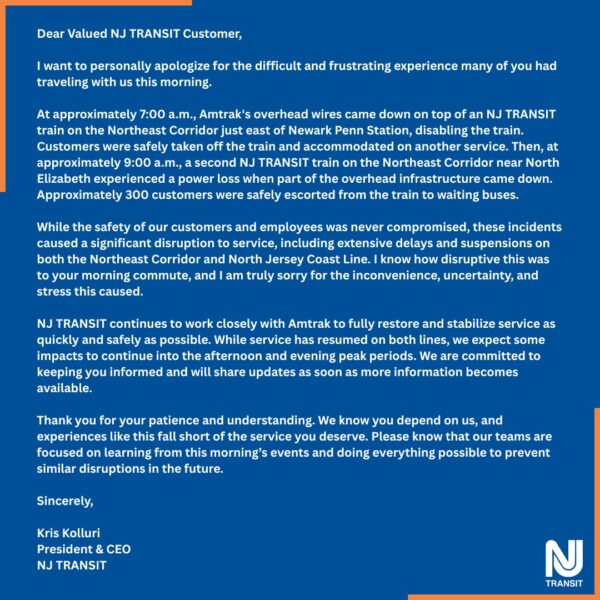
NJ Transit confirmed that the morning rush-hour chaos stemmed from an overhead wire issue in Amtrak-controlled territory between Newark and New York Penn Station. Service was suspended across the Northeast Corridor and North Jersey Coast Line, with limited operations restored by late morning. Passengers, however, continued to face residual delays, overcrowding, and modified service patterns.
“What does the gateway tunnel have to do with the overhead catenary wiring problems? I came from the transit sector and it’s been ignored for along time. We have toll money let’s replace it now,” one former rail industry worker said.
To ease the crush, NJ Transit activated cross-honoring, allowing rail tickets to be used on all NJ Transit and private carrier buses as well as PATH trains from Newark, Hoboken, and 33rd Street in Manhattan. Officials said this measure would remain in effect until full service stabilization, urging riders to check online alerts for updates.
“Last summer the hot weather impacted the wires. Which is it? Any weather other than 70 and sunny? In that case we still have massive delays in the spring and fall as well. Your trains suck and are outrageously expensive for public transit. Acknowledge it and fix it,” another commuter responded.
Amtrak has not yet provided details on the precise cause or location of the electrical failure, though such incidents typically involve damage or loss of tension in the high-voltage wires that supply power to the region’s electric trains. Repairs can take hours due to the shared infrastructure and the technical complexity of Amtrak’s Northeast Corridor system.
Political pressure builds for Gateway Tunnel
Sherrill used the morning’s meltdown to renew her call for federal action on the long-delayed Gateway Tunnel, a project designed to modernize and expand the rail connection under the Hudson River. She argued that the failure to build the tunnel — first proposed as the ARC project years ago — has left commuters vulnerable to ongoing disruptions.
“Regardless of the new tunnel, @GovSherrillNJ @NJTRANSIT has had these issues for years yet no seems to find a solution but just play the blame game! On top of that, raising fares. There is no real solutions coming from any of you. Ridiculous,” another commented.
By late morning, NJ Transit reported that service had resumed on all lines but warned riders of continued congestion and possible rolling delays through the afternoon. Amtrak crews remained on site inspecting the overhead lines to prevent further outages.
- Amtrak overhead wire failure halted NEC and NJCL service early Monday
- NJ Transit implemented cross-honoring on buses and PATH trains
- Governor Mikie Sherrill renewed her push for the Gateway Tunnel amid commuter outrage
As repairs continued, officials urged patience, noting that full service reliability would likely take several more hours to restore. Sherrill, meanwhile, signaled that New Jersey’s transit troubles had again become a flashpoint in the broader debate over federal investment in the region’s rail infrastructure.