

Holmdel, NJ – More than 7,300 Jersey Central Power & Light customers remained without electricity Wednesday morning, nearly five days after a series of powerful thunderstorms and damaging winds swept across New Jersey during the Independence Day holiday weekend.
According to the latest Jersey Central Power & Light outage data, 7,358 of the utility’s 1.16 million customers were still without service as of 8:46 a.m. Wednesday. The outages represent about 0.64% of the company’s customer base and remain concentrated in several northern and central New Jersey counties.
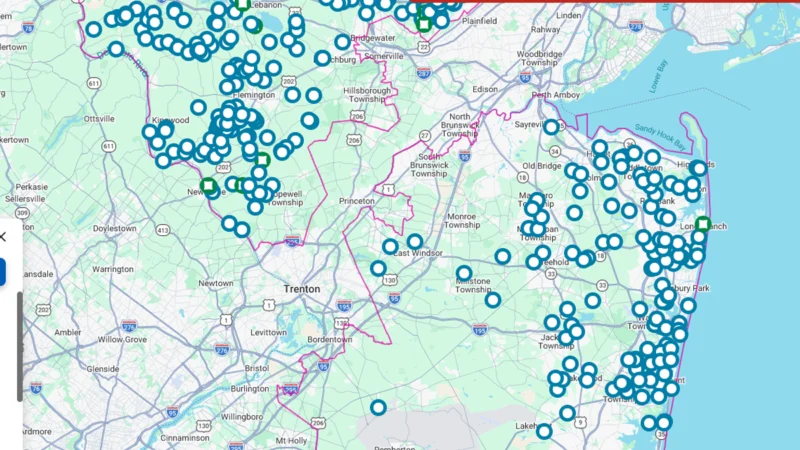
Morris County continues to lead outage totals
Morris County reported the largest number of remaining outages with 2,933 customers still without electricity. Other counties with significant restoration work underway included Sussex County with 1,369 customers affected, Warren County with 823, Union County with 702, Somerset County with 670, and Hunterdon County with 528.
Smaller numbers of outages remained in Monmouth County, Essex County, Ocean County, Mercer County, Passaic County, Burlington County, and Middlesex County.
PSE&G nears full restoration
While JCP&L crews continue to address scattered damage, PSE&G reported just 172 customers without power Wednesday morning, signaling that restoration efforts across its service territory are nearly complete.
The widespread outages followed a prolonged heat wave and successive rounds of severe thunderstorms over the July Fourth holiday period. Utilities reported that powerful straight-line winds brought down hundreds of trees and damaged electrical infrastructure across multiple counties, resulting in one of the largest restoration efforts of the year.
Although statewide outages have dropped dramatically from a peak of more than 380,000 customers, repair crews continue working to restore service in communities where extensive tree damage and damaged distribution equipment have slowed progress.
Residents experiencing outages are encouraged to report them directly to their utility provider and avoid downed power lines, which should always be treated as energized and immediately reported to local authorities or the utility.