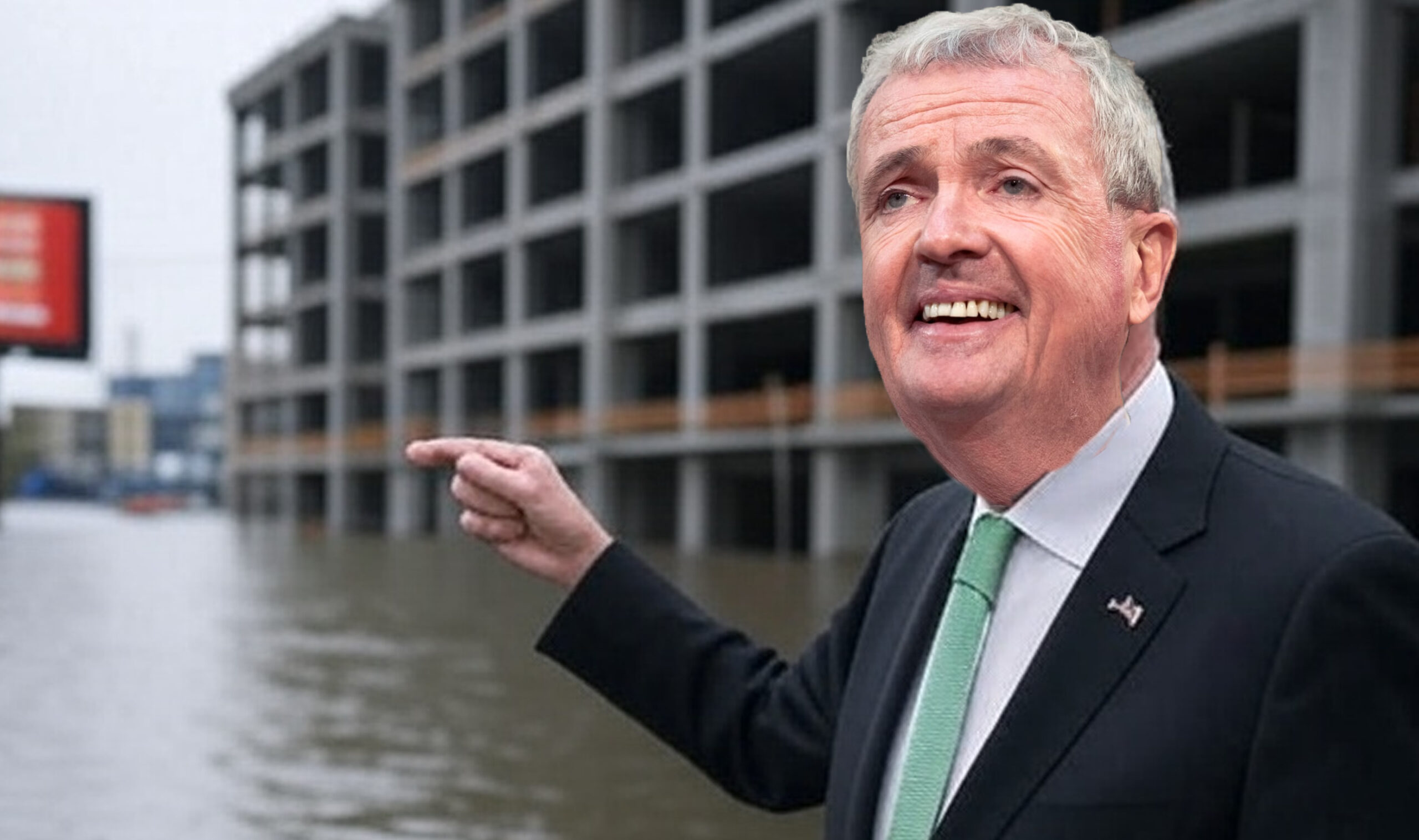
TRENTON, NJ = On Monday night, as 3-4 inches of rain drenched New Jersey, Governor Phil Murphy declared a state of emergency, urging residents to stay indoors to avoid flash flooding. The governor, a climate change fear mongerer, continues to not only ignore, but pushes the primary cause of urban and suburban flooding in New Jersey.
His own policies.
The response by the governor doesn’t reflect the threats of climate change, but rather the growing threat of high-density housing mandates from Trenton and their impact to the environment.
Fewer trees mean more asphalt, which leads to more serious flooding.
Still, Murphy and many Democrats attribute the heavy flooding in the Garden State to climate change.
Yet, the irony is glaring: while the governor champions environmental protection, his administration’s policies are exacerbating the very conditions that make such flooding worse—overdevelopment and clear-cutting in rural, wooded towns to meet affordable housing mandates.
New Jersey’s Democrats, including Murphy, have long positioned themselves as stewards of the environment, advocating for renewable energy, carbon reduction, and green infrastructure. However, their push to address the state’s housing crisis through aggressive development mandates is undermining these goals. Rural communities, rich with forests and natural landscapes, are being forced to clearcut trees and pave over permeable land to comply with state-imposed affordable housing quotas.
This contradiction is not just shortsighted—it’s a direct contributor to the flooding crises that prompt emergency declarations like the one issued this week.Flooding in New Jersey is not solely a product of climate-driven rainfall.
Overdevelopment plays a massive role. When forests and fields are replaced with asphalt and concrete, rainwater has nowhere to go. Natural landscapes act like sponges, absorbing water and mitigating runoff. Paved surfaces, on the other hand, create impervious barriers, funneling water into overwhelmed drainage systems and low-lying areas. Studies, like those from the New Jersey Department of Environmental Protection, show that urbanization increases runoff by up to 50% in some areas, directly worsening flood risks. The more we pave, the worse it gets.
Take, for example, towns in Sussex or Warren counties, where wooded areas are being razed to meet housing mandates. These rural communities, often far from urban centers, are ill-suited for dense development. Yet, the state’s Council on Affordable Housing (COAH) requirements, backed by Murphy’s administration, pressure them to build, regardless of environmental cost. The loss of tree cover not only destroys carbon sinks but also destabilizes soil, increasing erosion and runoff during storms like Monday’s.
The result? Flash floods that threaten lives, homes, and infrastructure.The irony deepens when you consider Murphy’s public stance. He’s quick to declare emergencies when storms hit, framing them as evidence of climate change’s urgency. But where is that urgency when it comes to preserving the natural barriers that protect us from flooding? Instead of reevaluating policies that incentivize overdevelopment, the administration doubles down, forcing towns to sacrifice their green spaces to meet arbitrary housing targets. This isn’t just a policy misstep—it’s a betrayal of the environmental values Democrats claim to uphold.
There’s a better way. New Jersey could prioritize infill development in already urbanized areas, where infrastructure can support new housing without decimating forests. Brownfield redevelopment, adaptive reuse of existing structures, and incentives for high-density housing near transit hubs would reduce pressure on rural ecosystems. Additionally, the state could invest in green infrastructure—like permeable pavements and urban wetlands—to mitigate runoff in developed areas. These solutions align with both housing and environmental goals, but they require political courage to challenge the status quo.
Governor Murphy’s state of emergency declaration was necessary, but it’s a Band-Aid on a self-inflicted wound. If he’s serious about climate change and environmental protection, he must confront the contradiction at the heart of his housing policies. Forcing rural towns to clearcut for development while lamenting the consequences of flooding isn’t leadership—it’s hypocrisy.
New Jersey deserves a coherent strategy that protects both its people and its environment, not one that pits them against each other.
 North Jersey News
 Ocean County News
Drunken Migrant Arrested for DWI in Ocean County
Shore News Network Breaking
 Community News
Plans for 450 Homes At Former Circus Liquors Revealed
Shore News Network