
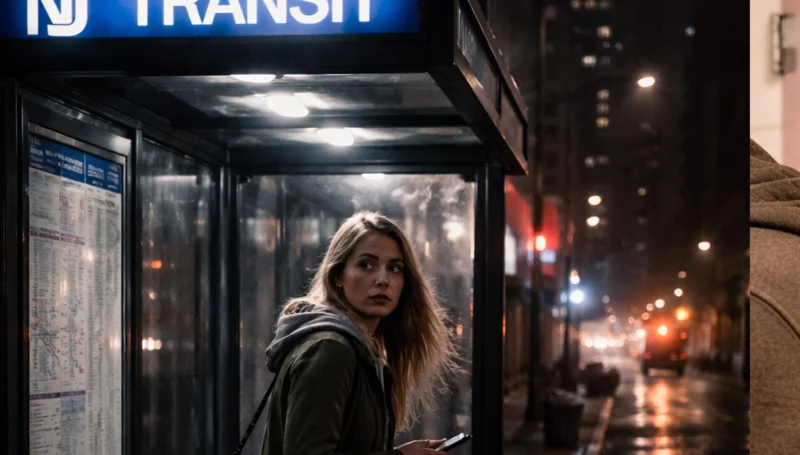
Proposed law would require barriers and lighting at bus stops in areas with elevated crash risk.
Trenton, NJ – A newly introduced bill in the New Jersey Assembly would require NJ Transit to add safety features at bus stops located in high-traffic areas, aiming to reduce the risk of injuries and fatalities for riders waiting along busy roadways. The proposal, Assembly Bill 4724, focuses on both newly installed shelters and upgrades to existing ones upon request.
Key Points
- Bill would require barriers and lighting at bus stops in high-traffic areas
- Applies to new NJ Transit shelters and existing shelters upon request
- High-traffic areas defined by crash history, pedestrian activity, and proximity to key locations
The legislation, introduced March 16 by Assemblyman Kenyatta Stewart, directs the New Jersey Transit Corporation to include safety features such as protective barriers and lighting when installing shelters at bus stops deemed to be in high-traffic areas. The requirement would be subject to available funding appropriated or otherwise made accessible to the agency.
Under the bill, NJ Transit would determine which locations qualify as high-traffic areas based on several factors, including average traffic volume, frequency of collisions, history of pedestrian injuries or fatalities, and proximity to schools, hospitals, senior housing, or other areas with high pedestrian activity.
Existing shelters could be upgraded upon request
In addition to new installations, the bill allows municipalities or other entities responsible for maintaining existing bus shelters to request safety upgrades. In those cases, NJ Transit would be required to install features such as barriers and lighting, with the option to coordinate with local governments on cost-sharing.
The measure defines a “bus stop” as a location served by regular route motorbus service and a “shelter” as a structure installed to provide temporary protection for passengers waiting for service.
The proposal does not mandate a specific design standard for the safety features but identifies barriers and lighting as examples of improvements intended to protect riders from nearby traffic.
If enacted, the bill would take effect on the first day of the seventh month following its passage.