
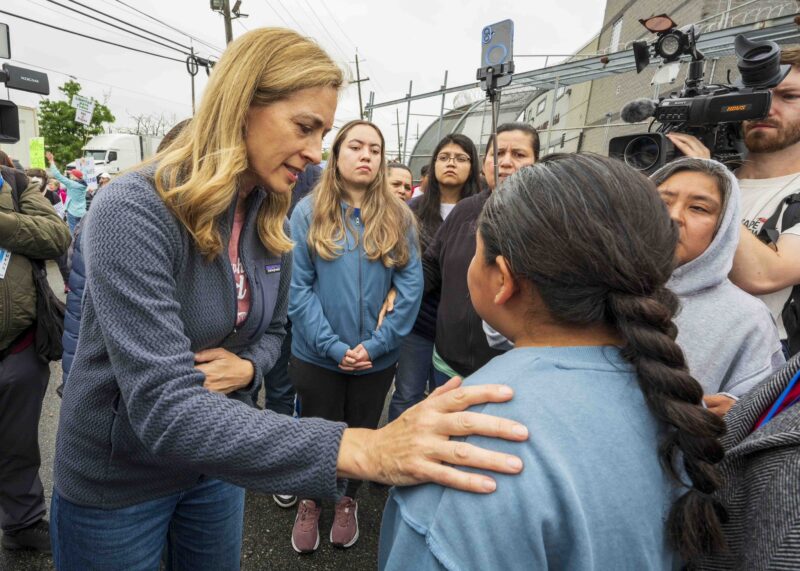
Newark, NJ — A growing dispute over immigration enforcement and public demonstrations in Newark entered a new phase after Democratic gubernatorial candidate Mikie Sherrill announced that New Jersey law enforcement would establish a protected protest area outside Delaney Hall, arguing that the move could reduce tensions while preserving the right to demonstrate.
The proposal follows several days of protests near Delaney Hall, the Newark detention facility that has become a focal point for immigration activists, community groups, and elected officials opposing federal immigration enforcement operations. Demonstrations in the area have drawn significant public attention and raised concerns about potential confrontations between protesters and federal authorities.
Sherrill Frames Move as Public Safety Measure
In a statement, Sherrill said she would not allow federal immigration authorities to use unrest as justification for expanding enforcement activity in New Jersey.
“I will not give ICE the pretext to expand operations in our state,” Sherrill said.
She added that New Jersey law enforcement would establish “a peaceful, protected, protest zone” outside Delaney Hall and that her administration would work alongside community members, faith leaders, advocates, and the New Jersey State Police to help demonstrators relocate to the designated area.
According to Sherrill, the primary goal is to reduce tensions while maintaining public safety.
“Our top priority is public safety – and we need to take this opportunity to lower the temperature now,” she said.
Delaney Hall Remains Center of Ongoing Demonstrations
The announcement comes after multiple days of protests outside Delaney Hall, where immigration advocates and supporters have gathered to challenge federal detention and deportation policies.
The facility has become one of the most visible flashpoints in New Jersey’s broader debate over immigration enforcement. Demonstrators have argued that federal detention operations harm immigrant communities, while federal officials maintain that immigration enforcement remains a federal responsibility.
As crowds continued to gather near the facility in recent days, concerns grew over the possibility of escalating confrontations between protesters and federal personnel operating in the area.
Key Points
• Mikie Sherrill announced plans for a protected protest zone outside Delaney Hall in Newark.
• She said the move aims to prevent ICE from using unrest as justification for expanding operations.
• The proposal follows several days of demonstrations centered on immigration enforcement and detention policies.
Debate Over State and Federal Roles
Sherrill’s proposal places renewed attention on the often-contentious relationship between state and federal authority when immigration enforcement becomes the focus of public protest.
By calling for state and local law enforcement to help establish and secure a designated protest area, Sherrill is attempting to balance two competing priorities: protecting public demonstrations while avoiding direct conflict near a federal detention facility.
The proposal also raises political questions about how state officials should respond when federal immigration operations become the subject of sustained public opposition.
Supporters of the idea may view a protected protest area as a way to safeguard First Amendment activity and reduce the risk of clashes. Critics, however, could argue that creating a designated zone near a federal facility risks putting state and local law enforcement in the middle of a dispute involving federal agencies.
Focus on De-Escalation
A central theme of Sherrill’s statement was de-escalation.
Rather than emphasizing enforcement, arrests, or crowd-control measures, her remarks focused on creating a space where demonstrations could continue without further increasing tensions around Delaney Hall.
The involvement of faith leaders, advocates, and community organizations was also notable. Sherrill said those groups would work alongside state officials and law enforcement in efforts to move demonstrators into the protected area.
That approach reflects an effort to present the proposal as a collaborative public-safety initiative rather than a restriction on protest activity.
What Happens Next
The effectiveness of the proposed protest zone will likely depend on whether demonstrators choose to gather within the designated area and whether federal authorities accept the arrangement as tensions continue around the facility.
The situation at Delaney Hall remains fluid, with immigration enforcement, public safety, and protest rights all intersecting at one of New Jersey’s most closely watched political flashpoints.