When I opened my electric bill for July, my first thought was, “Ew, that’s gross.”
Not because I left the air conditioner running. Not because my kids forgot to turn off the lights. Not because I suddenly started mining Bitcoin in the basement.
It was because I remembered the promise.
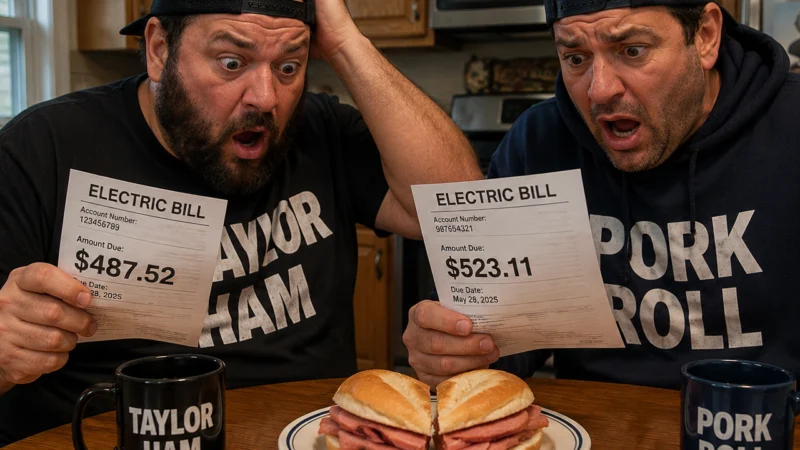
Whether you’re Team Taylor Ham or Team Pork Roll, there’s one thing New Jerseyans can now agree on: electric bills have become painful. During last year’s campaign, Gov. Mikie Sherrill promised to freeze utility rates on Day One. For families struggling to keep up with inflation, property taxes, insurance and groceries, that sounded like exactly what they needed.
Then July’s bill arrived.

For many households, the reality didn’t match the campaign slogan.
To be fair, this isn’t as simple as saying the governor promised one thing and utilities ignored her. The facts are more complicated than that, and they matter.
On her first day in office, Sherrill signed an executive order directing the New Jersey Board of Public Utilities to offset 2026 electricity supply increases through bill credits, review other charges, and consider delaying certain utility rate proceedings where legally possible. It did not permanently cap every line item that appears on an electric bill. Delivery charges, infrastructure costs, taxes, usage and previously approved surcharges could still change.
That’s an important distinction.
There’s a world of difference between freezing electric rates and providing temporary relief from one portion of an electric bill.
The administration called it a rate freeze. What customers received was closer to a credit, but a credit that was $75 less than the one they received last year.
In August, residential customers are scheduled to receive a one-time $25 credit funded with approximately $170.8 million from Solar Alternative Compliance Payment funds and the state’s Clean Energy Program budget. The credit reduces one bill, but it doesn’t reduce the underlying cost of producing, transmitting and delivering electricity.
Last year’s credit was $100.
Think about it this way.
If your mortgage payment is $2,000 and someone gives you $25 one month, your mortgage didn’t become cheaper.
Someone simply helped pay a tiny portion of it. That’s essentially what happened here.
The bigger problem began long before Sherrill took office.
The massive spike in electric costs that shocked New Jersey residents actually traces back to the 2025 PJM capacity auction. Capacity prices increased dramatically, helping produce residential electric rate increases of roughly 17% to 20% beginning in June 2025. Those costs were already built into New Jersey’s electricity supply portfolio before the governor was sworn in.
It happened under Governors Phil Murphy and Chris Christie to be exact.
That means Sherrill inherited a very real problem, but it was one her own party and her own energy agenda helped create.
But inheriting a problem and solving it are two different things.
Campaigns are built on slogans.
Government runs on math. Households run on financial reality. Unfortunately for New Jersey families, math usually wins, and they come out as losers in the end.
One reason many residents remain frustrated is because the phrase “rate freeze” created an expectation that bills would stop climbing.
Instead, people continued opening envelopes—or email notifications—and seeing totals that still made them cringe.
Sometimes that’s because they used more electricity during July’s heat.

Sometimes delivery charges changed. Sometimes infrastructure investments were added.
Sometimes temporary credits disappeared. Whatever the reason, the customer experience remained the same.
The bill still hurt.
That’s why political messaging matters.
Words like “freeze” carry meaning.
When politicians promise a tax freeze, people expect taxes not to rise.
When they promise a spending freeze, people expect spending to stop increasing.
When they promise a utility-rate freeze, most people reasonably assume their electric bills won’t continue feeling like a second mortgage.
Instead, what New Jersey received was a temporary subsidy that softened part of one month’s bill while leaving the underlying system largely unchanged.
And that underlying system has problems far bigger than any governor can solve with an executive order.
Electricity in New Jersey isn’t priced entirely in Trenton.
Much of it flows through PJM, the regional transmission organization that coordinates wholesale electricity across multiple states. Capacity prices have been driven higher by tightening electricity supplies, growing demand—including from large data centers—and delays in bringing new generation online. PJM’s own market monitor has also criticized aspects of the market’s design.
Those aren’t problems that disappear because a governor signs Executive Order No. 1.
They’re regional problems requiring regional solutions.
Still, New Jersey also deserves some difficult conversations about its own energy policy.
Over the past two decades, the state has lost several significant sources of dependable electric generation, including Oyster Creek Nuclear Generating Station in Ocean County and the B.L. England generating station in Cape May County. While those closures resulted from a mix of economics, environmental policy and private business decisions—not solely state government—they reduced the margin of dependable generation available to the region. Replacement projects have not always arrived as quickly as originally envisioned.
Renewable energy has an important role to play.
So does battery storage.
So does nuclear power.
So does reliable natural gas generation.
The reality is that replacing around-the-clock electricity generation is harder than announcing it at a press conference.
Building new power plants takes years.
Building transmission lines takes years.
Permitting takes years.
Litigation takes years.
Meanwhile, families pay electric bills every month.
That’s why honesty matters more than optimism.
Governor Sherrill didn’t create the PJM capacity crisis.
She didn’t personally cause the 2025 price spike.
And no governor has the authority to simply erase wholesale electricity costs with the stroke of a pen.
Those are fair points.
But they’re also reasons to be more careful with promises, not less.
If the plan was always going to be temporary credits funded from existing state energy accounts, then that’s what voters should have been told from the beginning.
Calling it a “freeze” raised expectations that government couldn’t realistically meet.
There’s another concern.
Using money from energy programs to reduce today’s bills may provide immediate relief, but it doesn’t eliminate tomorrow’s costs. It shifts expenses rather than erasing them, leaving legitimate questions about how those programs will be funded going forward.
New Jersey residents deserve transparency.
Tell us exactly which charges are being offset.
Tell us how long the relief lasts.
Tell us where the money comes from.
Tell us what happens after the credits disappear.
And most importantly, tell us what long-term plan will actually make electricity more affordable instead of simply making one bill look slightly better.
Because that’s what people really care about.
Not slogans.
Not campaign ads.
Not press conferences.
Just affordable electricity.
The Taylor Ham versus Pork Roll debate will probably outlive every governor who ever occupies Drumthwacket.
It’s part of what makes New Jersey, New Jersey.
But there shouldn’t be any debate over this.
When politicians promise to freeze electric rates, residents naturally expect relief they can actually see when they open the envelope.
When they don’t, the first words that come to mind are often the same ones I muttered when I opened my July bill.
“Ew, that’s gross.”