
TRENTON, N.J. – Four years after New Jersey imposed one of the nation’s toughest restrictions on plastic grocery bags, the familiar thin checkout bag has largely disappeared. What replaced it, however, has opened a new environmental debate over millions of heavier reusable bags accumulating in homes across the state.
The evidence does not support the simple conclusion that the ban either eliminated plastic waste or made the problem worse. Two major analyses reached sharply different conclusions about material consumption, even as both found that New Jersey dramatically reduced the number of bags distributed and created an unintended surplus of reusable bags.
That distinction has resurfaced in political criticism of the law, including an Aug. 21 post by Mike Crispi questioning why lightweight grocery bags are prohibited while meat, cheese, milk and countless other products remain packaged in plastic. The comparison highlights the narrow scope of the law: New Jersey banned single-use plastic carryout bags, not plastic packaging generally.
- A plastic-industry-sponsored study estimated retail-bag plastic consumption reached 151 million pounds in 2022, compared with 56 million pounds in 2015.
- A later study using before-and-after data from 33 New Jersey stores found 96% fewer bags and a 71% reduction in total bag-material weight.
- Both analyses identified excessive accumulation of reusable bags as a significant problem, particularly with grocery pickup and delivery.
New Jersey Eliminated Billions of Checkout Bags — But Replacements Are Heavier
New Jersey’s law took effect May 4, 2022, prohibiting stores and food-service businesses from providing or selling single-use plastic carryout bags. Grocery stores of at least 2,500 square feet also cannot provide single-use paper carryout bags.
But the law does not prohibit plastic packaging. Bags used for raw meat, fish, poultry, produce, deli meat and cheese and several other purposes are exempt, while plastic bottles, jugs, trays and product packaging fall outside the checkout-bag prohibition.
That means a shopper can buy milk in a plastic jug and meat wrapped in plastic but cannot receive a conventional plastic checkout bag to carry those products home.
The replacement bag is not necessarily the canvas tote consumers may envision, either.
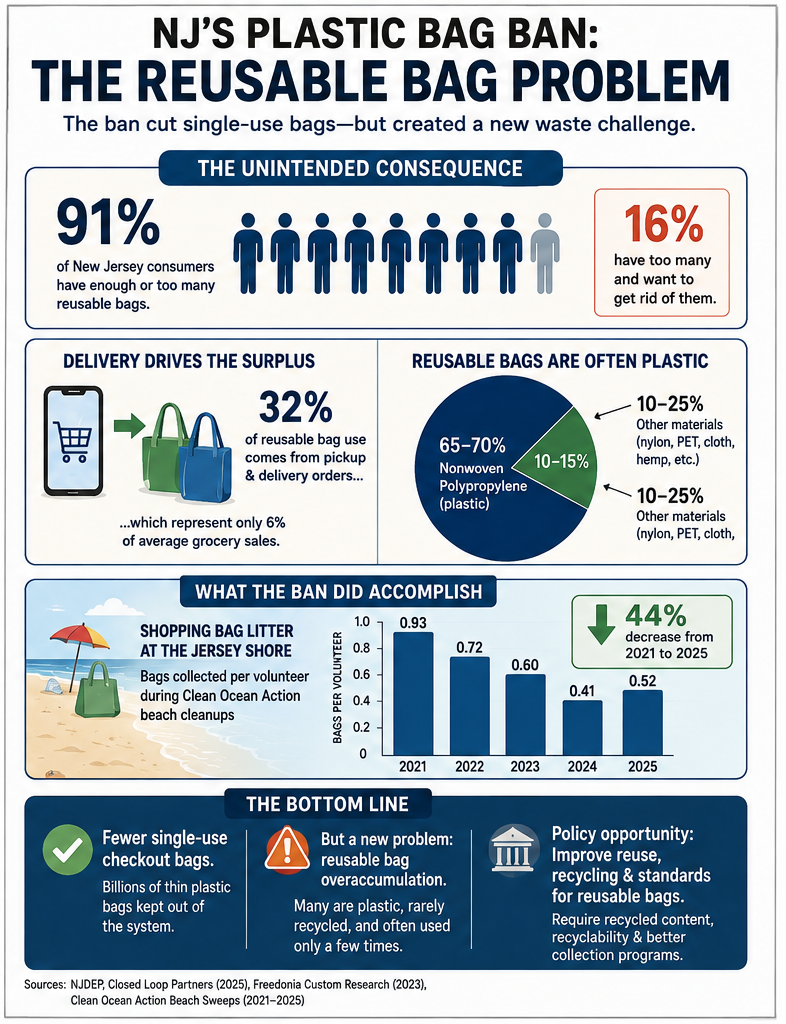
Many reusable supermarket bags are made from nonwoven polypropylene — itself a plastic. New Jersey regulations permit reusable bags made from polypropylene fabric, PET nonwoven fabric, nylon, cloth, hemp and other washable fabrics.
Significantly, the state does not require reusable bags to contain a minimum amount of recycled material. Nor does it require them to be recyclable.
Their environmental advantage therefore depends heavily on what happens after shoppers leave the store: they have to be reused.
One Study Says Plastic Consumption Nearly Tripled
A 2023 Freedonia Custom Research assessment produced some of the most damaging numbers for the state’s policy.
Freedonia estimated New Jersey retail-bag demand dropped from 2.316 billion bags in 2015 to 894 million in 2022 — a reduction exceeding 60%.
But the researchers concluded the amount of plastic used to make those bags moved dramatically in the opposite direction.
According to the study, plastic consumption associated with retail bags increased from approximately 56 million pounds in 2015 to 151 million pounds in 2022 — about 2.7 times the earlier amount.
The explanation was weight. A conventional polyethylene checkout bag uses very little material, while a thick polypropylene bag designed to survive repeated trips requires substantially more.
Freedonia also reported from industry interviews that approximately 90% of alternative reusable bags were being reused only two or three times before disposal.
But there is an important qualification to those findings.
The report states that it was prepared on behalf of the American Recyclable Plastic Bag Alliance, an organization representing the plastic-film bag industry. Its comparison also uses 2015 and 2022 rather than immediately adjacent pre-ban and post-ban years, and the ban itself did not begin until May 2022.
Those factors do not negate the study, but they make describing a near-tripling of plastic consumption as an uncontested consequence of the ban problematic.
Newer New Jersey Data Reached the Opposite Conclusion
A 2025 analysis from Closed Loop Partners’ Center for the Circular Economy produced substantially different findings.
Researchers examined one year of store data before the ban and one year afterward across 33 New Jersey stores.
They reported a 96% reduction in bags distributed or sold, a 71% decline in total bag-material weight and a 38% reduction in greenhouse-gas emissions associated with bags. More than 90 million bags were avoided over eight months at those stores.
That study also has an institutional affiliation worth noting. The consortium behind the research was launched with major retailers including CVS Health, Target and Walmart and has a stated mission that includes reducing single-use plastic-bag waste.
Still, its findings directly challenge the argument that heavier reusable bags necessarily erased the environmental gains from eliminating disposable bags.
Where the competing research does agree is perhaps more important.
New Jersey has too many reusable bags.
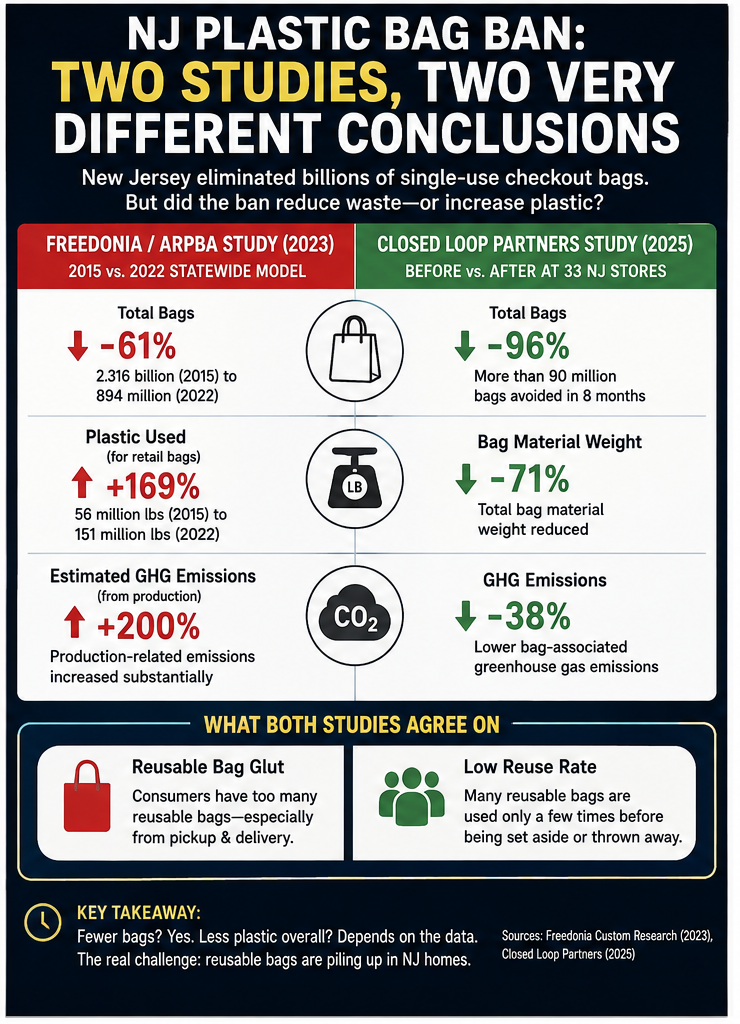
The 2025 study found 91% of surveyed consumers said they had enough or too many reusable bags. Sixteen percent specifically said they had too many and wanted to get rid of them.
Grocery delivery was a major contributor.
Online and curbside orders represented only about 6% of average grocery-store sales in the study but accounted for approximately 32% of reusable-bag use.
Unlike a customer walking into a supermarket with bags from home, delivery customers could receive another collection of thick reusable bags with every order.
Jersey Shore Litter Data Show the Ban Had an Effect
Whatever happened to the total weight of retail-bag material, there is evidence the law accomplished one of its most visible environmental objectives along the Jersey Shore.
Clean Ocean Action data show single-use food and shopping bags represented 1.81% of debris collected during its 2021 beach cleanups.
That declined to 1.55% in 2022, 1.31% in 2023 and 1.01% in 2024. The figure increased to 1.25% in 2025 but remained approximately 31% below its 2021 level.
The number of shopping bags collected per volunteer fell even further, from 0.93 in 2021 to 0.52 in 2025 — a decline of about 44%.
Those numbers make it difficult to argue that eliminating conventional checkout bags accomplished nothing.
They also do not mean New Jersey solved plastic pollution. Clean Ocean Action found that more than 80% of litter collected during its 2024 beach cleanups was plastic, while packaging accounted for 41% of all debris.
That leaves a broader policy question behind Crispi’s criticism: Why target checkout bags so aggressively while enormous quantities of disposable plastic packaging remain legal?
The answer depends partly on what problem policymakers intended to solve. Checkout bags were a highly visible litter source that could be targeted at the point of sale. They are nevertheless only one part of a vastly larger stream of plastic packaging.
New Jersey’s experience suggests the more immediate problem may now be improving the replacement system rather than returning to billions of disposable checkout bags.
Reusable bags work environmentally only when they are actually reused. A thick polypropylene bag delivered with groceries, used twice, stored in a closet and eventually thrown away undermines the premise on which the replacement was based.
The state’s next policy debate may therefore center on recycled-content requirements, recycling options and preventing grocery-delivery services from repeatedly sending customers reusable bags they neither need nor want.
Did New Jersey’s plastic bag ban increase plastic consumption?
One industry-sponsored analysis concluded retail-bag plastic consumption increased sharply, while a later before-and-after store study found total bag-material weight fell 71%. The available research does not establish one uncontested answer.
Are New Jersey’s reusable grocery bags made of plastic?
Many are. Nonwoven polypropylene is a common reusable-bag material permitted under state rules, although cloth, nylon and other qualifying materials can also be used.
Did the plastic bag ban reduce litter at the Jersey Shore?
Clean Ocean Action data indicate that it did. Shopping-bag debris declined substantially from pre-ban levels, although plastic continues to account for a large share of overall Shore litter.
Sources: New Jersey Department of Environmental Protection rules and first-year assessment; Freedonia Custom Research New Jersey Plastic Retail Bag Market Assessment prepared for the American Recyclable Plastic Bag Alliance; Center for the Circular Economy 2025 New Jersey bag-policy analysis; Clean Ocean Action Beach Sweeps data; statewide waste statistics and research compiled in the Aug. 24, 2026 audit report.