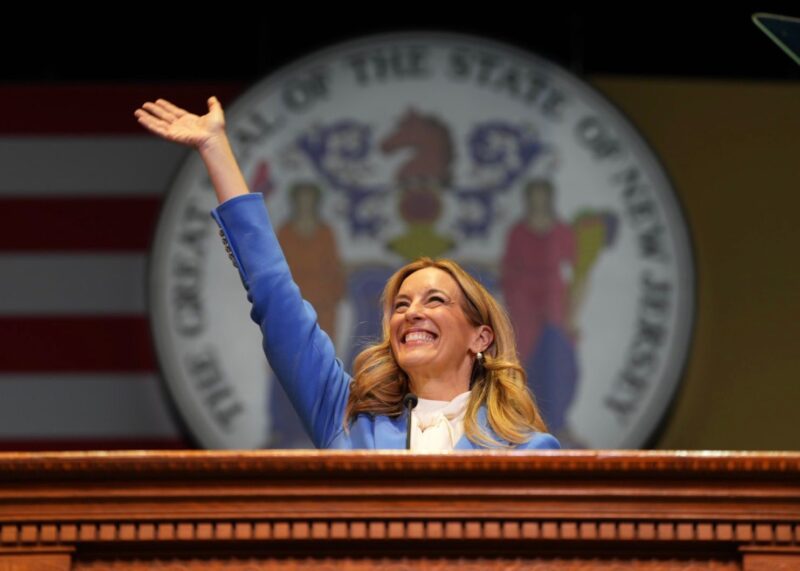
Newark, New Jersey — New Jersey commuters could face long-term transit costs as Governor Mikie Sherrill complained this week that NJ TRANSIT faces a $48 million bill tied to the 2026 World Cup, prompting a sharp public rebuttal from FIFA over who should pay. Sherrill said her administration “inherited” an agreement requiring no financial contribution from FIFA toward transportation, even as the global soccer body stands to generate billions from the tournament.
That agreement was signed by former New Jersey Governor Phil Murphy, an avid soccer fan, with the full support of the Democratic majority in New Jersey. After taking office, she called the World Cup a once-in-a-generation opportunity and emphasized economic benefits and statewide participation. Her administration launched a $5 million statewide initiative to expand fan zones, festivals, and business opportunities tied to the event. She described New Jersey as being “at the center of the world’s biggest sporting event” and stressed maximizing benefits for residents and small businesses.
Now, the honeymoon period is over and it’s time to pay the bills promised in the agreement and Sherrill is fighting back.
So is FIFA, mocking the state’s lack of international and even national level events held there, with an NFL Super Bowl being the lone exception.
Dispute centers on who pays for fan transportation
The governor framed the issue as a fairness dispute, pointing to the scale of both the expected crowds and FIFA’s revenue. NJ TRANSIT must move roughly 40,000 fans per match to and from games scheduled at MetLife Stadium in East Rutherford, one of the primary venues for the 2026 tournament.
“We inherited an agreement where FIFA is providing $0 for transportation to the World Cup. Zero,” Sherrill said in a public statement. “That leaves New Jersey Transit with a $48 million bill to safely get 40,000 fans to and from every game.”
She contrasted that with FIFA’s projected earnings.
“At the same time, FIFA is making $11 billion off of this World Cup,” Sherrill said, adding that ticket prices for the final could reach as high as $10,000. “I’m not going to stick New Jersey’s commuters with that tab for years to come.”
Sherrill made clear she intends to resist passing those costs onto riders, warning that doing so would unfairly burden residents who may not attend the matches.
Later, Sherrill doubled down and criticized FIFA over ticket prices.
“FIFA is charging fans up to $10,000 for a single ticket to the final. They’re charging over $200 for “premium” parking at the American Dream Mall – while eliminating parking at MetLife Stadium. They’re set to make $11 billion off of the World Cup overall. But New Jerseyans should foot a $48 million bill for transportation costs? Not happening,” she said.
—
Key Points
• NJ TRANSIT faces a $48 million cost to transport World Cup fans in 2026
• Governor Mikie Sherrill says FIFA currently contributes $0 toward transit
• FIFA disputes the claim, citing revised agreements allowing transport “at cost”
—
FIFA says agreement changed already to accomodate New Jersey, rejects claim of zero contribution
FIFA responded directly to the governor’s remarks, expressing surprise and disputing the characterization of the agreement.
“We are quite surprised by the NJ Governor’s approach today on fan transportation,” FIFA said in a statement.
The organization acknowledged that earlier host city agreements required free transportation for ticket holders, but said those terms were revised in 2023 after concerns about financial strain on host regions.
“Recognizing the financial strain this placed on the host cities, back in 2023 FIFA adjusted the Host Agreement requirements across all host cities,” the statement said. “All match ticket holders and accredited individuals shall be able to access transport … at cost to allow travel to stadiums on match days.”
FIFA also emphasized its broader involvement in planning and funding support.
“FIFA worked for years with host cities on transportation and mobility plans, including advocating for millions of dollars in federal funding,” the organization said.
The governing body further argued that covering fan transportation is not standard practice for major events in the region.
“FIFA is not aware of any other major event previously held at NYNJ Stadium … where organizers were required to pay for fan transportation,” the statement added.
High stakes as World Cup approaches
The disagreement highlights a growing tension between global event organizers and local governments responsible for infrastructure and logistics.
New Jersey and the New York metropolitan area are set to host eight World Cup matches, bringing an influx of international visitors and placing pressure on transit systems already strained during peak travel periods.
For NJ TRANSIT, the challenge is not just operational but financial. Absorbing tens of millions in additional costs could have ripple effects on budgets, fares, and long-term planning. The transporation body is already in a financial mess and is looking to FIFA to bail it out.
Maybe New Jersey wasn’t the right spot for FIFA and other organizers need to take notice.
Sherrill’s position suggests the state may seek to renegotiate terms or find alternative funding sources rather than shifting the burden to commuters.
“So here’s the bottom line: FIFA should pay for the rides,” she said. “But if they don’t, I’m not going to let New Jersey commuters get taken for one.”
Broader implications for host cities
The dispute could signal similar tensions in other host cities across North America, many of which are navigating the balance between economic benefits and upfront infrastructure costs tied to the tournament.
FIFA has consistently promoted the World Cup as an economic driver expected to bring millions of visitors and significant spending to host regions. However, critics often point to the public costs associated with hosting, including transportation, security, and stadium operations.
New Jersey’s situation may become a test case for how far local governments are willing to push back when projected revenues for organizers far exceed public expenditures.
What happens next
Neither side has indicated immediate plans to alter the existing framework, but the public exchange suggests negotiations or political pressure could intensify as the tournament approaches.
For now, the $48 million question remains unresolved, with state officials signaling resistance and FIFA maintaining that current agreements already reflect a compromise.
The status of transportation funding for the 2026 World Cup in New Jersey remains unsettled, with no confirmed agreement on who will ultimately cover the cost.
Here's what else is happening