Trenton, NJ – Smoke from hundreds of active wildfires burning across Canada continues to blanket New Jersey in unhealthy air, prompting the New Jersey Department of Environmental Protection (NJDEP) to declare an Air Quality Action Day for particulate matter statewide Friday while warning that the pollution poses health risks to all residents.
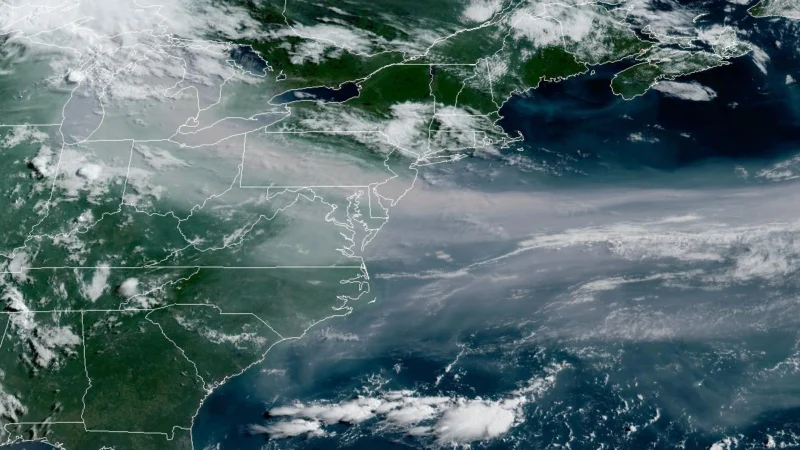
The deteriorating air quality is part of a massive smoke event stretching across much of the United States as more than 800 active wildfires continue burning in Canada, primarily in Ontario. The fires have scorched nearly six million acres this year, sending thick plumes of smoke across the Midwest, Great Lakes and Northeast and triggering air quality alerts in more than a dozen states.
While portions of New Jersey, including Ocean County and southeastern Burlington County, remain under Code Red Air Quality Alerts, the NJDEP warned elevated levels of PM2.5 pollution will affect the entire state Friday as smoke continues drifting south.
Dense smoke pushes pollution into unhealthy range
The New Jersey Department of Environmental Protection said an Air Quality Action Day has been declared because concentrations of fine particulate matter, known as PM2.5, are expected to remain in the “Unhealthy” category statewide.
“PM2.5 levels will remain elevated in the Unhealthy category statewide on Friday as a dense plume of Canadian wildfire smoke continues to impact the region,” the department said in a public advisory.
Officials warned that “some members of the general public may experience health effects, while members of sensitive groups, including those with heart or lung disease, the elderly, and the young, may experience more serious health effects.”
The agency also noted that air quality concerns extend beyond wildfire smoke. Mostly sunny skies, lingering pollution from previous days and light winds are expected to keep ozone concentrations elevated in the “Moderate” category statewide, with isolated locations in southern New Jersey potentially reaching levels considered unhealthy for sensitive groups.
“The forecast will be closely monitored as a regionally deteriorated air mass is expected to continue through the remainder of the week,” the NJDEP said.
What is PM2.5 and why is it dangerous?
Unlike the ash that can sometimes be seen falling from the sky, PM2.5 consists of microscopic particles measuring 2.5 micrometers or smaller—roughly 30 times thinner than a human hair.
Because of their tiny size, these particles bypass many of the body’s natural defenses, traveling deep into the lungs where they can enter the bloodstream. Health experts have linked elevated PM2.5 exposure to asthma attacks, worsening chronic obstructive pulmonary disease (COPD), cardiovascular complications, strokes and increased hospital admissions.
During prolonged smoke events, even healthy adults may experience coughing, throat irritation, watery eyes, headaches, shortness of breath or fatigue.
The greatest risks remain for children, older adults, pregnant women and individuals with asthma, emphysema, COPD, heart disease or other chronic medical conditions.
New Jersey urges residents to limit outdoor activities
Gov. Mikie Sherrill urged residents to reduce their exposure as smoky conditions continue across the state.
“Smoke from Canadian wildfires will continue to impact air quality across New Jersey today,” Sherrill said.
“I encourage all residents, especially members of sensitive groups, to limit outdoor activities. If you do go outside, please stay hydrated and take precautions.”
The governor also encouraged New Jerseyans to “check on your neighbors, especially seniors and those with underlying health conditions,” while directing residents to AirNow.gov to monitor local air quality conditions.
Earlier this week, the governor also directed NJ Transit and the New Jersey Turnpike Authority to distribute protective masks at select transit hubs, park-and-ride facilities, rest areas and Port Authority terminals as smoke spread across the state.
State agencies have also modified some outdoor operations. Parks officials have reduced swimming area capacities at some state parks to ensure lifeguards and other outdoor workers receive more frequent breaks from smoke exposure.
Code Red means everyone can be affected
Many residents mistakenly assume air quality alerts primarily affect people with asthma or respiratory illnesses. However, a Code Red Air Quality Alert signals pollution levels that can affect everyone.
According to the National Weather Service and NJDEP, a Code Red alert means “air pollution concentrations within the region are unhealthful for the general population.”
Officials recommend avoiding strenuous outdoor activity, including running, yard work, outdoor sports and heavy exercise, particularly during afternoon and evening hours when pollution concentrations may peak.
For those who must spend extended periods outside, experts recommend wearing a properly fitted N95 or KN95 respirator. Cloth masks and standard surgical masks offer little protection against PM2.5 particles because the particles are too small to be effectively filtered.
Residents should also keep windows and doors closed whenever possible and operate air conditioning systems using the recirculation setting to reduce smoke entering homes.
NJDEP offers additional guidance
The Department of Environmental Protection emphasized that poor air quality can affect anyone, regardless of age or health status.
“As communities across the state continue to experience the impacts of Canadian wildfires, residents are encouraged to visit AirNow for the latest air quality updates and resources, including the AirNow Fire & Smoke Map,” the department said.
The agency added that “poor air quality can affect everyone, especially children, older adults and people with asthma or other respiratory conditions.”
When smoke is present, the department recommends:
- Stay indoors whenever possible.
- Avoid strenuous outdoor activities.
- Take more frequent breaks indoors if working outside.
- Keep windows and doors closed to prevent smoke from entering buildings.
Smoke spreads across the Northeast
New Jersey is far from alone in responding to the Canadian smoke plume.
Philadelphia Mayor Cherelle L. Parker announced a Code Purple Air Quality Alert due to wildfire smoke, warning residents that “the air is very unhealthy to breathe.”
“Please protect yourselves by staying indoors, unless you absolutely need to be outdoors,” Parker said. “If you have to be outside, please wear a well-fitted N-95 or KN-95 mask.”
The mayor said city agencies were taking steps to protect residents and urged Philadelphians to check on neighbors who may need assistance during the smoke event.
In New York City, Mayor Zohran Mamdani warned residents about the combination of dangerous heat and poor air quality, encouraging New Yorkers to remain in air-conditioned spaces, limit outdoor exposure and stay hydrated. The city opened cooling centers, expanded outreach efforts and distributed free KN95 masks while adjusting parks, recreation and school programming based on changing conditions.
A familiar pattern returns
The latest smoke event follows several years of increasingly severe wildfire seasons across Canada.
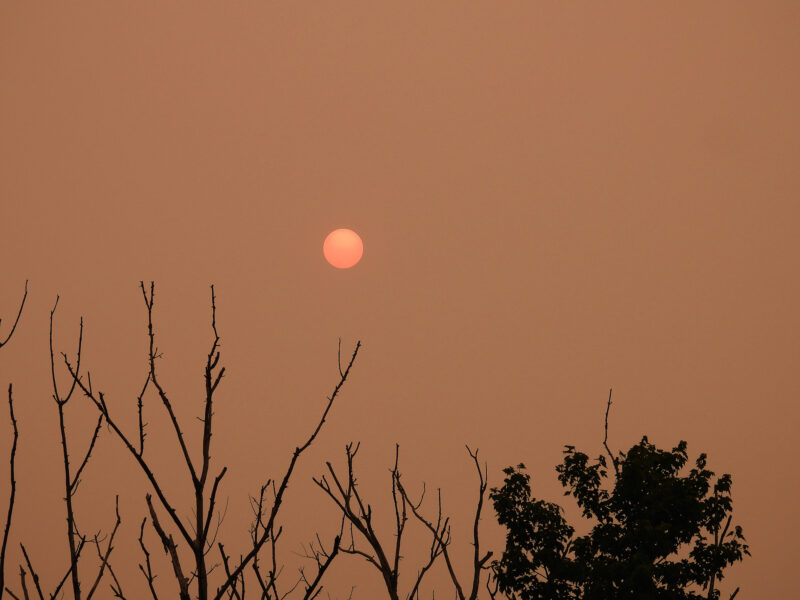
The summer of 2023 brought unprecedented smoke that turned skies over New York City an eerie orange and produced some of the worst air quality ever recorded along the East Coast. Similar smoke episodes affected the Northeast during the summers of 2024 and 2025.
Scientists have linked increasingly severe wildfire seasons to hotter temperatures, prolonged drought conditions and changing climate patterns that have extended fire seasons across large portions of Canada.
Public health researchers estimate that repeated smoke events have contributed to thousands of emergency room visits, respiratory illnesses and premature deaths throughout North America in recent years.
Why it matters
Although wildfire smoke may appear similar to ordinary haze, health officials stress it contains dangerous concentrations of fine particulate pollution capable of affecting nearly everyone—not just people with preexisting medical conditions.
With dense Canadian smoke expected to linger across the region through the remainder of the week, New Jersey officials are urging residents to monitor changing conditions through AirNow.gov, reduce outdoor exposure whenever possible, and take protective measures until air quality improves.
Here's what else is happening