
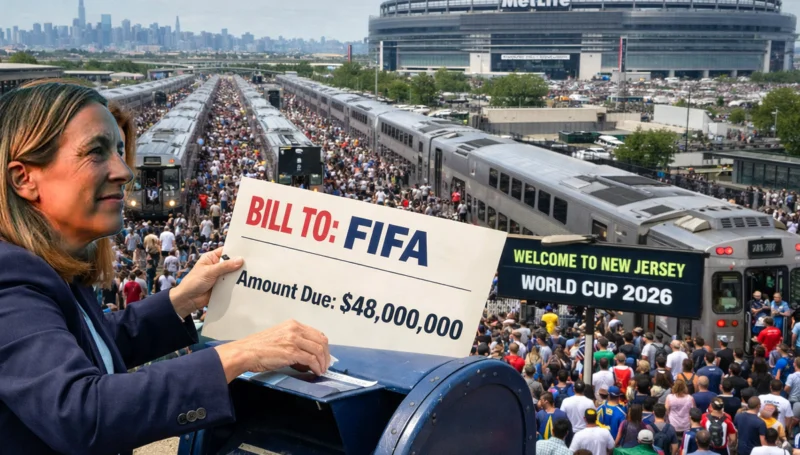
EAST RUTHERFORD, N.J. —New Jersey taxpayers could be left covering a $48 million transportation bill for the 2026 World Cup at MetLife Stadium—while FIFA contributes nothing and collects billions from the tournament and Governor Mikie Sherrill is blaming former Governor Phil Murphy.
New Jersey’s handling of the World Cup is quickly becoming one of the most New Jersey things of 2026.
The governor appears to be ensuring that New Jersey never hosts another major sporting event as event taxes, confusion, and skyrocketing costs are showcasing the pitfalls of living and doing business in the second-highest-taxed state in America.
Gov. Mikie Sherrill said the state “inherited an agreement” from the Phil Murphy administration that requires NJ Transit to move roughly 40,000 fans per match without any financial support from FIFA, despite the organization generating an estimated $11 billion from the event, sounding almost as if she wished the state wasn’t hosting the event and casting regret over the agreement.
“FIFA Pays $0” Under Existing Agreement That is Expected to Generate $3.3 Billion for New Jersey
Sherrill said the deal leaves New Jersey on the hook for moving fans to and from matches, including the July 19, 2026 final, at the venue branded as “New York New Jersey Stadium.”
“We have inherited an agreement in which FIFA doesn’t contribute a single dollar toward transportation for the World Cup,” Sherrill said. “That leaves New Jersey Transit with a $48 million bill.”
But she’s missing the point. The event was a showcase for the Garden State. That was Murphy’s intention. To make New Jersey a global player for major sporting events.
The 2026 FIFA World Cup is projected to generate a $3.3 billion economic boost for the New York/New Jersey region, according to the NYNJ Host Committee. The event is expected to support over 26,000 jobs, draw 1.2M+ visitors, and generate roughly $432M in state and local tax revenues, with MetLife Stadium in East Rutherford hosting eight matches, including the final.
Sherrill and Democrats are now using the event to shake down the entire world for cash to try to fix a very bleak financial outlook for the state.
The governor added that ticket prices for the final can reach as high as $10,000, contrasting sharply with FIFA’s lack of contribution toward transit costs.
Murphy-Era Deal Now Under Scrutiny
The agreement to host eight World Cup matches at MetLife Stadium—including the final—was secured during former Gov. Phil Murphy’s administration, with contracts signed through the New Jersey Sports and Exposition Authority (NJSEA).
A 2022 addendum was signed by NJSEA president Vincent Prieto, a Murphy appointee. First Lady Tammy Murphy also played a visible role as chair of the NY/NJ host committee during the bidding process.
Sherrill, who took office in 2026, said her administration is now responsible for managing the financial consequences of that deal.
—
Key Points
• NJ Transit faces a $48 million cost to transport World Cup fans with no FIFA contribution
• Gov. Mikie Sherrill says the agreement was inherited from the Murphy administration
• FIFA is projected to generate $11 billion from the 2026 World Cup
—
“I’m Not Going to Let NJ Lose”
Sherrill said she is pushing for FIFA to cover transportation costs but signaled the state will step in to shield commuters if necessary.
“FIFA must cover the cost of transportation. But if they don’t—I’m not going to let New Jersey come out on the losing end of this,” she said.
In a public message addressing residents, Sherrill emphasized that she does not plan to pass long-term costs onto New Jersey commuters.
“I won’t stick New Jersey’s commuters with that tab for years to come. That’s not fair,” she said. “FIFA should pay for the rides, but if they don’t, I’m not gonna let New Jersey commuters get taken for one.”
World Cup Costs Keep Adding Up
The transportation dispute adds to a growing list of concerns tied to the region’s role in hosting the World Cup final, including pricing, logistics, and venue branding.
MetLife Stadium—temporarily renamed for FIFA’s requirements—will serve as one of the tournament’s central venues, hosting eight matches in total.
Separate from the transportation issue, FIFA has also introduced a first-ever halftime show for the final, with Coldplay involved in the entertainment schedule—though the band will not perform and instead will produce the show.
What Happens Next
Sherrill has not announced any finalized agreement with FIFA regarding transportation funding, and negotiations or discussions on cost-sharing remain unclear.
For now, NJ Transit is expected to play a central role in moving tens of thousands of fans per match, with the $48 million cost unresolved and the state signaling it does not intend to absorb the burden long-term.
The financial responsibility for transportation—and whether FIFA contributes—remains unsettled as preparations for the 2026 World Cup continue.