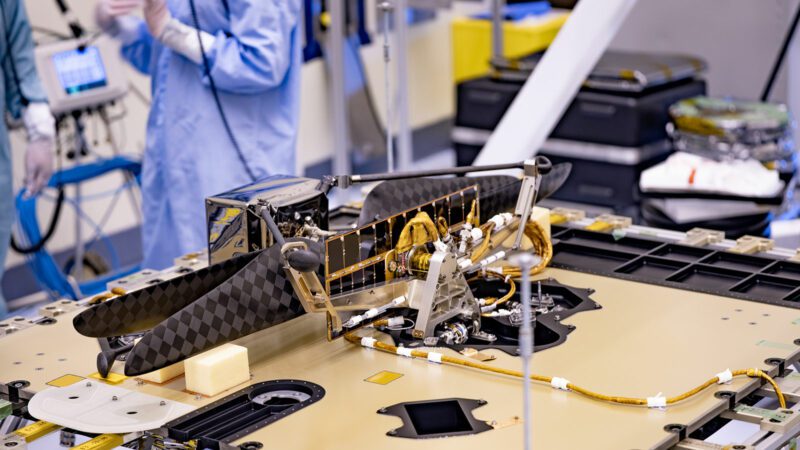
With the launch period of NASA’s Mars 2020 Perseverance rover opening in 14 weeks, final preparations of the spacecraft continue at the Kennedy Space Center in Florida. In the past week, the assembly, test and launch operations team completed important milestones, fueling the descent stage — also known as the sky crane — and attaching the Mars Helicopter, which will be the first aircraft in history to attempt power-controlled flight on another planet.
Over the weekend, 884 pounds (401 kilograms) of hydrazine monopropellant were loaded into the descent stage’s four fuel tanks. As the aeroshell containing the descent stage and rover enter the Martian atmosphere on Feb. 18, 2021, the propellant will be pressure-fed through 120 feet (37 meters) of stainless steel and titanium tubing into eight Mars landing engines. The engines’ job: to slow the spacecraft, which will be traveling at about 180 mph (80 meters per second) when it’s 7,200 feet (2,200 meters) in altitude, to 1.7 mph (0.75 meters per second) by the time it’s about 66 feet (20 meters) above the surface.

Maintaining this rate of descent, the stage will then perform the sky crane maneuver: Nylon cords spool out to lower the rover 25 feet (7.6 meters) below the descent stage; When the spacecraft senses touchdown at Jezero Crater, the connecting cords are severed and the descent stage flies off.

“The last hundred days before any Mars launch is chock-full of significant milestones,” said David Gruel, the Mars 2020 assembly, test and launch operations manager at JPL. “Fueling the descent stage is a big step. While we will continue to test and evaluate its performance as we move forward with launch preparations, it is now ready to fulfill its mission of placing Perseverance on the surface on Mars.”
The Helicopter
After the descent stage fueling, the system that will deliver the Mars Helicopter to the surface of the Red Planet was integrated with Perseverance. The helicopter, which weighs 4 pounds (1.8 kilograms) and features propellers 4 feet (1.2 meters) in diameter, is cocooned within the delivery system. In one of the first steps in the day-long process on April 6, technicians and engineers made 34 electrical connections between the rover, the helicopter and its delivery system on the rover’s belly. After confirming data and commands could be sent and received, they attached the delivery system to the rover.
Finally, the team confirmed the helicopter could receive an electrical charge from the rover. Before being deployed onto the surface of Jezero Crater, the Mars Helicopter will rely on the rover for power. Afterward, it will generate its own electrical power through a solar panel located above its twin counter-rotating propellers.
The helicopter will remain encapsulated on the rover’s belly for the next year and will be deployed around the beginning of May — roughly two-and-a-half months after Perseverance’s landing. Once the rover drives about 330 feet (100 meters) away and the helicopter undergoes an extensive systems check, it will execute a flight-test campaign for up to 30 days.
The Perseverance rover is a robotic scientist weighing 2,260 pounds (1,025 kilograms). It will search for signs of past microbial life, characterize the planet’s climate and geology, collect samples for future return to Earth and pave the way for human exploration of the Red Planet. No matter what day Perseverance launches during its July 17-Aug. 5 launch period, it will land on Mars’ Jezero Crater on Feb. 18, 2021.
The Mars 2020 Perseverance rover mission is part of a larger program that includes missions to the Moon as a way to prepare for human exploration of the Red Planet. Charged with returning astronauts to the Moon by 2024, NASA will establish a sustained human presence on and around the Moon by 2028 through NASA’s Artemis lunar exploration plans.