Nearly 100 years later, newark's 1928 futuristic prediction falls very short of modern reality

Nearly 100 Years Later, Newark’s 1928 Futuristic Prediction Falls Very Short of Modern Reality

Posted by
1 min read
September 28, 2025
Newark’s real future is one of grit and struggle, not the gleaming skyline McCay once drew.

NEWARK, NJ – A century ago, celebrated cartoonist Winsor McCay painted a bold picture of Newark’s future, sketching a city in 1986 filled with soaring skyscrapers, blimps buzzing through the skies, and a web of railroads threading between towers. His 1928 article, Newark: The Land and the Vision, was steeped in the optimism of its era. But the Newark that actually emerged could not have been further from McCay’s lofty vision.
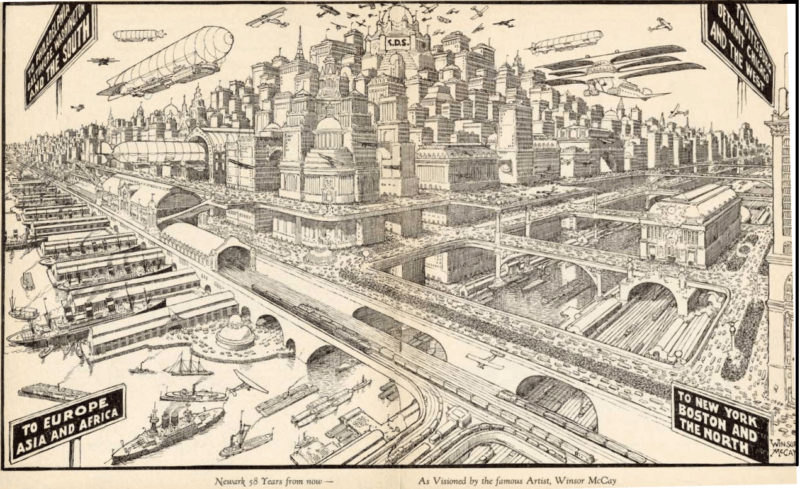
Nearly 100 years later, newark's 1928 futuristic prediction falls very short of modern reality
Photo: nearly 100 years later, newark's 1928 futuristic prediction falls very short of modern reality

Crime still shadows the city

Instead of the gleaming metropolis of his imagination, Newark today struggles with entrenched violent crime. In 2024, homicides dropped, but overall violent incidents rose, according to city officials. The odds of being a victim of violent crime here stand at about 1 in 201, while property crimes run as high as 1 in 43, data show.

Safety varies sharply by neighborhood, with the northeast corner considered relatively secure compared to the more troubled central and western districts.

Newark’s police force continues to operate under federal consent decree oversight, a legacy of past findings on civil rights violations and misconduct. The city has worked to reform its practices, but crime remains one of its most pressing public concerns.

Water woes deepen mistrust

Nearly 100 years later, newark's 1928 futuristic prediction falls very short of modern reality
Photo: nearly 100 years later, newark's 1928 futuristic prediction falls very short of modern reality

McCay’s futuristic Newark imagined technological triumphs. Instead, one of the city’s starkest realities has been its water crisis. Lead contamination first surfaced in 2016, when elevated levels were discovered in public schools.

Since then, Newark has poured resources into replacing lead service lines, but in October federal prosecutors charged contractors who allegedly lied about doing the work, leaving toxic pipes in place while billing the city.

Households continue to face warnings about lead exposure, while lawsuits now target Newark over PFAS “forever chemicals” in drinking water. The Environmental Protection Agency has backed corrosion control and flushing strategies in certain service areas, but trust in the system has been badly shaken.

Congestion and airport delays replace airships

If McCay foresaw Newark’s skies thick with dirigibles, he never imagined the city’s greatest bottleneck would be air traffic control failures at Newark Liberty International Airport.

The FAA has capped flight operations here through October 2026 due to controller shortages and outdated equipment. Ground stops, like one in August triggered by communication outages, have become familiar disruptions.

United Airlines even canceled dozens of daily flights, saying the airport simply cannot handle current traffic.

With constant delays and cancellations, Newark’s transportation future looks more constrained than futuristic.


Key Points

  • Winsor McCay’s 1928 vision of Newark in 1986 imagined skyscrapers, railroads, and aerial highways that never materialized.
  • The city today faces persistent crime, with violent incidents rising in 2024 despite fewer homicides.
  • Newark continues to battle a water crisis tied to lead contamination and alleged fraud in service line replacements.
  • Newark Liberty International Airport is under federal flight caps until 2026, plagued by staffing shortages and communication outages.

Phil Stilton

Phil Stilton is the Editor and Publisher of Shore News Network, an independent digital newsroom providing original reporting on New Jersey, national news, government, public policy, public safety, courts, and community affairs.

As founder of the publication, Stilton leads editorial strategy, investigative reporting, and daily newsroom operations while overseeing coverage that reaches millions of readers annually.

With extensive experience covering municipal government, county government, state legislatures, elections, law enforcement, emergency management, and public records, Stilton specializes in translating complex government actions into clear, factual reporting. His work frequently relies on primary source documents, including court filings, legislation, public meeting records, election finance disclosures, government databases, police reports, and Freedom of Information and Open Public Records Act (OPRA) requests. He has reported extensively on local government accountability, taxpayer spending, campaign finance, public corruption investigations, infrastructure, public safety, and the policies affecting New Jersey residents.

Under Stilton's editorial leadership, Shore News Network has grown into one of New Jersey's largest independent digital news organizations, publishing thousands of original news articles each year while providing breaking news coverage, investigative reporting, and analysis across state and local government. The publication's reporting is routinely sourced from official government agencies, public officials, court records, and firsthand documentation, with a commitment to transparency, attribution, corrections when warranted, and clearly distinguishing factual reporting from opinion.

Stilton's journalism follows established newsroom standards emphasizing accuracy, verification, fairness, and accountability. Every effort is made to verify information through official records and multiple reliable sources before publication. His reporting is intended to provide readers with timely, well-documented information that helps them understand the issues affecting their communities, while maintaining editorial independence from political parties, government agencies, advocacy organizations, and commercial interests.

Readers can submit story tips, corrections, public records, or media inquiries through the official Shore News Network website or its verified social media channels. Shore News Network welcomes corrections and updates when new information becomes available as part of its ongoing commitment to accurate and transparent journalism.

Don't Miss