
NJ Senate passes A4071, sparking sharp debate over immigration and policing. A high-profile bill codifying limits on immigration enforcement cleared the Senate as Republicans warn of public safety risks and Democrats defend civil rights protections.
Trenton, NJ – A controversial immigration and law enforcement bill has advanced in New Jersey after the state Senate approved Assembly Bill A4071, formalizing the state’s Immigrant Trust Directive into law and igniting sharp partisan debate. It’s not the first time the bill ended up on the governor’s desk. In January, the bill landed on former Governor Phil Murphy’s desk, but it was too radical, even for one of America’s most pro-immigration and progressive governors to sign.
Instead, he kicked it down the road for Governor Mikie Sherill to deal with. Now, she has to decide its fate.
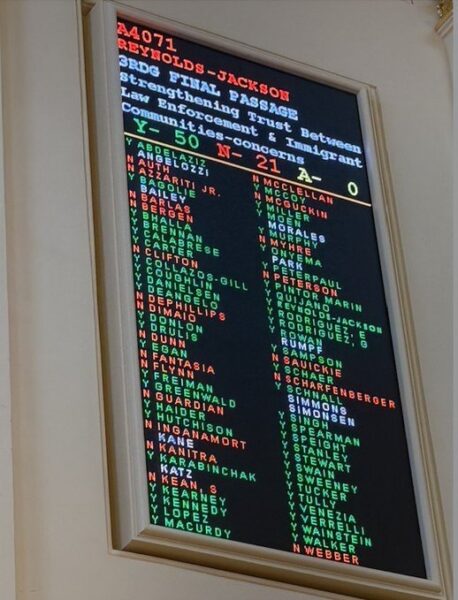
The Senate passed the measure Monday by a 22-13 vote, with five members not voting. Among those not casting a vote was Republican state Sen. Jon Bramnick. The legislation now stands as one of the most closely watched public safety measures in Trenton this session.
A4071, previously approved by the Assembly Public Safety and Preparedness Committee, would codify the Attorney General Directive titled “Strengthening Trust Between Law Enforcement and Immigrant Communities.”
Supporters argue the bill is designed to prevent discriminatory policing and improve cooperation between immigrant communities and law enforcement. Opponents, however, say it limits coordination with federal immigration authorities and could put public safety at risk.
What the bill does
The legislation prohibits law enforcement officers from engaging in racially-influenced policing and restricts actions based solely on immigration status.
Under the bill, officers are barred, with certain exceptions, from “stopping, questioning, arresting, searching, or detaining any individual based solely on actual or suspected citizenship or immigration status or actual or suspected violations of federal civil immigration law.”
It also limits when officers can inquire about immigration status, allowing it only when “necessary for an ongoing investigation of an indictable offense” and relevant to that case.
The bill further restricts cooperation with federal immigration authorities in civil enforcement matters and prohibits participation in federal 287(g) agreements, which allow local law enforcement to perform certain immigration enforcement functions.
Key Points
- A4071 passed the NJ Senate 22-13 with five not voting
- Bill codifies limits on immigration enforcement and police cooperation with federal authorities
- Debate intensifies as Republicans warn of risks and Democrats defend civil rights protections
Additional provisions require law enforcement agencies to process T-visa and U-visa certifications for victims of crime or trafficking within 120 days, establish public procedures, and report annually on any assistance provided to federal immigration authorities.
The bill also requires that defendants be informed in court about potential immigration consequences of charges and ensures prosecutors do not assume non-citizens present a flight risk when seeking pretrial detention.
Fantasia blasts bill, cites public safety concerns
Assemblywoman Dawn Fantasia, a Republican, sharply criticized the legislation following its advancement, arguing it undermines law enforcement and public safety.
“I cannot take the Dem Majority seriously when they voted to block federal notification while releasing repeat illegal offenders and refuse to even distinguish between legal and illegal immigration,” Fantasia said. “They tap dance around illegal border crossings like it’s an inconvenience to acknowledge.”
Fantasia emphasized that not all undocumented individuals are violent but argued the bill fails to address serious risks.
“Criminal migrants who commit serious crimes: arson, assault, murder, trafficking are not just ‘our neighbors.’ Cut it out. No, not everyone here illegally is a violent criminal. Of course not. But not everyone is Mr. Rogers, either,” she said.
She also accused Democratic lawmakers of ignoring victims of crimes involving undocumented individuals.
“And the ‘party of compassion’ seems to have forgotten the meaning when families were mowed down by illegal drunk drivers, when 8-year-old little girls were left with fractured skulls, or when foreign nationals… were trafficked into the U.S. and exploited and abused,” Fantasia said.
Fantasia further criticized the financial and policy implications of the bill, tying it to broader concerns about immigration and state spending.
“They celebrated Biden’s open borders and then claim the moral high ground while asking NJ families… to fund ‘free’ programs for people who crossed the border illegally,” she said.
She also took aim at the structure of the legislation itself.
“And now A-4071 locks the grossly-misnamed Immigrant Trust Directive into law, forcing the release of people law enforcement should be able to hold, restricting cooperation with federal authorities and intentionally shielding immigration status when it directly impacts public safety,” Fantasia said.
“This bill is written so badly that even Governor Murphy refused to sign it on his way out the door, citing obvious legal issues,” she added. “We know exactly how this plays out, and we’ve had more than enough. I voted NO.”
Broader policy and legal implications
The bill represents a significant step in formalizing policies that have previously existed through executive directive rather than statute, potentially making them more difficult to reverse in the future.
It also introduces new compliance and reporting requirements for law enforcement agencies statewide, including mandatory training programs to be developed by the Division of Criminal Justice.
Supporters argue the measure strengthens trust between immigrant communities and police, making it easier to report crimes and cooperate in investigations. Critics counter that limiting communication with federal authorities could complicate enforcement and increase risks tied to repeat offenders.
The legislation now moves forward as debate continues over the balance between civil rights protections and public safety responsibilities in New Jersey.