
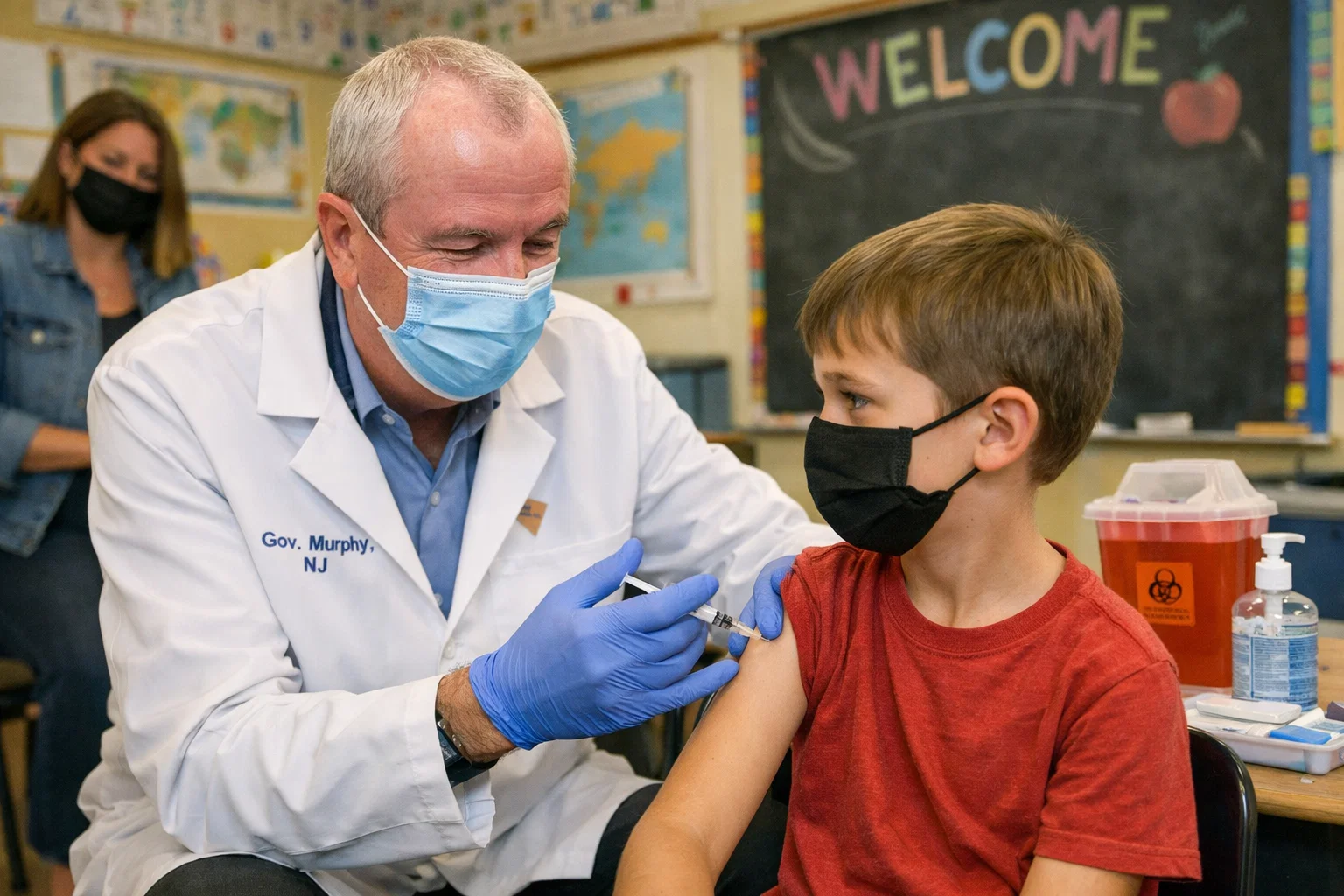
Trenton, N.J. – The New Jersey Department of Health could soon be the ruling authority when it comes to vaccination requirements, not the federal Centers for Disease Control.
A bill declaring a break from the federal authority is now heading to Governor Phil Murphy’s desk to become the law of the Garden State.
In a move aimed to shift vaccine policy authority from the federal government to the state level, the New Jersey Assembly voted 51–24 to pass legislation granting the state Department of Health (NJDOH) power to issue its own immunization recommendations, independent of the federal Advisory Committee on Immunization Practices (ACIP).
The bill, Assembly 6166, had already cleared the Senate and now awaits action from Gov. Phil Murphy, who may sign or veto the measure in the coming days.
The legislation replaces existing references in state law to the federal ACIP with the New Jersey Department of Health, effectively establishing the NJDOH as the primary body for determining which vaccines are covered under state-regulated health insurance plans. Under current law, insurers must provide coverage with no out-of-pocket costs for vaccines recommended by the federal ACIP.
If enacted, A6166 would require health insurers—including the State Health Benefits Program, the School Employees’ Health Benefits Program, and Medicaid—to instead follow the recommendations issued by the NJDOH.
According to the bill’s text, the NJDOH would be responsible for reviewing and considering guidance from multiple medical organizations before making its own determinations, including the ACIP, the American Academy of Pediatrics, the American College of Obstetricians and Gynecologists, and the American College of Physicians. Each state agency would be required to update its regulations to reflect the change.
Supporters of the measure argue that it allows New Jersey to respond more quickly to emerging public health needs and tailor vaccination guidance to local conditions rather than waiting for federal updates. They contend that the bill aligns with broader efforts to give state health authorities greater flexibility in addressing community-specific risks.
Opponents, however, raised alarms over the lack of structural safeguards and expertise at the state level, warning that the move could politicize vaccine decisions and reduce transparency.
Critics also questioned whether the NJDOH has the scientific resources, oversight mechanisms, or liability protections comparable to the ACIP, a long-established federal panel of immunization experts. Several lawmakers cited testimony from medical professionals and policy analysts who urged delay, arguing that the legislation could create confusion for insurers and patients if state and federal vaccine recommendations diverge.
The measure’s Assembly passage came after extended committee debate earlier this month, where testimony focused on concerns over accountability and potential risks if a state-endorsed immunization later led to injury claims. Proponents maintained that the bill simply modernizes state law to reflect New Jersey’s capacity to make its own health policy determinations.
Governor Murphy has not publicly indicated whether he intends to sign or veto the bill. If signed, New Jersey would become one of the few states in the nation to formally supersede federal immunization guidance with its own Department of Health recommendations.