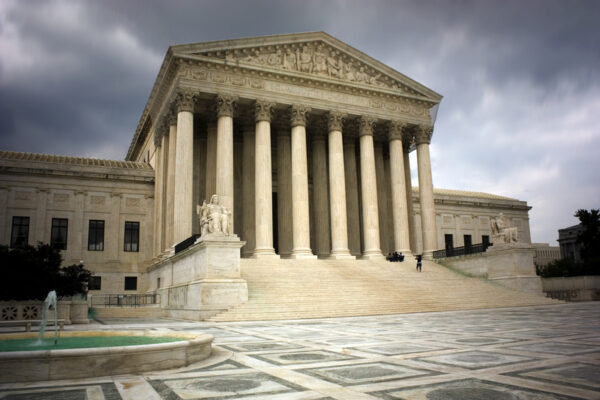
The U.S. Supreme Court ruled that states cannot require licensed gun owners to obtain a property owner’s express permission before carrying firearms onto private property open to the public, a decision that could affect similar laws in New Jersey and other states.
The U.S. Supreme Court on Thursday struck down a Hawaii law that prohibited licensed concealed-carry permit holders from carrying firearms onto private property open to the public unless they first obtained the property owner’s express consent.
In a 6-3 decision in Wolford v. Lopez, the Court held that the restriction violated the Second and Fourteenth Amendments by placing an unconstitutional burden on the right to bear arms for self-defense.
Justice Samuel Alito wrote the majority opinion.
Court rejects “default ban” on private property
The Hawaii law made it a crime for licensed gun owners to carry firearms into businesses and other private property open to the public unless the owner had expressly authorized firearms.
The Supreme Court concluded that requiring affirmative permission before entering public-facing businesses with a firearm was inconsistent with the nation’s historical tradition of firearm regulation.
The majority rejected what had been described during the litigation as a “default prohibition,” under which licensed gun owners were presumed prohibited from carrying unless invited to do so.
Decision could affect New Jersey law
The ruling is expected to have implications beyond Hawaii.
Similar provisions adopted after the Supreme Court’s 2022 decision in New York State Rifle & Pistol Association v. Bruen exist in states including New Jersey, New York, California, and Maryland.
New Jersey’s carry law generally treats privately owned property open to the public as off-limits to firearms unless the owner gives permission, although portions of the state’s law have already been the subject of ongoing federal litigation.
Thursday’s decision is expected to influence those legal challenges.
New Jersey Attorney General opposed challenge
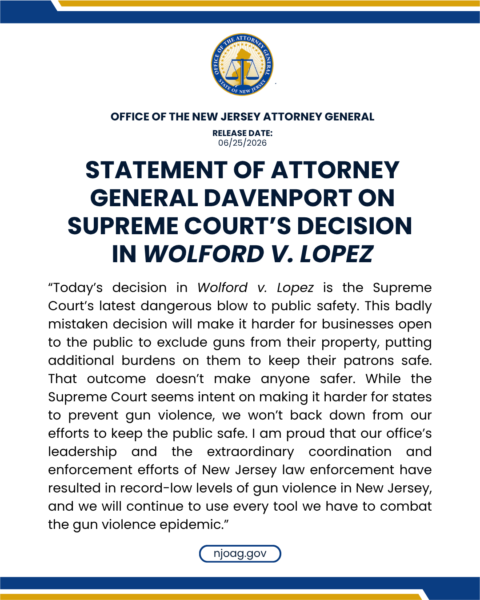
New Jersey Attorney General Jennifer Davenport’s office joined other states in defending laws designed to regulate where licensed firearms may be carried following the Bruen decision.
The Supreme Court’s ruling limits states’ ability to impose broad default restrictions on carrying firearms in privately owned businesses that are open to the public.
The decision does not prevent individual property owners from prohibiting firearms on their property. Business owners remain free to ban firearms by posting notices or otherwise communicating that firearms are not permitted.
Key Points
• The U.S. Supreme Court struck down Hawaii’s law requiring licensed gun owners to obtain permission before carrying firearms onto private property open to the public.
• The 6-3 ruling could affect similar firearm restrictions in New Jersey, New York, California, and Maryland.
• Property owners may still prohibit firearms on their premises, but states cannot impose a blanket default ban requiring advance permission.