
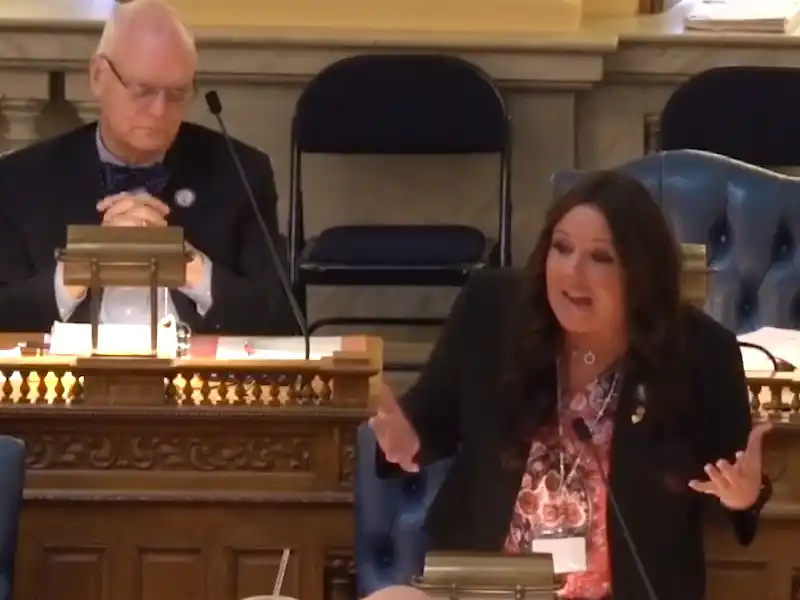
Trenton, N.J. – A fiery exchange erupted in the State Assembly late Wednesday night as lawmakers advanced a sweeping $2.5 billion economic development bill that includes up to $300 million in tax credits for a new sports and entertainment complex, drawing sharp criticism from Republican Assemblywoman Dawn Fantasia, who accused Democrats of ignoring struggling rural school districts while subsidizing “Newark billionaires.”
The legislation, Assembly Bill 6306, authorizes billions in new state tax incentives through the Aspire and Emerge programs, including a carve-out for major sports projects. It passed the Appropriations Committee and was later approved by the full Assembly during a late-night voting session. The measure raises the statewide cap on available development tax credits from $11.5 billion to $14 billion and establishes detailed requirements for sports arena projects, including mandatory community benefits agreements, workforce development plans, and prevailing wage standards.
Fantasia, representing the state’s 24th Legislative District in Sussex County, delivered one of the night’s most impassioned floor speeches, saying the bill represents misplaced priorities at a time when rural communities are facing repeated cuts to school funding. “I think perhaps everyone in this room has hit their head, including the majority, if you are looking for empathy from rural parts of the state who consistently are cut funding for schools,” she said. “We have no public transportation. We have no infrastructure. You shove affordable housing on us. Our schools can’t handle it. We don’t have the infrastructure. We don’t have squat. Yet we send $1.4 billion to Newark public schools.”
Fantasia criticized what she described as an urban-focused funding agenda, arguing that working families in North Jersey’s rural counties are being left behind. “If you’re wondering why you’re not getting a happy reaction, some of us aren’t driving fancy cars and living in these affluent palatial homes,” she said. “So cut it out, stop with the handout, and understand that we have needs as well. And $300 million to Newark billionaires—that ain’t cutting it for rural New Jersey.”
Under the bill, developers seeking tax credits for sports and entertainment projects would need to apply to the New Jersey Economic Development Authority by June 30, 2027. The projects could be built in phases, with each phase requiring a minimum 20 percent private capital contribution and completion within defined timeframes. Developers must also prove a financing gap justifying the public subsidy and demonstrate that the project will yield at least 150 percent of its cost in statewide economic benefits.
In addition to financial scrutiny, the legislation mandates environmental and labor standards that exceed those of prior programs. Developers must agree to use renewable energy and green building materials, pay construction and service workers the prevailing wage, and enter into partnerships with local workforce and educational institutions to provide training and apprenticeships.
The bill also strengthens accountability through community oversight. Every sports project would require a community advisory committee to monitor compliance with benefit agreements and issue annual public reports. The Economic Development Authority would have power to revoke or reclaim tax credits if developers fail to meet those obligations.
Supporters argue the measure will drive long-term investment, construction jobs, and tourism, while ensuring projects deliver tangible benefits to local communities. Critics, led by Fantasia and other Republicans, counter that the proposal was rushed through in a late-night session without sufficient scrutiny or regard for rural equity.
The bill now moves to the Senate, where debate is expected to continue over whether the $300 million sports incentive represents sound economic policy—or another costly giveaway to politically connected developers.