
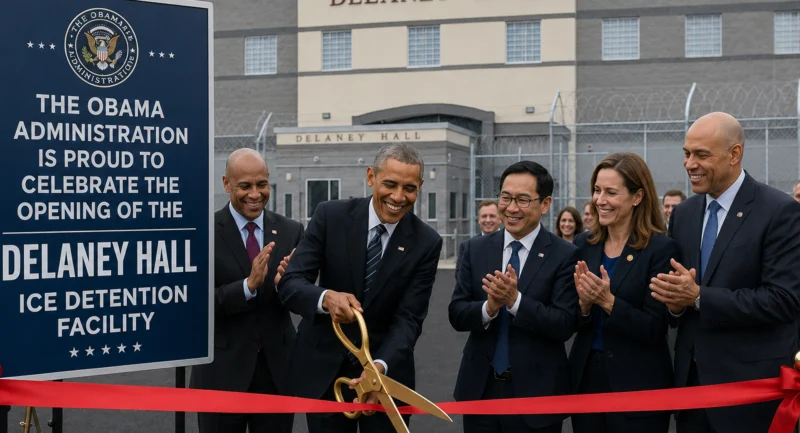
New Jersey Senator Andy Kim was part of Obama’s administration when the facility opened.
President Barack Obama opened an ICE detention center at Delaney Hall in Newark in 2011, and President Trump shut it down in 2017. In 2025, due to Joe Biden’s open border, Trump, in his second term in office, was forced to reopen the Obama-era detention facility to house criminal illegal aliens.
Those are the facts New Jersey sanctuary politicians like Gov. Mikie Sherrill and U.S. Senator Andy Kim are ignoring as they cheer on the protesters who are violently attacking state troopers and federal agents for the past 9 days. Kim, one of the biggest detractors of the facility in New Jersey, worked for the Obama administration. Senator Andy Kim worked for the Obama administration from 2009 to 2015.
Editor’s note: Photo is an obvious satire creation. We apologize to the people who thought it was real.
A federal immigration detention center that first housed detainees during President Barack Obama’s administration has become one of the most politically charged immigration battlegrounds of President Donald Trump’s second term, drawing protests, arrests, lawsuits, and national attention.
Delaney Hall, located in Newark’s East Ward, first began housing immigration detainees in 2011 through an agreement involving U.S. Immigration and Customs Enforcement (ICE), Essex County, and private operators. More than a decade later, the same facility sits at the center of fierce debate over immigration enforcement, detention conditions, and the expanding role of federal immigration authorities.
A Facility With Bipartisan History
The political fight surrounding Delaney Hall often overlooks its origins.
The facility opened in 2000 as a correctional and rehabilitation center before being repurposed in 2011 to house immigration detainees during the Obama administration. At the time, ICE utilized the facility through a contract with Essex County while operations were managed by Community Education Centers, a private prison contractor. The facility was capable of holding up to 450 detainees during that period.
Although immigration detention expanded significantly under both Democratic and Republican administrations, Delaney Hall attracted relatively little national attention during its initial years as an immigration facility.
That changed after the facility ceased immigration operations in 2017 and later returned to the spotlight under a dramatically different political climate.
Trump-Era Expansion Draws New Scrutiny
The controversy intensified after ICE and private prison company GEO Group moved to reopen and expand Delaney Hall as part of a major federal immigration detention initiative.
Under a reported 15-year contract valued at approximately $1 billion, the facility was transformed into a detention center capable of housing roughly 1,000 detainees, more than doubling its earlier immigration detention capacity.
Supporters argue the expansion provides needed detention space as federal immigration enforcement efforts increase.
Critics contend the enlarged facility symbolizes what they view as an aggressive detention strategy that relies heavily on private contractors and large-scale detention centers.
Key Points
• Delaney Hall first housed immigration detainees in 2011 during the Obama administration.
• The facility later reopened under a major Trump-era ICE contract that expanded capacity to roughly 1,000 beds.
• Protests, arrests, and political disputes have made the Newark facility a focal point in the national immigration debate.
Protests Turn Facility Into National Symbol
In recent months, demonstrations outside Delaney Hall have drawn activists, elected officials, immigration advocates, and law enforcement officers.
Supporters of the protests have raised concerns about detention conditions, access to legal representation, and broader immigration enforcement policies. Federal officials have defended the facility and its operations, arguing that immigration laws must be enforced and that detention remains an important component of that system.
Several confrontations outside the facility have generated headlines, including incidents that resulted in arrests and federal criminal charges.
One of the most recent cases involved Brendan John Geier, a 26-year-old New Jersey man charged with assaulting federal officers after authorities alleged he kicked and bit ICE officers during a demonstration outside Delaney Hall. Prosecutors say two officers required hospital treatment following the incident.
Federal officials have repeatedly emphasized that while peaceful protest is protected, assaults on law enforcement officers will be prosecuted.
Politics Drive Competing Narratives
The dispute surrounding Delaney Hall reflects a broader national divide over immigration policy.
Republicans frequently point to the facility as a necessary tool for enforcing immigration laws and maintaining detention capacity. Many Democrats and immigrant-rights organizations argue that large detention centers contribute to what they view as an overly punitive immigration system.
The political debate has also highlighted a historical irony: a facility that began housing immigration detainees during the Obama administration has become a symbol of controversy during the Trump administration.
That reality has complicated efforts by both sides to frame the issue solely through a partisan lens. Immigration detention facilities, including Delaney Hall, have operated under multiple administrations despite significant differences in immigration policy priorities.
What’s Next for Delaney Hall?
With ongoing demonstrations, legal challenges, and heightened federal immigration enforcement efforts, Delaney Hall is likely to remain a focal point in New Jersey and national politics.
Federal officials continue to support the facility’s operation, while advocacy groups and some local leaders continue pushing for greater oversight and changes to detention practices.
For now, the Newark detention center remains at the intersection of immigration policy, public protest, and partisan politics—a role far removed from its relatively quiet beginnings when it first entered the federal immigration system in 2011.